
No products in the basket.
How many requirements does COSHH place on the employer? It is a common question in the UK workplace safety. This matters because COSHH protects workers from harmful substances every day. HSE reports around 1.8 million work-related ill health cases in Great Britain each year, showing the need for strong safety rules. It applies in jobs like cleaning, labs, construction and healthcare.
COSHH does not give one fixed number. Instead, it sets several key duties for employers. These include risk assessment, safe control measures, training and exposure monitoring. In addition, employers must reduce risks and keep workplaces safe every day. Therefore, understanding these duties helps build safer and healthier work environments.
How Many Requirements Does COSHH Place on the Employer in UK Workplaces?
COSHH sets several key duties to protect workers from harmful substances. These duties work together as one safety system.
First, employers must assess risks from chemicals. Next, they must prevent or control exposure. They also need to provide training and clear safety information. In addition, they must use proper storage, PPE and safe work methods. They should also monitor exposure and check safety controls regularly. In simple terms, employers must manage safety at every step of chemical use at work.
Does COSHH Have a Fixed Number of Employer Requirements?
COSHH does not set a fixed number of employer requirements. Instead, it gives a group of clear duties to keep workers safe. These duties work together to control harmful substances at work.
First, employers must assess risks in the workplace. Then, they must prevent or control exposure. They also need to provide training, safe storage and clear information to workers. In addition, they must use PPE when needed and check safety controls regularly.
Overall, COSHH focuses on full safety management, not a single number of steps. Employers must follow all duties to protect workers from harm every day.
What are the Main COSHH Duties for Employers?
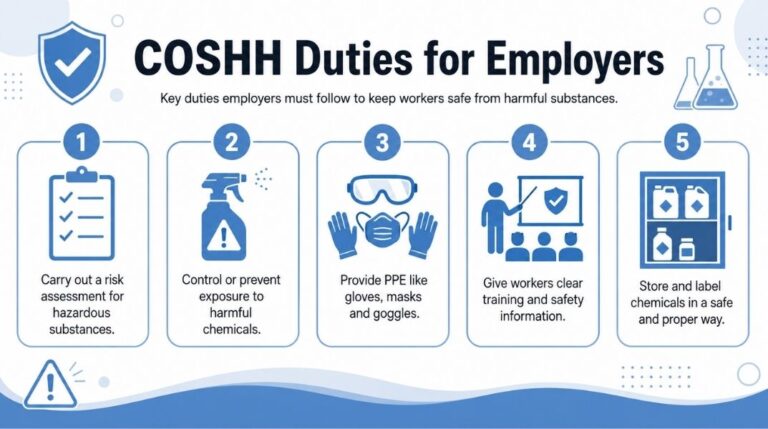
Employers must follow COSHH rules to keep workers safe from harmful substances. These duties help reduce accidents and health risks at work. They also make sure everyone knows how to handle chemicals safely. As a result, workplaces stay safer every day. Here are the main COSHH duties for employers:
- Carry out a risk assessment for hazardous substances.
- Control or prevent exposure to harmful chemicals.
- Provide PPE like gloves, masks and goggles.
- Give workers clear training and safety information.
- Store and label chemicals in a safe and proper way.
Why Do Employers Need to Follow COSHH Requirements?
Employers follow COSHH requirements to keep workers safe from harmful substances. These rules help stop exposure to chemicals, dust, fumes and gases at work. As a result, workers face fewer health problems and injuries.
Also, COSHH helps employers create safe working systems. It guides them to assess risks, control exposure and provide training. In addition, it supports proper storage and clear labelling of chemicals.
Most importantly, it protects everyone in the workplace. It also reduces accidents and long-term illness. So, following COSHH is not only a legal duty but also a simple way to keep work safe every day.
What is a COSHH Risk Assessment for Employers?
A COSHH risk assessment helps employers find and control dangers from harmful substances at work. It checks what chemicals people use and how they may cause harm.
First, employers look at the risks in each task. Next, they decide how to stop or reduce exposure. They may change the process, improve ventilation or use PPE.
After that, they put safety controls in place. They also share clear instructions with workers. Finally, they review the assessment if anything changes. This keeps the workplace safe and reduces health risks every day.
How Should Employers Control Exposure to Hazardous Substances?
Employers must control exposure to keep workers safe. They reduce contact with harmful substances like chemicals, dust and fumes. This helps prevent illness and accidents at work. Good control also keeps the workplace safe and clean.
- COSHH: It sets rules to manage harmful substances at work.
- Risk assessment: Identify hazards before starting any task.
- Ventilation: Improve airflow to reduce fumes and dust in the air.
- PPE: Use gloves, masks and goggles for personal protection.
- Safe storage: Keep chemicals in labelled and secure containers.
- Training: Teach workers safe handling and clear work steps.
If you want to understand these rules in detail, read our full guide on COSHH Hazardous Substances.
What Safety Measures Must Employers Provide Under COSHH?
Employers must provide clear safety measures under COSHH to protect workers. First, they must carry out a risk assessment for all harmful substances. Then, they must put control measures in place to reduce exposure.
Also, they must provide proper ventilation in work areas. In addition, they need to supply the right PPE, like gloves, masks and goggles. Workers must also receive simple training on safe handling.
Finally, employers must check and maintain all safety systems regularly. They should also keep safety rules clear and easy to follow. This helps prevent accidents and keeps the workplace safe.
Why is PPE Important in COSHH Compliance?
PPE is important because it protects workers from harmful substances at work. It acts as a simple barrier between the body and chemicals. As a result, it helps reduce burns, breathing problems and skin damage.
In addition, PPE gives extra safety when other controls are not enough. Gloves, masks, goggles and protective clothing all reduce risk during daily tasks. Furthermore, it helps workers feel safer and more confident.
However, PPE works best when people use it correctly. So, employers must provide the right equipment and training. This keeps workplaces safe and supports COSHH compliance every day.
What Training Must Employers Give Under COSHH?
Employers must give clear and simple COSHH training to all workers who handle harmful substances. To begin, they must explain what COSHH signs mean. This helps workers spot danger quickly at work.
After that, they must teach safe handling of chemicals. For example, how to use, store and dispose of them safely. Also, workers must learn how to use PPE like gloves, masks and goggles.
In addition, employers must show what to do in an emergency. This includes spills, leaks and first aid steps. Finally, they must refresh training when work or chemicals change. This keeps safety strong every day.
How Should Employers Store and Label Hazardous Substances?
Employers must store and label chemicals in a safe, clear way. This helps workers avoid mistakes and reduces workplace accidents. It also keeps chemicals easy to find and handle correctly.
- Store chemicals in sealed and proper containers only.
- Keep incompatible chemicals separate to prevent dangerous reactions.
- Use clear COSHH labels on every chemical container.
- Replace faded or damaged labels without delay.
- Label all decanted bottles immediately after transfer.
Why is Monitoring Exposure Important in COSHH?
Monitoring exposure is very important in COSHH. It helps employers check if workers breathe in or touch harmful substances. This keeps the workplace safe every day. It also helps find risks early before they become serious health problems.
Next, monitoring shows if safety controls are working well. If exposure levels are high, employers can act fast. They can improve airflow or give better PPE to workers. This reduces harm quickly.
In addition, monitoring builds a safer workplace for everyone. It protects workers from long-term illness and health damage. It also helps employers follow UK safety rules. Good monitoring also shows strong safety practices at work.
What is the Simple Summary of COSHH Employer Duties?
COSHH employer duties are simple. Employers must keep workers safe from harmful substances. At first, they must identify risks at work. Then, they must control or remove exposure. This helps prevent illness and injury.
Following that, they must provide clear training and safety information. Workers need to know how to handle chemicals safely. Also, employers must use proper storage and clear labelling. This avoids confusion and accidents.
In addition, they must monitor exposure when needed. They should also maintain safety controls and check them often. Finally, they must plan for emergencies like spills or leaks. In short, COSHH makes safety a daily responsibility at work.
Final Thoughts
So, how many requirements does COSHH place on the employer? COSHH does not give one fixed number. Instead, it sets several key duties to protect workers from harmful substances. These include risk assessment, exposure control, training and safe handling. All duties work together to reduce risks. In simple terms, employers must manage safety at every stage of chemical use in the workplace.
How many COSHH duties must an employer follow? Learn it step by step in our Control of Substances Hazardous to Health (COSHH) Training Course.
FAQs on How Many Requirements Does COSHH Place on the Employer
1. What requirements does COSHH place on employers?
COSHH places duties on employers to assess risks, control exposure and protect workers from harmful substances.
2. What are the 5 steps of COSHH compliance?
The 5 steps include risk assessment, prevention, control, monitoring and training.
3. How many steps are there to cause compliance?
There are usually 5 main steps to achieve COSHH compliance in workplaces.
4. How many steps are required by COSHH?
COSHH does not set a fixed number but follows several key safety steps.
5. What are the 5 steps to compliance?
The 5 steps are identify risks, assess risks, control exposure, review controls and train workers.
6. What are the 5 stages of risk assessment?
The 5 stages are identify hazards, decide who is at risk, evaluate risks, record findings and review regularly.
7. What are the 5 P’s of risk assessment?
The 5 P’s are people, place, process, products and prevention.
8. What are the 4 levels of risk assessment?
The 4 levels are low, medium, high and very high risk.
9. What are the 6 principles of risk assessment?
The 6 principles are identify hazards, assess risks, control risks, record results, review regularly and communicate clearly.
10. What are the 3 C’s of risk?
The 3 C’s of risk are control, communication and check.