
No products in the basket.
You do not need years of experience to build a well-paid career in the UK. What you need is the right starting route. That is where high paying jobs with no experience can open real doors. These roles can include trainee jobs, apprenticeships and entry-level positions that train you while you earn. Some paths need licences, checks or basic qualifications. Others need a strong portfolio or practical skills. At the same time, careers like train driver, HGV driver, prison officer, electrician, software developer and mortgage adviser can lead to strong pay over time. You just need to choose a route that fits your skills.
Now, let’s dive in and explore the top 15 high paying jobs with no experience in the UK and how to start each career.
Can You Really Get High Paying Jobs With No Experience in the UK?
A degree is not the only path to a good income in the UK. But you do need the right route. It is important to understand that high paying jobs with no experience mean you do not need previous history in that specific role to apply. It does not mean there is no training, no checks, no licence or instant high pay from day one.
To reach the top salaries, you will often need to pass various checks and stages. This might include training periods, getting specific GCSEs, or obtaining professional licences. You may also need to pass medical checks, background checks, security checks, or fitness tests. Many of these careers start with supervised work or apprenticeships where you learn the ropes while earning a wage.
What Does No Experience Really Mean Before You Apply?
In the UK job market, “no experience” usually means the employer is ready to take on beginners through trainee roles, apprenticeships, or junior positions. Some routes rely on you building a portfolio or getting a specific licence before you can start the work.
It is important to remember that the salary ranges shown for these careers represent the earning potential as you grow. Trainee pay can start lower and will rise once you finish your initial training. Also, some training routes are England only or vary across Scotland, Wales and Northern Ireland. Some trainee jobs do not open all year round. So, you may need to wait for a recruitment window to start your journey.
Which High Paying Jobs With No Experience Pay Well in the UK?
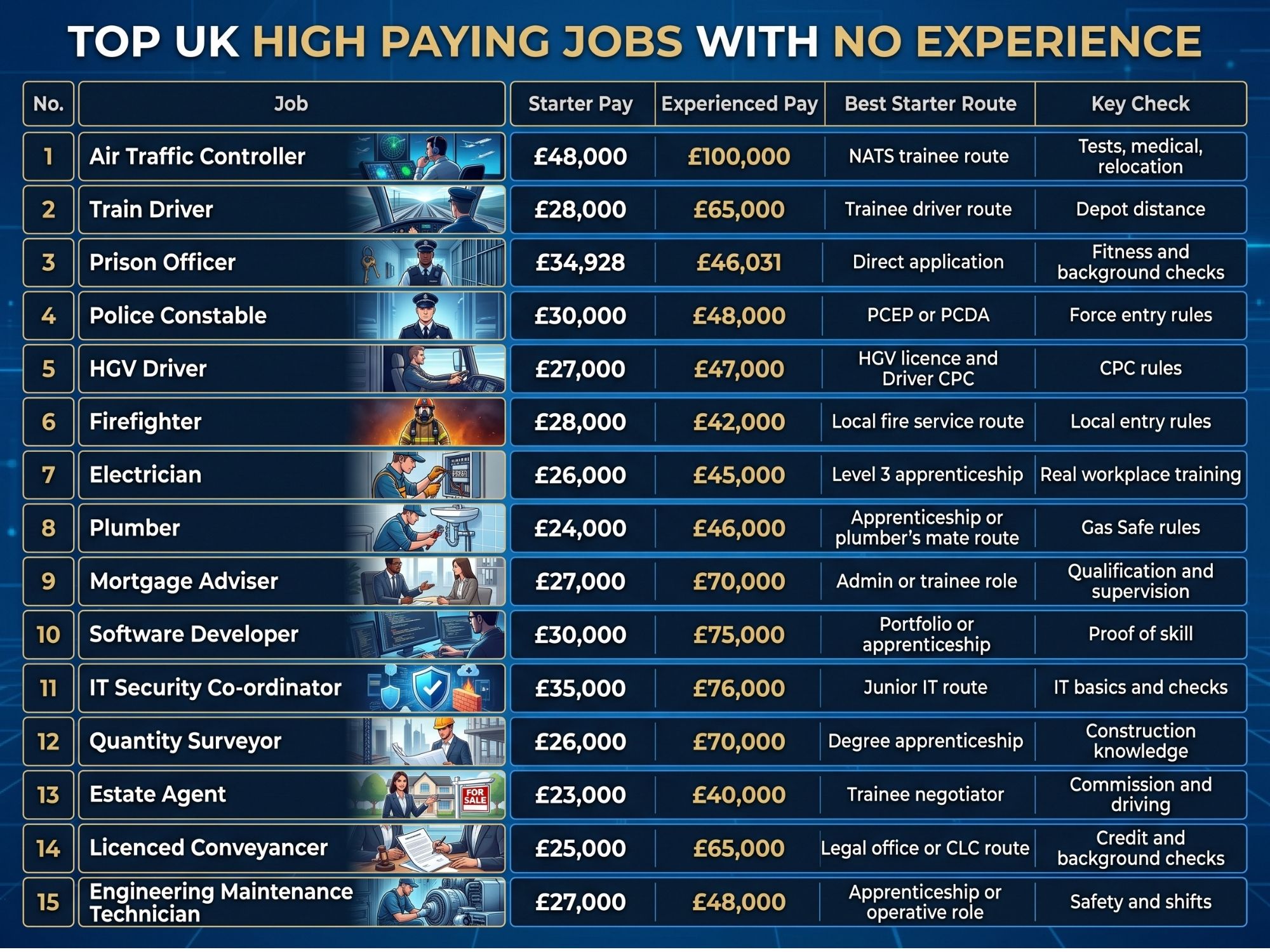
Note: Location, overtime, commission, and experience all play a part in your salary. If you studied outside the UK, check whether your certificates match UK GCSE or Level 3 requirements.
Air Traffic Controller
Air traffic controllers guide aircraft safely through the sky and around airports. They speak to pilots, watch radar screens, give clear instructions and help prevent danger in the air. This role fits people who can keep calm in tense moments, think too fast and follow strict rules with full care. After all, you are responsible for thousands of lives. So, concentration is the most important skill you can bring to the job.
- Salary: You can start on around £48,000, which is already a strong salary. As you gain experience as an air traffic controller, your pay can rise to about £100,000.
How Do You Become an Air Traffic Controller in the UK?
Start by checking the NATS trainee route. When recruitment opens, you can apply online and complete the early eligibility checks. After that, you move through several stages. These may include online ability tests, assessment centres, interview tasks, medical checks and security clearance. Once you pass these steps, your formal training starts at a college. Then, you move into live operational work at a control centre or airport.
What Qualifications Do You Need to Become an Air Traffic Controller?
- You need to be 18 or over before you start.
- Need the right to work in the UK.
- Most applicants need 5 GCSEs at Grade 4 or above.
- English and maths must be included in those grades.
- A CAA Class 3 medical check is part of the route.
- Security clearance is needed before training begins.
- Strict drug and alcohol rules apply to all staff.
- Relocation may be needed during training or after qualification.
How Do You Start as an Air Traffic Controller With No Experience?
Check the NATS recruitment website first to see if they are taking applications. The important point is that you do not need any aviation experience to apply. But you must be ready for tough aptitude tests, medical checks and security checks. Also, you may need to move to a different part of the country for work.
Want to understand how airports work behind the scenes? Explore the Level 2 Diploma in Airport Management Course and build early knowledge before starting your aviation career route.
Train Driver
Train drivers operate passenger, freight or engineering trains across the UK rail network. They check the train controls before departure, follow track signals and drive to a strict schedule. Not only that, they also speak with control centres and report any problems. The work can feel independent because you spend a lot of time alone in the cab. However, that independence comes with serious responsibility. You must stay alert, follow safety rules and protect everyone on board.
- Salary: UK train driver pay starts at around £28,000 for beginners. Once they gain experience, their salary can reach about £65,000.
How Do You Become a UK Train Driver?
You can apply directly for a trainee train driver role when vacancies open on train company websites. Another route is to start in a different rail job first, such as a conductor, station worker or passenger assistant. This allows you to build rail experience and learn how the network operates before applying for driver training when an internal vacancy appears.
What Qualifications Do You Need to Become a Train Driver?
To become a train driver, you usually need to be at least 20 or 21 years old depending on the company. Most employers look for GCSE English and maths at Grade 4 or equivalent. You will need to pass a very thorough medical check that looks at your eyesight, hearing and general health. Background checks are also required. That is why applicants must show strong focus, clear communication skills and the ability to follow rules exactly. Most importantly, each train company sets its own entry rules. So you should check their specific requirements before applying.
How Do You Start as a Train Driver Without Experience?
- Look for trainee driver roles on various train company websites.
- Set job alerts on recruitment sites as these vacancies close quickly.
- Check whether you live close enough to the depot for early shifts.
- Prepare for difficult safety tests and medical checks.
- Show that you can stay calm, follow rules and work with full focus.
Before you chase a train driver role, learn the world around the track. Explore the Rail Training course and take a smarter first step into rail.
Prison Officer
Prison officers supervise people in prisons, remand centres and young offender institutions. They manage daily behaviour, carry out searches, keep people safe and support the rehabilitation of prisoners. The job can feel stressful because you work in a restricted environment. Still, it can suit people who know how to stay fair, firm and calm under pressure.
- Salary: Prison officers can earn from £34,930 to £46,030, depending on where they work and their contracted hours.
How to Become a Prison Officer in the UK?
To become a UK prison officer, start by finding a vacancy on the official Prison and Probation Jobs website. After that, you will complete an application form, eligibility checks and an online test. If you pass these stages, you will be invited to an assessment day. This usually includes role-play scenarios, written checks, fitness tasks and a formal interview. These steps help the employer check if you have the right attitude and personality for the role.
What Qualifications Are Needed to Become a UK Prison Officer?
- This role is open to applicants aged 18+.
- Applicants need the legal right to work in the UK.
- Formal qualifications like A levels are not always needed.
- Medical and fitness checks are part of the process.
- Hearing and eyesight checks may apply during the medical.
- Background checks will be completed for all successful candidates.
- Reading, writing and number skills are checked during assessment.
How Do You Start as a Prison Officer Without Prior Experience?
Prison officer roles are open to beginners but the job is not light work. To enter this career, visit the official Prison and Probation Jobs website and look for a vacancy near you. Before you apply, make sure you understand the shift pattern. This role can include nights, weekends and bank holidays. You also need to feel ready for emotional pressure and daily work in a high-security environment.
Police Constable
Police constables respond to emergency incidents, protect local communities, investigate crimes and support vulnerable people. The job is varied and can involve anything from attending emergency calls and making arrests to paperwork and preparing for court. It is a career that demands honesty, good judgement and the ability to earn public trust.
- Salary: Police constables can earn around £30,000 a year at the start. As they build experience, their yearly income can reach about £48,000.
How Do You Become a Police Constable in the UK?
First, you must choose the specific police force you want to join, such as the Met, West Midlands Police or a local county force. Then check which entry route they have open. Some forces offer the Police Constable Entry Programme (PCEP) or the Police Constable Degree Apprenticeship (PCDA). Once you apply, the process moves through several stages. These include assessments, interviews, fitness checks, medical checks and detailed vetting before you can start the role.
What Qualifications Do You Need to Become a Police Constable?
- You need to be 18 or over before your appointment.
- Many routes ask for GCSE English and maths at Grade 4.
- Some routes need Level 3 study or equivalent work experience.
- A fitness test is a mandatory part of the process.
- Medical checks are usually required for all new recruits.
- Vetting and background checks are very serious.
How Do You Start as a Police Constable Without Previous Experience?
The best way to start is by visiting your chosen police force website. One thing many people miss is that not every force offers every entry route at the same time. For that reason, your first step should be to check which recruitment window is open. Then, you can plan your route based on your current qualifications.
HGV Driver
HGV drivers transport food, fuel, building materials and other goods between suppliers and customers. They plan their routes, check their vehicles for safety, load and unload goods safely, and keep detailed records of their driving hours. It is very practical work that requires a lot of responsibility on the road.
- Salary: HGV driving can offer a solid income from the start, with beginner pay around £27,000 a year. Experienced drivers can earn about £47,000. However, newly qualified drivers may start lower, often around £22,000 to £26,000. With Class 1 experience, pay can move towards £30,000 to £35,000.
How to Become an HGV Driver in the UK?
You must start with a full UK car licence. Once you have that, you can apply for a provisional HGV licence and complete a medical examination. After that, you will need to train with a private provider, through an apprenticeship or via a Skills Bootcamp if one is available. You must pass both the driving test and the Driver CPC (Certificate of Professional Competence) before you can work professionally.
Want to know what makes an HGV safe before the journey starts? Explore the HGV Mechanic Course and build useful vehicle knowledge.
What Qualifications Do You Need to Become an HGV Driver?
- A full car licence must come first.
- Most professional drivers need to be over 18.
- A provisional HGV licence is needed for training.
- Medical checks are a legal part of the licence process.
- Driver CPC is needed for all professional driving work.
- CPC training must stay updated every 5 years.
- Specialist loads like chemicals may need extra training.
How Do You Start as an HGV Driver?
Start by checking which HGV licence you need for the type of driving work you want. Many beginners think one driving test is enough but professional HGV work needs more than that. On top of that, you also need the correct licence category, your Driver CPC and a strong understanding of road safety and tachograph rules.
Firefighter
Firefighters respond to fires, road traffic accidents, water rescues and other emergencies. They also spend a lot of time giving fire safety advice to the public and visiting homes or businesses to help reduce the risk of fire. That wider role means the job requires excellent teamwork, physical fitness and the ability to think clearly in dangerous situations.
- Salary: New firefighters can earn around £28,000 a year. Over time, this can rise to about £42,000 as they build skill, confidence and service experience.
How Do You Become a Firefighter UK?
You need to check your local fire and rescue service website to become a UK firefighter. The reason is that entry rules can change depending on where you live. You can also apply directly when they have a recruitment drive or look for an Operational Firefighter apprenticeship. After that, you will need to pass written tests, physical assessments, fitness checks, medical checks and a long period of initial training.
What Are the Entry Requirements for UK Firefighters?
- Many services ask for GCSE English and maths.
- You usually need to be 18 or over to apply.
- A full driving licence can often help your application.
- Fitness tests are a major part of the recruitment route.
- A medical check is usually needed for all applicants.
- Background checks may apply before you start.
- Aptitude tests and interviews are very common.
How Do You Start as a Firefighter With Zero Experience?
If you have no firefighting experience, your best starting point is your local fire service website. Check their current entry rules first, as each service can set its own requirements. From there, you can build useful experience through volunteering, emergency call handling, fire safety work or on-call firefighter roles in rural areas.
Before the siren, there is judgement. Explore the Level 2 Fire Safety course and learn how fire risks are spotted before they turn into emergencies.

Electrician
This is one of the strongest trade routes in the UK for people who want to earn while they learn. After all, skilled electrical workers are in constant demand across homes, offices and construction sites. ECA evidence to Parliament also says the electrical industry has a shortfall of up to 5,000 new entrants each year. This shows why the trade has strong long-term value.
- Salary: New electricians can earn around £26,000 a year. As they build experience, their pay can reach about £45,000. Those who specialise in testing, commercial projects or self-employed work can often earn higher income over time.
How to Become an Electrician in the UK?
The most common and respected route is usually a Level 3 apprenticeship. This allows you to work alongside qualified electricians while studying with a training provider one day a week. As you train, you learn about safe isolation, wiring, testing, finding faults, building regulations and how to work safely on a busy construction site.
What Qualifications Do You Need to Become an Electrician?
- An installation and maintenance route can work well.
- A Domestic Electrician route can also fit some learners.
- Most advanced routes need 5 GCSEs at Grade 4.
- English and maths are usually included in requirements.
- Real employer-based training matters more than just theory.
- Workplace experience is needed, not only classroom study.
- Some site roles may ask for proof of trade competence.
How to Start as an Electrician With No Work History?
Apply for apprenticeships first through local companies or national training providers. A college course in electrical installation can also help you secure a trainee place with a firm if you need extra preparation. However, the truth most guides skip is that a short six-week course alone does not make you a fully qualified electrician.
Don’t wait too long to take your first serious step into this trade. Join our Professional Electrician Course and build job-focused knowledge in wiring, safety and electrical systems.
Plumber
Plumbers install and repair water, heating and drainage systems. They fix leaks, repair pipes, fit new bathrooms and service central heating systems. Some plumbers later choose to specialise in gas work, heat pumps or other low-carbon heating technologies as the UK moves away from traditional boilers.
- Salary: Plumbing can start with a steady yearly income of around £24,000. As plumbers gain experience and take on more skilled work, their pay can rise to about £46,000.
How to Become a Plumber in the UK?
The best way to learn is through real work because plumbing is a practical trade. For that reason, you can start through a plumbing apprenticeship, a college course or a plumber’s mate role in the UK. These routes help you learn tools, pipework and repairs on actual jobs. Over time, you can work towards higher trade qualifications. This can help you work independently or join a larger plumbing firm.
How Do You Get Qualified as a Plumber in the UK?
- A plumbing and domestic heating route is very common.
- Building Services courses can also lead into plumbing.
- College can help you find a trainee job with a firm.
- A plumber’s mate role can build real experience quickly.
- Gas work needs legal Gas Safe registration.
- Construction site work may need a specific site card.
- Practical customer skills matter when working in homes.
How Can You Start a Plumbing Career With No Experience?
If you want to start plumbing without experience, look for plumber’s mate roles, apprenticeships or local college courses first. These routes can help you learn the trade from the ground up. However, it is important to know that plumbing and gas work are not the same. To work on boilers or gas fires, you need the correct legal registration on the Gas Safe Register.
Water problems do not wait, and neither should your trade journey. Join our Professional Plumbing Course and learn the work behind every safe, working home.
Mortgage Adviser
The main duty of a mortgage adviser is helping people choose the right mortgage deal when they are buying a property. They look at the client’s income, monthly spending, deposit and credit history to see which lender rules they meet. This is office-based work but it is also highly regulated and needs careful attention to detail.
- Salary: Mortgage adviser pay can start at around £27,000 a year, with many beginner roles sitting between £26,000 and £30,000. As advisers gain clients and handle more complex cases, their income can grow to around £45,000 to £75,000, especially with commission or bonuses.
How Can You Get Into Mortgage Advice in the UK?
A good route for a beginner is to start in a bank, a customer service role or as a mortgage administrator. While working in these junior roles, you can study for the CeMAP, which stands for Certificate in Mortgage Advice and Practice, or another recognised qualification. Then, you will work under supervision for a period before you can give regulated mortgage advice on your own.
What Qualifications Are Needed for Becoming a Mortgage Adviser?
- CeMAP is a very common qualification route.
- A Certificate in Mortgage Advice can also work.
- A Mortgage Adviser Level 3 apprenticeship is possible.
- Some people move through general financial advice routes.
- Supervised work comes before you give full advice.
- FCA-related competence is needed for this role.
- Commission and OTE should be checked carefully.
Mortgage advice starts with trust, but it also needs the right knowledge. Join our CeMAP Mortgage Advisor Course and start preparing for this regulated career path.
How Do You Start as a Mortgage Adviser With No Experience?
Mortgage advice is not a job where you jump straight into giving recommendations. For that reason, look for mortgage administrator, bank adviser or trainee mortgage adviser roles first. These jobs help you understand lenders, paperwork and customer needs. At the same time, check the pay details carefully because mortgage adviser jobs often include commission or OTE. In simple terms, OTE means your possible earnings with bonuses, not the basic salary you are guaranteed.
Software Developer
We already know that software developers create, test and improve websites, mobile apps and computer systems. They write the code that makes these tools work, fix bugs and work with teams to build new features. This role can be office-based, hybrid or fully remote. Skills England also states that the UK needs 69,000 more programmers and software development professionals in the Digital and Technologies sector by 2035. This shows the real demand for this role.
- Salary: Beginner software developers can earn around £30,000 a year. With strong skills and experience, pay can reach around £75,000 to £84,000+.
How Do You Train to Become a Software Developer?
You should choose one coding path first to avoid getting overwhelmed. Most beginners interested in the web can start with HTML, CSS and JavaScript. Others may prefer to start with a language like Python. You then build small projects, host them on sites like GitHub to create a portfolio and apply for apprenticeships or junior developer roles.
What Qualifications Do You Need to Become a Software Developer?
- A Software Development Technician route can help beginners.
- Software Developer Level 4 route can work for some.
- DevOps route may suit more technical learners.
- A Digital T Level can build early skills for young people.
- College computing courses can help you get started.
- Self-study can work if you show proof of what you can do.
- A portfolio needs real projects to show your skills.
So, How Do You Start Your Software Development Career?
The effective way to start is to build something you can actually show. It could be a simple website, a basic app or a small dashboard. The key point is simple: a strong portfolio proves you can write code. For many tech companies, that can matter more than a certificate.
IT Security Co-ordinator
IT security co-ordinators protect computer systems and business data from illegal access or theft. They assess risks, test the company’s defences, watch for any suspicious activity on the network and help fix security problems after an attack. It is a growing field with a lot of career potential.
- Salary: IT security co-ordinator pay can start at around £35,000 a year and rise to about £76,000 with experience. To put that into context, cyber security analysts with 1 to 3 years’ experience can earn £35,000 to £49,000. With 4 to 6 years’ experience, pay can reach £51,500 to £65,000.
How Do You Become an IT Security Co-ordinator UK?
Most people start in a junior IT role, such as IT support or network support, or through a digital apprenticeship. This allows you to learn how computers, networks and servers actually work. Once you have the basics, you can add cybersecurity training and move towards junior security roles.
What Are the Entry Requirements for IT Security Co-ordinator Jobs?
- Junior IT support can be the doorway into the industry.
- Network support builds useful basics for security.
- A Software and Data Level 2 route can help.
- Hardware and network routes can also fit well.
- Computing or cyber courses can support your move.
- Some roles need specific background checks.
- Strong problem-solving matters every single day.
How Do You Start as an IT Security Co-ordinator With Zero Experience?
Cybersecurity often starts before the word “security” appears in your job title. A good first step is an IT support, helpdesk or network support role. These jobs teach you how systems, users and security problems work in real life. Once you understand the basics, you can move towards IT security with more confidence.
Hackers look for weak doors. Your first step is learning how to spot them. Join our IT Security course and start building the mindset behind cyber protection.
Quantity Surveyor
Quantity surveyors are the people who manage the total cost of construction projects from start to finish. They deal with building materials, labour costs, contracts, budgets and project risks. This role suits people who enjoy numbers and want to shape real building projects.
- Salary: A quantity surveyor can start on around £26,000 a year. Experienced quantity surveyors can earn up to £70,000. However, trainee roles may start lower, often around £18,000 to £24,000. Graduate quantity surveyors usually earn around £25,000 to £32,000, while senior or management roles can reach £57,000 to £71,000+.
How Do You Become a Quantity Surveyor in the UK?
You can start through a degree apprenticeship, an assistant quantity surveyor role or a surveying technician route. A degree apprenticeship is a strong choice because you can earn while working towards a degree. In other starter roles, you learn the job from inside the construction industry. As you build experience, you develop real skills in construction costs, contracts and project budgets.
What Qualifications Do You Need to Become a Quantity Surveyor?
- A quantity surveying degree is one of the most common routes.
- Level 6 degree apprenticeship can also work very well.
- A surveying assistant role can help you enter the field.
- Surveying technician route can build useful experience.
- Degree routes often need GCSEs and A levels or equivalent.
- Maths and basic construction knowledge are very useful.
- Chartered status can improve your long-term career prospects.
How Do Beginners Become Quantity Surveyors With No Experience?
Start with a UK construction firm as an apprentice, assistant quantity surveyor or surveying technician. This gives you real site and office experience while you learn how projects are priced and managed. The route can take a few years, but it can lead to strong pay, chartered status and senior roles in UK construction.
Estate Agent
The person who helps people buy, sell or rent homes and commercial properties is an estate agent. They arrange viewings, speak with buyers and sellers, value properties based on the local market and negotiate final deals. This role suits people who are energetic and enjoy face-to-face sales work. This role also has steady demand, as the UK records around 98,450 residential property transactions in a month.
- Salary: An estate agent can start on around £23,000 a year, while experienced estate agents can earn up to £40,000. To understand the pay better, trainee estate agents may start around £17,000, with an average OTE near £21,000. With experience, pay can reach £34,000 to £45,000 plus commission. In senior London management roles, earnings can go much higher, but this is not guaranteed.
How to Become an Estate Agent in the UK?
To become a UK estate agent, you can start as a trainee sales negotiator, letting assistant or agency administrator. These roles help you learn how to list properties, arrange viewings, speak with clients and follow up on sales. Most training happens on the job, so you learn by working with more experienced estate agents.
What Qualifications Are Required to Become an Estate Agent?
You usually need GCSE English and maths at Grade 4 to become a successful estate agent. But qualifications are only one part of the job. Employers also look for strong customer service and sales skills. You should feel comfortable using IT systems and understand your local area well. Phone confidence also matters because you will speak with clients every day. Most importantly, you will almost certainly need a full UK driving licence to travel between property viewings.
How Do You Start as an Estate Agent With No Experience?
The best first step is to apply for trainee estate agent roles at local high street agencies. You can also start as a letting assistant, property administrator, viewing assistant or sales support worker. These roles help you learn the property market from the inside. The interesting thing is that your people skills can matter more than your formal education in this job. However, check how commission works before you accept a role. You should also ask whether weekend work is part of the job.
Open doors with viewings, but win deals with knowledge. Start with our Estate Agent Diploma and step into UK estate agency with authority.
Licenced Conveyancer
Licenced conveyancers handle the legal side of buying and selling property in the UK. They deal with the contracts, coordinate with mortgage lenders, check legal documents and handle the final completion of the sale. It is a great legal career for people who do not want to go to university to become a solicitor first.
- Salary: A licenced conveyancer can start on around £25,000 a year. This can rise to about £65,000 with experience. However, pay often starts lower at the early stage. Trainee or newly qualified conveyancers may earn around £19,000 to £27,000. After qualification, pay can move to around £32,000 to £55,000 as you handle more cases and build stronger legal knowledge.
How Do You Become a Licenced Conveyancer Without a Degree?
The practical way to start is in a legal office, conveyancing team or property law support role. This helps you learn how property cases work before you handle bigger legal tasks. At the same time, you can study for CLC-approved qualifications while you work. Over time, you can move from a support role or technician route into a fully licenced conveyancer role.
What Qualifications Do You Need to Become a Licenced Conveyancer?
- Legal office work can be your first step into the field.
- A Legal Technician apprenticeship can help you learn.
- A Conveyancing Technician route can work for many.
- CLC Level 4 can lead to technician work.
- CLC Level 6 can lead to fully licenced work.
- A credit check may apply to this role.
- Enhanced background checks may also apply.
What Is the Easiest Way to Start as a Licenced Conveyancer?
Your first step does not have to be a law degree. A legal admin, conveyancing assistant or property law support role can place you close to real property cases from day one. You learn how files move, how clients are updated and how legal checks are handled. From there, you can study CLC-approved qualifications while gaining the work experience needed to grow into a licenced conveyancer role.
Engineering Maintenance Technician
Engineering maintenance technicians are the people who keep busy workplaces moving when machines break down or slow down. Without their work, one faulty machine can delay a whole production line. To prevent that, they service and repair motors, pumps, gearboxes and control panels. This role suits people who enjoy using tools and finding out why machines have stopped working.
- Salary: An engineering maintenance technician can earn around £27,000 at the start, then move towards £48,000 as their fault-finding skills and site experience grow. For context, graduate maintenance engineers often earn £25,000 to £30,000. Mid-level roles usually sit around £30,000 to £40,000, while senior roles can reach £45,000 to £58,000.
How Do You Become an Engineering Maintenance Technician in the UK?
You can enter this role through an apprenticeship, an engineering operative job or a college course. From there, you learn how to spot faults, replace worn parts, check risks and follow safety rules on real industrial equipment. This makes the training practical, not just classroom-based.
What Qualifications Can Help You Start in Engineering Maintenance?
- Engineering and Manufacturing Level 2 can start the route.
- Engineering Maintenance Technician Level 3 is a strong option.
- Mechatronics Level 3 can also fit modern factories.
- An engineering operative job can build experience.
- College engineering courses can support your entry.
- Safety awareness matters every single day in this role.
- Advanced routes may need specific GCSEs.
How Do You Enter Engineering Maintenance Technician Work From Scratch?
Apply for apprenticeships or engineering operative roles in local factories, warehouses or manufacturing sites. These jobs help you learn how real machines fail, how faults are fixed and how safety rules work on the floor. The work can involve shifts, noisy sites and protective clothing, but that is also where you build the practical skills employers trust.

Do Overseas Qualifications Count for High Paying Jobs in the UK?
Yes, overseas qualifications can count for UK jobs, but employers may ask you to prove how they compare to UK qualifications. If you moved to the UK from another country, your certificates may still help you enter these career routes. However, some employers may ask for a UK qualification comparison before they accept them.
You may also need extra documents, such as proof of your right to work in the UK or a full UK driving licence for driving-based roles. Some public service, transport and security jobs may also require background checks in the UK and sometimes from your previous country. So, before you apply, check each employer’s rules and see how they treat overseas certificates.
Which High Paying Jobs With No Experience Can Start Without a Degree?
Many of the highest paying jobs no degree in the UK are found in the trades, transport and public services. If you are looking for well-paid jobs without qualifications UK, you should consider roles like a train driver, HGV driver, prison officer or estate agent. Other UK jobs without university include becoming an electrician, a plumber, a software developer or a mortgage adviser.
The core message is that having no degree does not mean you will have no training. You will still need to work hard to get your licences, pass your checks or complete your apprenticeship to reach the higher salary levels.
Which Beginner Jobs Are Hard but Worth the Pay?
There are some high paying jobs nobody wants UK because they involve long hours, physical work or a lot of responsibility. Jobs that no one wants to do but pay well often include being a prison officer, an HGV driver, a firefighter or an engineering maintenance technician.
Air traffic control is also very demanding because of the mental pressure involved. These jobs pay well precisely because they demand more from you than a standard office job. If you can handle the pressure or the physical work, they offer excellent career stability.
Which Job Should You Choose Based on Your Strengths?
- If you stay calm under pressure, look at air traffic, police, fire or prison work.
- When details matter to you, look at conveyancing, quantity surveying or IT security.
- If you like fixing, driving or working with tools, plumbing, electrical, HGV or engineering routes can fit.
- If you like people and targets, estate agency or mortgage advice may suit you.
- For tech-minded learners, software development or cybersecurity can be strong.
What Should You Check Before Applying?
- Check if the salary listed is trainee pay or experienced pay.
- Look at whether GCSE English and maths are strictly needed.
- Find out if a full UK driving licence is required for the role.
- Ask whether medical or fitness checks apply to all recruits.
- Check if background or security checks are needed for the site.
- See if recruitment stays open all year or has specific windows.
- Notice if the pay includes commission or OTE bonuses.
- Compare rules across England, Scotland, Wales and Northern Ireland.
- Keep proof ready if your qualifications came from overseas.
Final Thoughts: Choose a Career, Not Just a Salary
A high salary can feel exciting, especially when you want a better future. But the right career should also fit your skills, lifestyle and long-term goals. So, do not choose a job only because the salary looks high. In the UK, many high-paying jobs with no experience still need training, checks, licences, or apprenticeships. That is why you should choose a route you can start, manage and grow with. If you stay patient and build real skill, the money can follow your experience.
FAQs
What is the highest paying job with no experience in the UK?
- Air traffic control stands out as one of the best-paid options here. You do not need aviation experience to apply, but you must pass tough tests, medical checks and training.
Can I get a high paying job without a degree?
- Yes, you can get a high-paying job in the UK without a degree. But you may still need training, licences, checks or an apprenticeship before your pay grows.
Which UK jobs pay well after training?
- Train driver, HGV driver, electrician, plumber, prison officer and mortgage adviser can pay well after training. The key is to finish the route and build real job skills.
Can immigrants use overseas qualifications in the UK?
- Yes, overseas qualifications can help, but UK employers may ask for proof. You may need a UK comparison, right-to-work documents or extra checks before you start.
Which beginner jobs are best for long-term pay?
- Software development, IT security, quantity surveying, licenced conveyancing and electrical work can offer strong long-term pay. These routes grow well when you keep learning and building experience.