
No products in the basket.
Some UK jobs offer high salaries, but people still avoid them. But why? The simple truth is that higher pay often comes with greater pressure, danger or long working hours. Some roles also require workers to stay away from home for weeks or months. In many cases, high paying jobs nobody wants UK workers to consider can offer £40,000 to £100,000 with experience. However, these jobs may also need special training, strict licences or medical checks. As a result, employers often struggle to find and keep suitable workers. That is why employers offer higher pay but still find it hard to recruit.
Now, let’s dive deeper into this guide to explore ten tough careers, their pay, entry routes and real downsides.
What Counts as a High-Paying Job in the UK?
First of all, you need to know what a good UK salary looks like today. According to the Office for National Statistics (ONS), full-time workers earned a median salary of about £39,000 in April 2025. This means a salary above £40,000 sits slightly above typical full-time earnings. However, many well paid jobs UK workers enter start on a lower wage. Pay can rise as you gain experience, specialist skills or a promotion. Some employers also offer extra pay for working in London. Not only that, overtime may increase your monthly income as well. Even so, these careers remain some of the best paid jobs UK workers can consider today.
High Paying Jobs Nobody Wants UK: Why Do Tough Roles Pay More?
Tough jobs often pay more because employers struggle to find enough people. The main reasons are usually:
- Risk
- Pressure and
- Heavy responsibility
Some roles require night shifts to keep people safe. Others involve cold weather, remote sites or dangerous equipment. You may also need special licences, medical checks or extra training before you start. The thing most people do not realise is that many workers leave these jobs after a short time. As a result, companies may offer better pay to attract reliable staff.
- Working in dangerous spots means fewer people apply for the role.
- Having a very rare skill makes your time much more valuable.
- Working while others are sleeping often leads to extra cash allowances.
Are High Paying UK Jobs Really Unpopular?
Not exactly. Most people want the high salary. But strict entry tests, tough shifts and demanding lifestyles stop many from joining or staying.
You should not take the phrase “nobody wants” too literally. To be fair, many of these jobs still get thousands of applications each year. Air traffic control is a good example. It is popular but the entry process is very hard. The point worth remembering is that only a small number of applicants pass the tests. Others lose interest when they learn about the long shifts and pressure. Some roles are also harder to fill in certain areas. Remote locations and night work put many people off. Actually, people may want the money but the lifestyle does not suit everyone.
High Paying Jobs Nobody Wants UK: Which Roles Stand Out Most?
These ten jobs stand out because they offer good pay and clear ways to get started. Most can pay £43,000 or more with experience. Some can even reach over £100,000. However, each role also comes with pressure, long hours, risk or time away from home. Your final pay will depend on your employer, location and experience.
UK High-Paying Jobs: Salary, Hours and Entry Routes
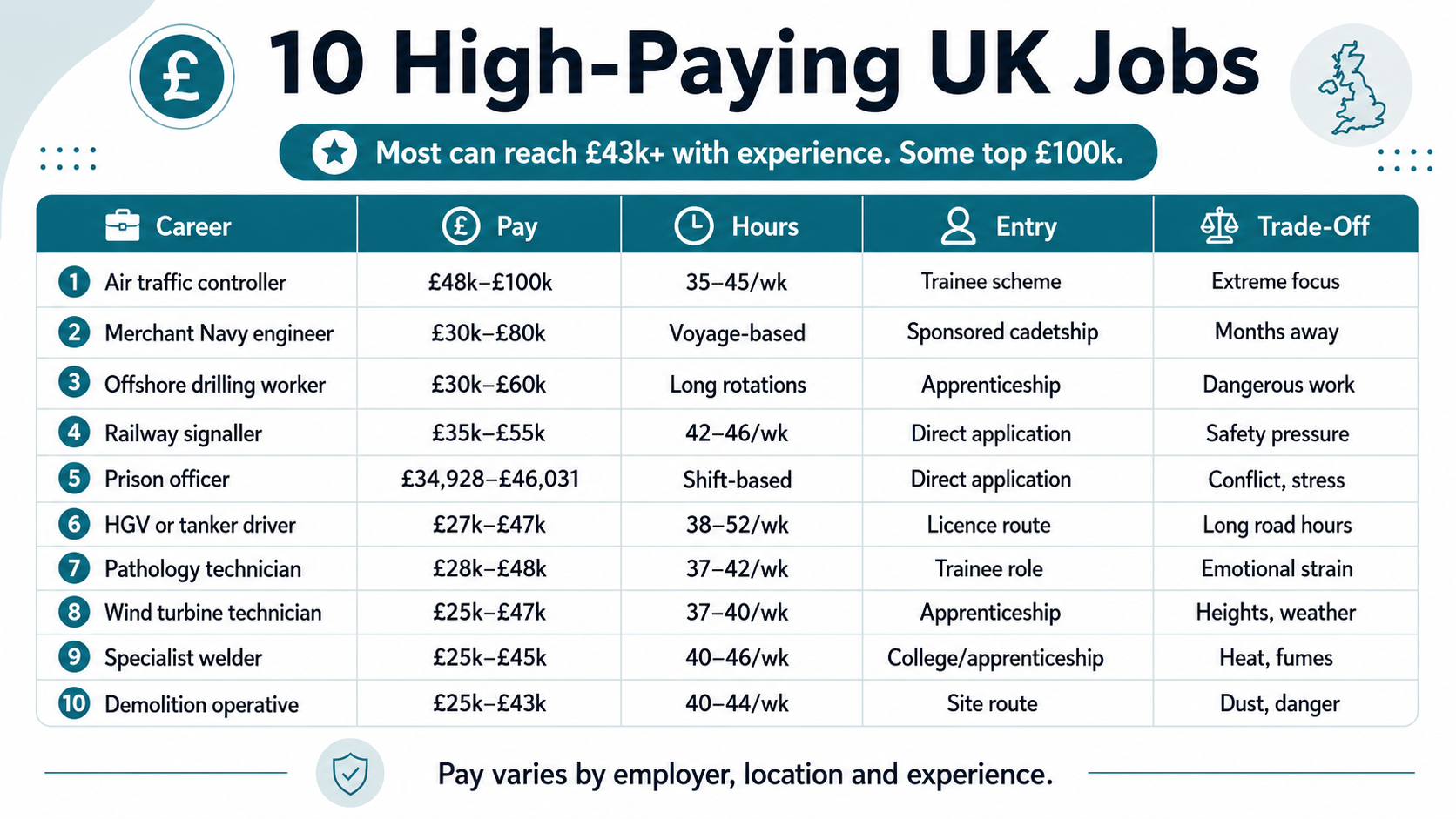
Salary figures show common career ranges. They do not guarantee starting income.
The numbers tell part of the story. Now, let’s explore the jobs behind them.
Why Do Air Traffic Controllers Earn Up to £100,000?
Air traffic controllers usually earn between £48,000 and £100,000 a year. To start with, they guide aircraft and keep passengers safe. They also help pilots during the most dangerous parts of a flight. Most people work 35 to 45 hours a week on a shift pattern.
You can become an air traffic controller in the UK through the NATS trainee scheme. Applicants usually need GCSEs in English and maths. They must also pass strict medical, security and ability checks. Initial training often takes around one year. With experience, air traffic controllers can move into training, supervision or management roles.
But why do people avoid this dream job?
- Making one tiny mistake could put many lives at risk.
- Your shift patterns will change all the time and ruin sleep.
- You might have to move to a different city for training.
- Keeping focus for hours makes your brain very tired.
- Failing a medical check can end your career instantly.
Is Merchant Navy Engineering Worth Life at Sea?
Merchant Navy engineers spend long periods of time living on large ships. Actually, they maintain the massive engines and electrical systems that keep ships moving. Merchant Navy engineers earn about £42,000 a year on average. However, salaries can range from £30,000 to £80,000, depending on rank and experience.
A sponsored officer cadetship offers one of the best routes into Merchant Navy engineering. The programme usually takes about three years and combines study with real sea experience. You will also need a valid seafarer medical certificate before working at sea. With experience and the right qualifications, you can progress from junior officer to chief engineer.
Why is Merchant Navy engineering not for everyone?
- Living in a small cabin for months is very difficult.
- Fixing a broken engine in a storm is extremely stressful.
- Being away from land can make you feel very lonely.
- The motion of the sea can make sleeping quite hard.
- Medical help may be far away during a serious emergency.
How Much Can Offshore Drilling Workers Earn?
Offshore drilling workers usually earn between £30,000 and £60,000 a year. Many work for two weeks at a time, often on long shifts. During that period, they live and work on an offshore rig.
You can get into this via an engineering apprenticeship. Many people start as a “roustabout” to learn the basic skills needed. Physical fitness is a must for these dangerous jobs that pay well UK companies offer. You will also need to pass a survival course to work offshore.
Why do people avoid this job mainly?
- You are stuck on a rig in the middle of the sea.
- The weather in the North Sea can be very scary.
- Working around heavy machinery always carries a risk of injury.
- Working 12-hour night shifts in the cold is very draining.
- If there is an emergency, you cannot just walk away.
Why Can Railway Signallers Earn £55,000?
Railway signallers control the tracks to keep trains from hitting each other. Generally, they earn between £35,000 and £55,000 each year. The average UK salary for a railway signaller is about £38,000 a year. The working week is often between 42 and 46 hours long. As the railway runs every day, you will also need to work many weekends and bank holidays.
Most people apply directly to Network Rail for railway signaller positions. You do not always need previous rail experience to get an interview. These are safety-critical jobs UK passengers rely on every day. That said, you must be very good at staying calm under pressure.
What are the hardest parts of railway signalling?
- You have to stay alert even when nothing is happening.
- Working through the night can be very bad for your health.
- If you make a mistake, the whole rail network stops.
- Sitting in a signal box alone can be quite boring.
- Dealing with rail accidents can cause a lot of stress.
Is Prison Officer Pay Worth the Pressure?
Prison officers in the UK can start on a salary up to £46,031. To be honest, your exact pay depends on where the prison is. Officers spend their day supervising inmates and keeping the wings safe. The practical reality is that you must be ready for conflict.
You do not need a degree to start this career path. Also, you will need to pass a fitness test and background check. Shifts can start very early or finish very late at night. The good news is that the training is fully paid.
What makes this career stressful?
- You might have to deal with physical threats every day.
- Walking through a prison can feel very loud and intimidating.
- Some prisons are located in very remote parts of the country.
- Being short-staffed can make the job feel much more dangerous.
- Serious incidents can stay in your mind long after a shift ends.
Can Tanker Drivers Earn More Than Other HGV Drivers?
Yes, specialist tanker drivers can often earn more than standard HGV drivers. Most HGV drivers earn between £27,000 and £47,000 a year. In comparison, fuel tanker drivers earn around £46,000 on average. Overtime and night shifts can push some salaries above £55,000. The higher pay reflects the extra risk and training involved.
So, what do you need to become a tanker driver? The Category C+E licence qualifies you to drive large articulated vehicles. Drivers must also get an ADR certificate to carry dangerous chemicals. Usually, you will work between 38 and 52 hours every week. The job involves a lot of sitting and waiting at delivery points. Essentially, you are responsible for very hazardous cargo.
What are the hardest parts of tanker driving?
- You spend almost all of your time alone in a cab.
- Sleeping in a truck at a service station is not fun.
- One accident with a fuel tanker can be a disaster.
- Traffic jams can make your working day feel never-ending.
- It is very difficult to eat healthily while on the road.
What Does an Anatomical Pathology Technician Earn?
Anatomical pathology technicians usually earn between £28,000 and £48,000 a year. Most work around 37 to 42 hours a week, although some may also work nights or weekends. Some roles require you to be “on-call” during the night. Anatomical pathology technicians work in mortuaries and hospitals. Mainly, they help doctors carry out post-mortem exams on deceased people.
Believe it or not, you can start as a trainee or complete a Level 3 mortuary technician apprenticeship. Applicants usually need five GCSEs at grades 9 to 4, including English and maths. The apprenticeship can take up to two years and must take place in a public or NHS mortuary. You also need emotional strength, attention to detail and a respectful attitude when caring for deceased people.
Still, why do some people avoid mortuary work?
- You will be around dead bodies every single working day.
- Some cases involving children can be very hard to handle.
- There is always a small risk of catching an infection.
- Being called out at 3 AM to a mortuary is tough.
- Most people will not want to hear about your workday.
Can Wind Turbine Technicians Earn £47,000?
Wind turbine technicians maintain and repair turbines on land and at sea. According to the National Careers Service (NHS), starters earn around £25,000 a year. Pay can rise to about £47,000 with experience. Most technicians work 37 to 40 hours a week. However, apprentices may earn less while completing their training.
A common way to become a wind turbine technician is through a Level 3 engineering apprenticeship. This usually takes three to four years and includes paid workplace training. You can also enter through an electrical or mechanical engineering course. Before starting, you may need a driving licence, safety training and background checks. Offshore roles may also require sea-survival training.
Why does high pay fail to attract more wind technicians?
- Climbing hundreds of feet in the air is very scary.
- It can be freezing cold and windy at the top.
- You often have to travel to very remote areas.
- If the weather is bad, you might be stuck offshore.
- There is not much space to move inside the turbine.
Why Do Specialist Welders Earn More?
A standard welder might earn £25,000 but specialists earn £45,000. These are the people who weld underwater or on high-pressure pipes. They usually work about 40 to 46 hours every week.
Most people become welders through a college course or apprenticeship. During training, you build practical skills and learn safe working methods. For specialist roles, you may also need welding coding certificates. These certificates prove that you can complete certain welds to an approved standard. As your skills grow, reading technical drawings can improve your job options.
What makes specialist welding a difficult career?
- The environment is always hot, smoky and very bright.
- You might have to crawl into very small, dark pipes.
- Holding heavy tools for hours makes your arms very sore.
- Breathing in welding fumes may damage your lungs.
- Loud machinery can damage your hearing without proper protection.
- Sparks and hot metal can cause serious burns.
Is Demolition Work a Well-Paid UK Career?
Yes, demolition work can offer good pay without a university degree. Demolition operatives usually earn between £25,000 and £43,000 a year. They safely dismantle old or unsafe buildings. Most work around 40 to 44 hours each week.
You can enter this career through site work or an apprenticeship. Many people start as general labourers and gain experience. Most demolition sites also require a valid CCDO card. The practical reality is that demolition needs skill and careful planning. It is not simply about breaking down buildings.
Why do people avoid demolition work?
- The air is often full of dust and loud noises.
- There is a constant risk of things falling on you.
- You have to work outside even when it is raining.
- Old buildings often contain dangerous hidden asbestos.
- Using heavy drills all day can damage your hearing.
Which Careers Can You Enter Without a Degree?
Several well-paid UK careers do not require a university degree. Prison officers, railway signallers, welders and demolition operatives can enter through training. HGV drivers can also qualify through the correct licence route. However, these jobs still require skills, checks and recognised training.
The simple fact is that employers often value practical ability over a degree. Yet, high paying jobs no degree still have clear entry rules. You may need GCSEs, medical checks or security screening. Some careers also require legal licences or safety certificates.
Apprenticeships offer another strong route into skilled UK jobs. They combine paid work with recognised training. Therefore, they suit school leavers and adult career changers. However, well-paid jobs without qualifications UK workers search for rarely need no training. Even high paying jobs with no experience require preparation and commitment.
- Direct-entry careers still use strict assessments.
- Licence-based jobs require approved qualifications.
- Apprenticeships let you earn while learning.
What Costs Should You Check Before Starting?
Before starting, check every cost linked to training and entry. Some careers require medical exams, licence tests or safety certificates. HGV drivers may pay for medical checks and driving tests. Offshore workers may need safety training and travel costs.
Some apprenticeships and cadetships cover most training costs. However, private courses may require full payment before you find work. The part people only notice later is that licences and certificates may need renewal.
Ask the employer which costs they will cover. Some companies fund training when you agree to stay for a set period.
- Is the training recognised by the industry?
- Does the employer cover medical checks?
- Will you receive pay during training?
What Should UK Immigrants Check Before Applying?
If you have moved to the UK, check your visa rules first. Actually, not every company on this list will be able to sponsor your visa. You should also check if your foreign qualifications count in the UK. Many UK jobs without university requirements are open to all residents. Usually, you will need to show a clear address history for security jobs. Look for jobs with paid training UK firms offer to help you settle in. Speaking of transport, make sure you have a valid UK driving licence.
Which Tough Career Matches Your Strengths?
Do not choose a career only for its salary. Instead, find a role that matches your skills and lifestyle. For example, independent workers may enjoy HGV driving. Physically strong people may suit demolition work. On the other hand, calm thinkers could consider signalling or air traffic control. Meanwhile, practical workers may prefer welding or engineering. The real lesson is that easy career changes that pay well UK workers can find still need the right personal fit.
Here are some careers that may match your strengths:
- Stay calm under pressure: Try air traffic control or railway signalling.
- Like travel: Consider a Merchant Navy career.
- Have physical strength: Look at drilling or demolition work.
- Feel comfortable at height: Try wind turbine maintenance.
- Handle emotional pressure well: Consider prison or mortuary work.
- Prefer working alone: Explore HGV or tanker driving.
- Enjoy precise practical work: Look at specialist welding.
Which Training Claims Should You Avoid?
Be careful when you are looking for training courses online. Some websites promise you a £50,000 job after just one week of study. The truth most guides skip is that real training takes time and effort. Basically, if a deal looks too good to be true, it probably is. Check that the training provider is listed on an official government website. Lastly, avoid any company that asks for thousands of pounds upfront without a contract.
- Avoid anyone who says you do not need any checks.
- Be wary of jobs that rely entirely on massive overtime.
- Never pay for a job interview or a “guaranteed” role.
Looking for useful training without unrealistic job promises? Training Tale offers practical online courses for personal growth and career change. So, explore trusted learning options and choose a course that matches your goals.
Final Thoughts: Which Difficult Career Is Worth It?
The best career is not always the one with the highest salary. It is the one you can manage safely for many years. Compare the starting pay, training time and daily pressure. Then think about your health, family life and personal strengths.
High paying jobs nobody wants UK workers to consider can offer strong rewards. However, every role has a clear trade-off. Some demand long shifts. Others involve danger, isolation or heavy responsibility.
The real lesson is that long-term success comes from the right fit. With that in mind, check official entry rules, current vacancies and training costs before making your decision.