
No products in the basket.
What is COSHH regulations? Every day, workers come into contact with chemicals, dust, and other hidden hazards without even noticing. That’s why the UK made COSHH regulations in 1988. These rules protect employees and anyone else who might be exposed at work. But how do COSHH regulations help? Actually, they explain how to handle, store, and use harmful substances safely. Because of this, even simple jobs like cleaning or office work become much safer.
In simple terms, COSHH tells you which substances are dangerous. It explains who must follow the rules and how to stay safe. It also covers risk checks and safety steps. Following these rules helps prevent sickness, injuries, and long-term health problems.
Now let’s explore what COSHH is and how these rules make work safer.
What Is COSHH Regulations and Its Meaning?
The full form of COSHH is Control of Substances Hazardous to Health. In simple words, it refers to anything at work that can harm your health, such as chemicals, dust, fumes, gases, or germs.
The UK first introduced COSHH in 1988 to protect workers from these risks. Later, the COSHH Regulations 2002 updated the rules, making them clearer and covering more hazards. These regulations explain how to handle substances safely and guide both employers and workers on how to stay safe at work.
COSHH is not a one-time rule. It is updated regularly to include new risks and better safety methods. This way, workplaces stay safer for everyone.
Why Are COSHH Regulations Important Today?
The key reasons COSHH rules matter for your safety and health:
- Immediate dangers: Chemicals, dust, or fumes can cause burns, skin problems, or breathing trouble quickly.
- Long-term health risks: Regular exposure can lead to serious illnesses like cancer, asthma, or lung disease.
- Important numbers: Millions of workers get sick from work-related hazards, and thousands die every year from long-term exposure.
- Hidden risks: Even small amounts over time can slowly damage your health.
- Business impact: Unsafe work can result in lost workdays, reduced productivity, and heavy fines for the company.
What Counts as a Hazardous Substance Under COSHH?
A hazardous substance is anything at work that can harm your health. This includes:
- Chemicals
- Dust like flour
- Wood or silica
- Fumes from welding or engines
- Vapours
- Gases and
- Germs like bacteria, viruses, or fungi
You might be surprised to learn that everyday items, like cleaning sprays or air fresheners, can be also harmful. These substances can affect your health in different ways. The most common is breathing in dust, fumes, or gases. They can also get into your body through skin contact, swallowing, or injections, such as a sharps injury.
What Is Not Covered by COSHH Regulations?
COSHH does not protect against every hazardous substance. Some materials are so dangerous that they have their own strict rules. For example:
- Lead – This metal can harm your nerves and organs. It is controlled under the Control of Lead at Work Regulations.
- Asbestos – Can cause serious lung disease and cancer. It’s managed by the Control of Asbestos Regulations 2012.
- Radioactive substances – Can damage cells over time. They follow the Ionising Radiations Regulations.
- Other dangerous hazards – Explosive materials or gases that reduce oxygen are very risky. They are covered by separate laws, like the Dangerous Substances and Explosive Atmospheres Regulations 2002 (DSEAR).
Many people think COSHH covers everything that is dangerous. But in reality, these high-risk substances need special rules because normal COSHH measures are not enough to keep people safe.
Who Must Follow COSHH Regulations?
COSHH rules apply to anyone who works with dangerous substances. First of all, employers have the main responsibility. They must check risks, give training, and make sure safety rules are followed. At the same time, employees must follow instructions, use safety gear correctly, and report any hazards or accidents.
Also, self-employed workers must follow these rules when handling dangerous substances. Many people don’t realise that even small businesses and freelancers must follow COSHH.
In the final analysis, everyone working with hazardous substances must remain alert and follow safety protocols. It ensures their well-being every single day.
What Is COSHH Risk Assessment?
A COSHH risk assessment is a simple check that you need to do before working with dangerous substances. In short, it helps you find risks early and take action to stay safe.
Also, this check is required by law in the UK. Any workplace that uses chemicals, dust, fumes, or germs must do so. So, think of it as protecting your health first, not just avoiding accidents.
A good risk assessment answers four simple questions:
- Which substances are harmful?
- Who might be affected?
- How can someone come into contact with them?
- What can we do to make it safer?
In the end, following these steps keeps everyone safe. It also makes the workplace healthier and makes it clear what everyone must do.
How Do You Carry Out a COSHH Risk Assessment?
Here’s a simple step-by-step flow.
- Identify substances – List all harmful substances in your workplace. This includes chemicals, dust, fumes, gases, and sprays.
- Check labels and SDS – Read warning labels carefully. Then check the Safety Data Sheet (SDS) for full safety details.
- Identify who is at risk – Think beyond workers only. Include cleaners, visitors, and anyone near the work area.
- Find exposure routes – Ask a simple question: how can it enter the body? Through breathing, skin contact, or swallowing.
- Assess the risk level – Look at how often exposure happens. Then think about how serious the harm could be.
- Apply control measures – Reduce the risk at the source. Use good ventilation, safer products, or safer working methods. Use PPE only when nothing else works.
- Record findings – Write everything clearly and simply. If it is not written, it is not considered safe practice.
- Review regularly – Do not do it once and forget it. Update it when anything in the workplace changes.
Many workplaces fail here. They skip regular checks and break safety rules without knowing.
Real example – Bleach used in a closed room with no air flow. As a result, strong fumes build quickly, making breathing difficult. So, opening a window or adding ventilation can stop the risk.
What Are COSHH Symbols and Why Do They Matter?
COSHH symbols are warning signs on chemical products. They show danger in a quick and simple way. You see them before you even use the product. They help you stay safe and avoid harm.
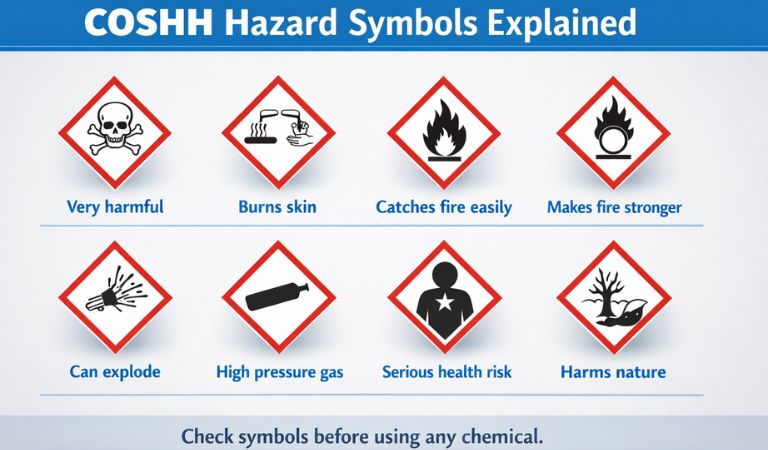
- Toxic (skull and crossbones) – Very harmful even in small amounts. It can cause serious sickness or death.
- Corrosive (test tube burning hand/metal) – Burns skin and can damage eyes. It can also damage metal surfaces.
- Flammable (flame) – Catches fire very easily. Heat, sparks, or flames can quickly start a fire.
- Oxidising (flame over circle) – Makes fire stronger and faster. It can increase the risk of fire or explosion.
- Explosive (exploding bomb) – Can explode from heat, shock, or pressure. Even a small hit can cause danger.
- Gas under pressure (gas cylinder) – Gas is stored under high pressure. It can burst or explode if heated or damaged.
- Health hazard (person with a star on chest) – Can cause long-term health problems. This includes cancer, lung damage, or breathing problems.
- Environmental hazard (dead fish and trees) – Can harm water, animals, and plants. Even small spills can damage nature.
Never ignore COSHH symbols. Always check them before using any chemical. One quick check can stop serious accidents and protect your health.
What Are Workplace Exposure Limits (WELs)?
Workplace Exposure Limits (WELs) are legal safety limits for air at work. They control how much of a harmful substance a worker can breathe in over time. In the UK, around 500 substances have these limits. As a result, WELs help lower the risk of sickness from dust, fumes, gases, and vapours.
However, a WEL is not a safe level for everyone. It only shows the highest legal limit you must not go over. Even below this limit, long exposure can still harm some workers. This risk is higher for people who are more sensitive.
Therefore, WELs alone are not enough to keep workers fully safe. Good control measures still matter every day. Good ventilation, safe work methods, and proper training all help reduce risk further.
What Is Health Surveillance in COSHH?
Health surveillance in COSHH means regular health checks for workers who handle harmful substances. It helps keep track of health over time. It also helps find early signs of harm before it becomes serious.
Next, this is needed when workers face regular exposure or high-risk work. Jobs with dust, chemicals, fumes, or similar hazards often need it. For example, employers may carry out lung function tests or skin checks. These simple checks help spot small changes in the body. They help catch problems early, before they get worse.
Finally, the main aim is early action. Health surveillance can show problems before symptoms start. As a result, workers can get help early and avoid long-term health damage.
What Are Employer and Employee Responsibilities Under COSHH?
COSHH safety is a shared responsibility. Employers set the system. Employees follow it in their daily work. As a result, both sides must act carefully to prevent harm.
Employer Responsibilities
Employers have the main legal duty under COSHH. First, they must do COSHH risk assessments and control exposure to harmful substances. Then, they must reduce or stop contact with these substances as much as possible. They also need to provide PPE and make sure workers use it correctly.
Next, employers must store and label all chemicals safely. After that, they must give clear training and proper supervision so workers understand the risks. They also need to prepare emergency plans for spills, leaks, or accidents. Where needed, they must check exposure levels and arrange health checks for workers.
Finally, employers must keep proper records of risk assessments, training, and safety checks. Therefore, this is a legal duty. If they fail, they can face large fines or legal action.
Employee Responsibilities
Employees also play an important role in COSHH safety. First, they must follow all safety rules and instructions at work. They must use PPE correctly and take care of it. Then, they must report spills, accidents, or broken equipment quickly. After that, they also need to attend training and health checks when required.
One important point is this. Ignoring safety rules is not only dangerous. As a result, it can also lead to legal action against the employee.
Where Do COSHH Regulations Apply in Real Life?
COSHH rules apply in many types of workplaces. They are not only for factories or labs. They apply anywhere harmful substances can affect health.
- Healthcare – Hospitals and clinics deal with blood, needles (sharps), and strong cleaning chemicals. Even a small mistake can cause an infection.
- Cleaning work – Bleach and disinfectants can harm skin and breathing. Regular use increases the risk.
- Construction sites – Dust, cement, and fumes can cause breathing problems over time.
- Food industry – Cleaning chemicals and food allergens can cause health issues if not controlled properly.
COSHH also applies in places people often forget.
- Offices – Printer fumes and cleaning sprays can affect the air people breathe indoors.
A real-life example is a sharp injury in healthcare. A single needle prick can cause a serious infection. This is why safe handling and correct disposal are very important every time.
What Is COSHH Regulations in Simple Terms? (Conclusion)
COSHH regulations are simple safety rules at work. They control harmful substances like chemicals, dust, fumes, and sprays. The main aim is clear. Keep people safe and protect their health.
To sum up, COSHH works in three simple steps. First, you find the risk. Then, you control exposure. After that, you follow safe working methods every day. As a result, COSHH helps prevent illness and serious health problems. It also makes the workplace safer for everyone.
Finally, here is the key message. Safety starts with understanding the risk. When you understand the danger, you can control it better.
Frequently Asked Questions (FAQs)
1. What are the main regulations of COSHH?
- COSHH rules focus on keeping workers safe from harmful substances. You must identify risks, control them, and give proper training. You also need to use safety equipment and review risks regularly.
2. What are the 5 main substances covered by COSHH?
- COSHH covers chemicals, dust, fumes, gases, and germs. These can harm your health at work. If a substance is dangerous, COSHH applies.
3. How to explain COSHH in an interview?
- Say it in a simple way. COSHH protects workers from harmful substances. It helps find risks and control them before they cause harm.
4. What is COSHH simple definition?
- COSHH means Control of Substances Hazardous to Health. It is a rule to keep people safe from harmful substances at work. It helps prevent illness and injury.
5. What are the three basic rules of COSHH?
- First, identify the hazard. Next, control the risk. Finally, protect yourself by following safety rules.
6. What are the 7 types of hazards?
- The main types are chemical, biological, physical, ergonomic, electrical, fire, and safety hazards. Each one can cause harm in different ways. You must stay alert to all of them.
7. What are the 5 basic workplace hazards?
- Common hazards include slips and trips, manual handling, harmful substances, noise, and unsafe equipment. These risks exist in many workplaces. You should spot and manage them early.
8. What are the 4 principles of hazard control?
- First, remove the hazard if possible. Then, replace it with a safer option. After that, control the risk and use safety equipment if needed.