No products in the basket.
What does TILEE stand for in manual handling? TILEE stands for Task, Individual, Load, Environment and Equipment. This simple five-step method helps you check risk before you lift, carry, push or pull anything at work.
HSE data shows manual handling causes around 30% of workplace injuries in the UK. It also leads to millions of lost working days every year. However, many injuries do not happen during the lift itself. They often start earlier when people rush, skip checks or miss warning signs.
That is where TILEE helps. It gives workers a simple way to pause for a moment and think before they act. It helps them spot risks early and choose a safer way before moving any load.
In this guide, we explain what TILEE means in manual handling and how it helps you lift safely at work.
What Does TILEE Stand for in Manual Handling?
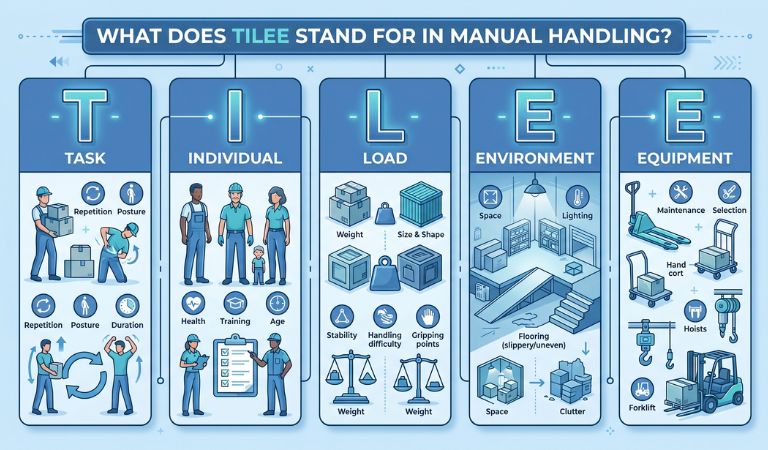
TILEE stands for Task, Individual, Load, Environment and Equipment. It is a simple safety check used before any manual handling task. People use it before lifting, lowering, carrying, pushing or pulling. It helps you see risk before you start.
Let’s make it clear in parts. Task means what you are doing and how often you do it. Individual looks at the person doing the job, such as strength, training and health. Load means what you move, like weight, shape and balance. Environment means the place, like space, floor condition and lighting. Equipment means the tools you can use, like trolleys or hoists, to make the job safer.
Sometimes you may see TILE in older guides. That version does not include Equipment. Later, safety experts added Equipment to make the check more complete and more useful in real workplaces.
So, what does TILEE stand for in manual handling? It is a trusted approach used at work and in training. It helps people notice risk early and act safely before any lift.
Why Is TILEE Important for Workplace Safety?
Manual handling injuries often happen when people rush or miss early warning signs before lifting. Here’s how TILEE helps in real work situations:
- TILEE reduces injury risk by helping workers check Task, Individual, Load, Environment and Equipment before they start.
- It improves planning by making people think before lifting, not after a problem happens.
- Employers use TILEE in risk assessments to build safer work habits and reduce accidents at work.
- It supports MHOR rules by making manual handling checks simple and easy to follow.
- Avoids manual handling when safer ways exist.
- Helps plan and control tasks that still need manual handling.
- Promotes safer choices before any manual task begins.
So, TILEE is more than a checklist. It is a simple habit that helps people work more safely every day.
UK Manual Handling Injury Statistics at a Glance
HSE data shows a clear problem in UK workplaces. Around 30% of all workplace injuries are linked to muscle and joint problems from manual handling. Recent reports also show over 7 million working days lost each year in the UK because of these injuries. Every year, many workers report pain in the back, neck or arms after lifting or carrying. Healthcare, warehousing, construction and retail face the highest risk. These jobs involve lifting and moving tasks every day.
So, what does this mean in simple terms? Most injuries do not happen in one sudden accident. They build up over time. People rush and skip planning. They also miss simple checks before lifting.
As a result, manual handling injuries remain common in the UK. Still, most of these injuries can be avoided. Better awareness and safe habits can make a big difference.
What Does Each Letter in TILEE Mean?
TILEE is a simple safety method before any lift. It helps you plan better using five key checks.
T = Task – What Should You Assess Before Lifting?
Task means what you do and how you do it. Start by looking at the movement. Is it smooth or awkward? Then check how often you repeat it. More repeats can put more strain on your body.
After that, think about posture. Do you need to bend, twist or stretch? These movements can increase injury risk. So, try to change the task if you can. Even a small change can make it safer.
I = Individual – Why Does the Person Matter?
Individual means the person doing the job. People are not the same. Some have more strength or training than others. So, check ability before lifting.
Also, think about tiredness. A tired person can lose control more easily. Old injuries also matter. In some cases, two people lifting together is safer and steadier.
L = Load – What Risks Can the Load Create?
Load means the item you move. Start with weight. Heavy loads put more pressure on the body. Then look at the shape. Odd or large items are harder to hold and control. Stability also matters. If the load moves or shifts, risk goes up.
Also, check the grip. You need a firm and safe hold. On top of that, check visibility. If you cannot see properly, the risk increases.
E = Environment – What Surroundings Increase Risk?
Environment means the place where you work. Start with the floor. Wet or uneven floors can cause slips and falls. Then check the space. Tight areas make movement harder. Lighting is also important. You must see clearly to work safely.
Also, think about stairs and slopes. These make lifting more risky. Weather can also affect safety, especially outside in rain, wind or ice.
E = Equipment – What Tools Can Reduce Risk?
Equipment means tools that help you move loads safely. Trolleys and sack trucks help reduce heavy lifting. Hoists help with very heavy items. Slide sheets help move things with less effort.
However, always check the equipment before use. A broken tool can make work unsafe instead of safer.
How Do You Use TILEE in a Manual Handling Risk Assessment?
A TILEE risk assessment helps you check safety before any lift or carry. You use it as part of a manual handling risk assessment to find risks early in a simple way.
- Avoid manual handling when a safer option is available
- Check each TILEE factor before you start the task
- Use safe methods or equipment to control or reduce risk
- Write down your findings so others can follow the same safe steps
- Look back at the task after you finish and see what you can improve next time
Example: Lifting archive boxes safely in an office setting
- Check the weight of each box and how many you can safely lift at one time
- Look at your route, floor condition and the space around you before you move
- If the boxes feel heavy or hard to carry, use a trolley to make the job safer
- If the load feels awkward or unsafe, ask for help and work with a partner
What HSE Tools Support TILEE Risk Assessments?
A TILEE risk assessment gives a quick way to check risk before any manual handling task. It helps you spot problems early and start safer planning at work.
To begin with, the HSE MAC Tool (Manual Handling Assessment Charts) supports lifting and carrying tasks. MAC checks key points like weight, distance, posture and how you do the lift. It then shows the risk level in a clear and simple way.
After that, the HSE RAPP Tool focuses on pushing and pulling tasks. It looks at the effort you need and checks if the task is safe or needs changes. This helps reduce strain during physical work.
On top of that, the Manual Handling Operations Regulations 1992 (MHOR) and HSE guidance L23 support the full process. L23 explains how employers should check and control manual handling risks in real workplaces.
So, TILEE and HSE tools work together. TILEE helps with quick checks before a lift. At the same time, MAC, RAPP and MHOR support deeper and more detailed risk checks. Together, they help make safer and better decisions at work.
Real Workplace Examples of TILEE in Action
In a busy warehouse, a worker walks toward stacked boxes. The job looks quick at first. But a short check changes the plan. The boxes feel too heavy for one person, so the worker splits the load. Then they notice a wet patch on the floor. So they clean it and use a trolley. This simple step helps avoid a risky lift.
In an NHS ward, a carer helps move a patient from bed to chair. The carer checks the situation and sees that the patient cannot support their weight. So they use a hoist instead of lifting by hand. After that, they clear the space around the bed so movement is easier. This keeps both the patient and staff safe.
In a retail shop, staff restock shelves during a busy shift. One worker picks up a box and feels it is heavy and awkward. So they carry fewer items at one time. Then they wait for a clear aisle before moving through. This helps them stay steady while customers move around.
Each example looks different. Still, TILEE guides every situation in the same way. Check carefully. Act safely. Move with control.
TILE vs TILEE vs TILEO: What’s the Difference?
In manual handling, you will often see three terms. These are TILE, TILEE and TILEO. All three help you think before you lift, carry, push or pull. The idea stays the same but each one adds more detail for safety.
TILE
TILE stands for Task, Individual, Load and Environment. This is the basic version used in many training sessions. It helps you stop and think before you start a job. If you search what TILE stands for, this is the simple meaning most people learn first.
TILEE and TILEO
TILEE adds one more part: Equipment. This includes tools like trolleys, hoists and sack trucks. It helps you check if you need support before lifting. So, you do not rely only on body strength.
TILEO works in a different way. It replaces Equipment with Organisation. So, TILEO’s meaning focuses on how the job is planned. It looks at who leads the task, how the work is arranged and how people stay safe during the job.
Quick Comparison
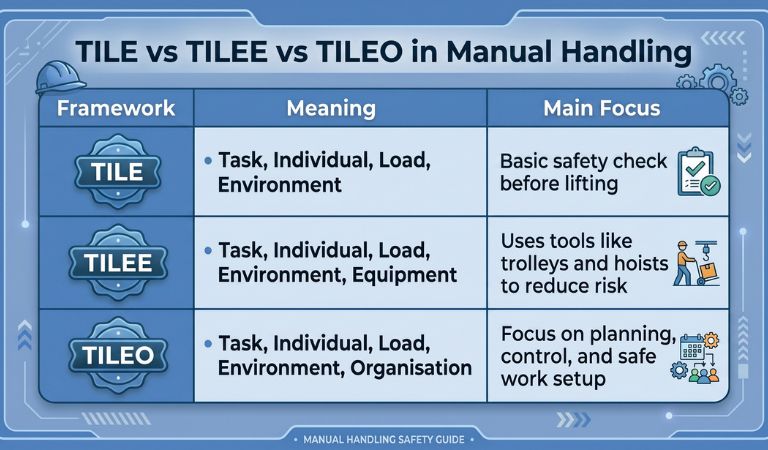
Each version builds on the other. So, workplaces choose the one that best fits their task, team and safety needs.
When Should You Avoid Manual Handling Completely?
Manual handling is not always the best choice. Sometimes the safest step is to stop and choose another way. A quick check can help you avoid serious injury.
You should avoid manual handling when the load feels too heavy or hard to hold. If it moves or slips, do not lift it alone. Also, check the route before you start. If the floor is wet, the space is tight or the path is blocked, stop and fix it.
Then think about equipment. If you do not have the right tools, do not take the risk. Use a trolley or hoist when needed. If the job needs more than one person, do not try to do it alone.
Your training also matters. If you are not trained, ask for help. If something does not feel right, pause and check the task again. So, remember this: not every load should be lifted by hand. Sometimes the safest choice is not lifting at all.
Common Manual Handling Mistakes TILEE Helps Prevent
- People lift without a plan, so the risk starts before the job begins
- Workers guess the weight, then struggle to hold and control the load
- Many ignore simple risks like wet floors or tight spaces which can cause slips or trips
- Some skip using tools, even when a trolley or hoist would make the job safer
- Workers rush the task, so they lose balance and proper control
- Many twist their body while lifting which puts strain on the back
TILEE helps you pause, check each risk and choose a safer way before you move anything.
Common Misconceptions About TILEE
Many people misunderstand TILEE, and this can lead to unsafe habits at work. Some think TILEE only matters for heavy lifting. That is not correct. Even light loads can cause injury, especially when people repeat the task or rush. Also, some believe TILEE only applies to warehouse jobs. In real work life, it applies everywhere. Offices, hospitals, shops, and many other workplaces use it every day.
On top of that, some workers trust the lifting technique alone. Good technique helps but it does not remove risk. You still need to check the task, load, and environment every time. Then, there is a common belief that equipment removes all danger. Tools like trolleys and hoists do help a lot. Still, you must use them properly and check the situation before you start.
Finally, many people think low-risk jobs do not need checks. Even simple tasks can cause harm if you skip planning or rush. So, remember that TILEE is not just for big or heavy jobs. It helps you think safely in every manual handling task.
Is There a Legal Weight Limit for Lifting in the UK?
Many people search for a fixed lifting limit in the UK. However, there is no single legal maximum weight for manual handling. The law does not give one set number for everyone.
Instead, safety depends on risk factors. So, you must look beyond weight. You should check how you lift, how often you repeat the task, your body position and the space around you. Even a light load can cause injury if you twist, rush or work in a tight space.
In the same way, HSE guidance does not focus on one fixed limit. It focuses on risk. That means you assess the full task, not just the weight in your hands. After that, tools like TILEE help you think step by step before you lift, carry, push or pull anything.
So, the key point is simple: the UK does not set one safe lifting weight. Safe lifting depends on how you do the task, not just how heavy the load is.
Safe Lifting Tips to Use Alongside TILEE
- Keep the load close to your body. This reduces strain on your back
- Use your legs to lift by bending your knees, not your back
- Avoid twisting your body while lifting or carrying the load
- Move in a slow and steady way. Do not rush the lift
- Use equipment like trolleys, hoists or sack trucks when they are available
- Ask for help if the load feels heavy, awkward or unsafe
These simple steps work best with a TILEE risk assessment. First, TILEE helps you check the task, load and environment before you start. Then, these lifting habits help you stay in control during the job. As a result, you reduce strain on your body and lower the chance of injury.
Why TILEE Improves Workplace Safety and Compliance
- Reduces injury risk by helping workers stop and think before every lift, carry, push or pull
- Supports training by giving staff a simple and clear way to check risk each time
- Builds safer teams by getting everyone to follow the same safe steps at work
- Helps workplaces follow HSE rules and stay within manual handling law
- Reduces sick days by preventing common lifting injuries
- Lowers costs linked to accidents, staff absence and injury claims
A TILEE risk assessment gives employers a simple way to improve safety every day. It helps staff make better choices at work. As a result, they stay safe and keep control during real tasks.
Ready to protect your back with every lift? Explore our Manual Handling Course and work more safely every day.
Conclusion: Why Use TILEE Before Every Lift
So now you know the answer to the question “what does TILEE stand for in manual handling?” It stands for Task, Individual, Load, Environment and Equipment.
TILEE is not just something you learn in training. It is a simple habit before every lift or move and helps you spot hazards early and avoid injuries before they happen. Also, it helps you make safer choices even when work feels busy or rushed.
On top of that, TILEE supports safer workplaces. When people use it every day, accidents go down and teamwork gets better. Small checks at the start can stop bigger problems later.
So, before you lift anything, just stop for a moment and use TILEE to stay safe. Make it a daily habit. It protects your body today and supports your health in the long run.
Frequently Asked Questions (FAQs)
1. What does tilee stand for?
- TILEE stands for Task, Individual, Load, Environment and Equipment. It helps you check safety before any manual handling task.
2. What does TILE stand for in manual handling?
- TILE stands for Task, Individual, Load and Environment. It is a simple way to spot risk before lifting or moving anything.
3. What are the four elements of TILE?
- The four elements are Task, Individual, Load and Environment. Each one helps you check a different part of the job.
4. What is the tileo method of manual handling?
- TILEO stands for Task, Individual, Load, Environment and Organisation. It focuses more on how work is planned and managed.
5. How does Tilee work?
- TILEE works by breaking a task into five simple checks. It helps you look at the job, the person, the load, the place and the equipment before you start.
6. What is the Tileo principle?
- The TILEO principle focuses on safe work planning. It looks at organisation, teamwork and how the job is controlled at work.
7. What are the 5 manual handling principles?
- The five main checks are Task, Individual, Load, Environment and Equipment. These help you reduce risk before you lift or move anything.
8. How secure is Tilee?
- TILEE is very secure when used properly. It helps prevent injury by making you think before you act but safe results still depend on correct use at work.
Manual Handling Course
Course Description :
- Certificate: Yes(Free)
- Accreditation: CPD Accredited
- Access: Lifetime