No products in the basket.
Many older homes in the United Kingdom still contain different types of asbestos today. This hidden material was very popular in construction before the year 1999.
Actually, this substance is the single greatest cause of work-related deaths in the country. Every year, roughly 5,000 workers die from asbestos-related diseases in the UK. Many homeowners do not realise there isn’t just one kind. This guide will answer your common questions regarding the different varieties. We will also show you where these materials are likely hidden.
Why Do Different Types of Asbestos Matter for Risk?
You might wonder if some kinds are more dangerous than others. Every variety of this mineral can cause very serious health problems. However, some types have sharper fibres that stay in your lungs longer. Scientists divide these minerals into two main groups based on their shape.
Experts call one group ‘serpentine’ because its fibres look like curly snakes. They call the other group amphibole because its fibres look like needles. Scientists often consider needle-like fibres more hazardous to human health. They can pierce the lining of your lungs much more easily.
Furthermore, the condition of the material is a very important factor. Some items are “friable”, which means they crumble easily by hand. Other items bond the fibres, locking them in hard plastic. Even the most dangerous type is safer if it remains solid.
Types of asbestos in the UK: chrysotile (white asbestos)
Builders and UK surveyors often call chrysotile “white asbestos”. It belongs to the serpentine family because its fibres are quite soft. Builders in Britain used this variety more than any other kind. Because it is flexible, manufacturers even wove it into fireproof fabrics.
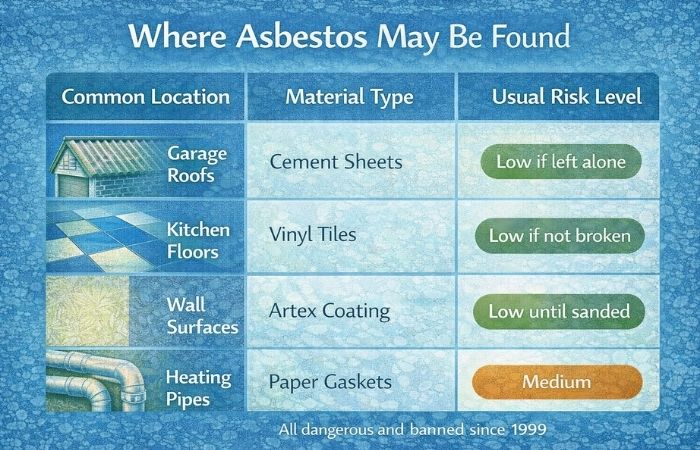
You can find white asbestos in many common household items today. For instance, it is often inside cement sheets on garage roofs. Many old floor tiles and textured wall coatings also contain it. Even water tanks and drainage pipes might have this material inside.
Can you identify chrysotile just by looking at the colour? Honestly, you cannot be sure without a proper laboratory test. Many materials look white but do not contain any harmful fibres. Conversely, some grey cement hides a large amount of white asbestos.
Asbestos types in the UK: amosite (brown asbestos)
The UK construction industry knows amosite as brown asbestos. This type belongs to the amphibole group and has very sharp fibres. Mining companies mostly mined it in Africa and used it for its strength. Builders liked it because it resisted heat very well in large buildings. This material is very common in Asbestos Insulation Board, or AIB. You might find AIB in ceiling tiles or partition walls. Builders also used it for fireproofing around structural steel beams. Sometimes, it hides inside old fire doors found in blocks of flats.
Why is AIB more dangerous than standard asbestos cement? Primarily, it contains a much higher percentage of dangerous fibres. It is also much softer and breaks very easily when touched. Therefore, even a small bump can release thousands of invisible dust particles.
Different forms of asbestos in the UK: Crocidolite (blue asbestos)
Safety experts frequently refer to crocidolite as blue asbestos. It is another member of the needle-like amphibole mineral family. According to experts, this mineral is the most hazardous type of asbestos. Its fibres are extremely thin and easy to inhale.
In the past, people used it for heavy-duty industrial insulation. You might find it in spray coatings on warehouse ceilings. It also appears in thick lagging wrapped around large boiler pipes. This material looks like blue fluff or old grey mud.
What should you do if you find suspected pipe lagging? Firstly, you must stop all work in that room immediately. Never try to touch or move blue asbestos yourself. This specific material requires the highest level of professional safety gear.
What Type of Asbestos is Commonly Found in UK Buildings?
Asbestos is probably present in the majority of UK buildings constructed prior to 2000. Properties built between 1950 and 1985 have the highest risk levels. During that era, people saw the material as a “miracle mineral” and used it in almost every part of a house.
Here are the top locations where you might find these materials:
- Roofs and Garages: Corrugated sheets and felt roofing.
- Boiler Rooms: Insulation on pipes and large heating tanks.
- Ceilings: Decorative coatings like Artex and suspended ceiling tiles.
- Walls: Internal partition boards and panels behind heaters.
- Floors: Plastic floor tiles and the sticky bitumen glue underneath.
You may hear the term “Asbestos-Containing Material” or “ACM”. This refers to any product that has these fibres mixed in. If a surveyor is not sure, they call it “presumed asbestos”. They treat it as dangerous until a lab proves it is safe.
Can You Tell the Type of Asbestos by Looking at it?
Many people believe they can identify asbestos by its colour. This is a very dangerous myth that can lead to mistakes. While raw minerals have colours, finished products often look totally different. A “white” ceiling coating could actually contain brown or blue fibres.
Manufacturers frequently mixed various forms of asbestos together. They did this to make products more durable or fire-resistant. A single floor tile might contain both chrysotile and amosite fibres. Therefore, the naked eye is never enough for a positive ID.
Only a UKAS-accredited laboratory can tell you the truth. Technicians use high-powered microscopes to look at the fibre shapes. They look for the curly serpentine or the straight amphibole needles. This is the only way to be 100% sure of the risk.
What’s the difference between friable and non-friable materials?
Understanding “friability” helps you stay safe during home DIY projects. ‘Friable’ means the material can be crushed into powder by hand. When a material is friable, it releases dust very quickly. This dust is what causes lung diseases like mesothelioma over time.
High-risk products, like pipe lagging, are almost always very friable. If you poke them, they crumble like a dry biscuit. On the other hand, non-friable materials are much more solid. Asbestos cement and vinyl floor tiles are good examples of non-friable items.
- High Risk (Friable): Sprayed coatings, loose-fill insulation, and pipe lagging.
- Medium Risk: Asbestos Insulation Board (AIB) and millboard.
- Lower Risk (Non-Friable): Bitumen products, cement sheets, and floor tiles.
Luckily, non-friable materials are safe if they stay in one piece. They only become dangerous if you drill, sand, or break them.
What does UK law say about asbestos types and management?
The Control of Asbestos Regulations 2012 is the main law here. It explains how people must manage these materials in all buildings. This law applies to employers, building owners, and even some tenants. They are called “dutyholders” because they have a duty to keep people safe.
You might need a specific type of survey for your property. An “Asbestos Management Survey” helps locate materials during normal daily use. However, a “Refurbishment Survey” is needed before you start any building work. This second survey involves looking inside walls and under floors.
Do homeowners have legal duties when doing small DIY tasks? Technically, the law focuses more on workers and commercial property managers. However, you still have a moral duty to protect your family. Furthermore, any builder you hire must follow the 2012 safety rules.
When is Removal Required vs Management in Place?
Finding one of the asbestos varieties does not always mean removal. If the material is in good condition, leaving it alone is safer. Moving it can actually create more dust than just leaving it. Sometimes, a professional will “encapsulate” the material instead of removing it.
Encapsulation means covering the asbestos with a thick, protective paint. This seals the fibres so they cannot fly into the air. This method is often cheaper and safer for the whole community. It is a great choice for items like sturdy cement flues.
However, you must take urgent action if the material is damaged. Cracks, water damage, or peeling surfaces are very serious warning signs. If you plan to knock down a wall, you must remove it. Never cover up damaged asbestos with wallpaper or simple wood panels.
Do Different Asbestos Types Require a Licensed Contractor?
In the UK, some jobs are too dangerous for normal builders. The law requires a “licensed contractor” for the most hazardous work. These professionals have special training and very expensive breathing equipment. They also use industrial vacuum cleaners with special filters to clean up.
Usually, work on lagging and sprayed coatings requires a licence. Most jobs involving Asbestos Insulation Board also fall into this category. Some low-risk jobs are called “Notifiable Non-Licensed Work” or NNLW. These require you to notify the government before the work starts.
You should always ask to see the contractor’s official licence. They should also provide a “Plan of Work” before they begin. After the job, you must receive a “Clearance Certificate” from an inspector. This document proves the air is clean and safe to breathe again.
What Should You Do if You Suspect Asbestos in Your Property?
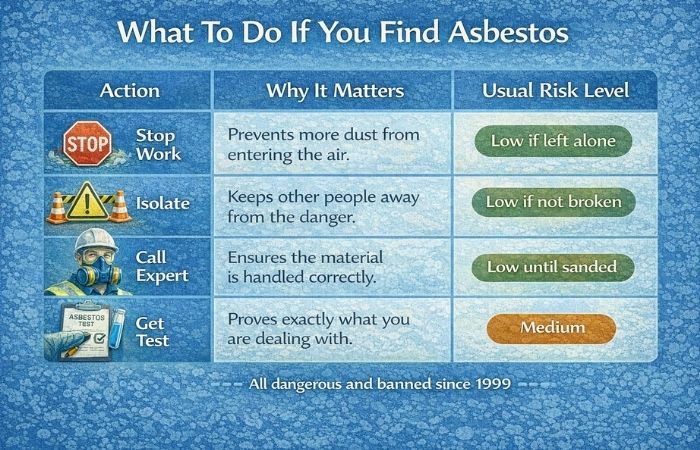
If you find a strange material, you must stop work immediately. Do not try to sweep up any dust with a broom. Do not put any suspicious waste into your normal rubbish bin. Instead, isolate the area and keep children and pets away.
Next, you should contact a professional surveyor for a sample. They will wear a mask and take a tiny piece for testing. You should tell them how old your building is today. It also helps to show them photos of the suspected area.
- Don’t: Drill, sand, or scrape the material.
- Don’t: Use a domestic vacuum cleaner on the dust.
- Do: Close the door and lock the room.
- Do: Call a UKAS-accredited testing company for help.
Taking these steps ensures that you do not breathe in any fibres. It also prevents the dust from spreading to other rooms. Safety is always more important than finishing a renovation quickly.
Final Thought on Various Types of Asbestos
It is vital to understand the different kinds of asbestos in your home. While some varieties are more fragile, all of them can harm you. Always remember to hire professionals for any testing or removal work. Please follow the UK safety regulations to keep your community safe.
Frequently Asked Questions (FAQs)
1. What are the 5 types of asbestos?
- Five common asbestos types are chrysotile, amosite, crocidolite, tremolite, and anthophyllite.
2. What type of asbestos is most dangerous?
- Crocidolite, also known as blue asbestos, is considered the most dangerous type.
3. What are the three types of asbestos in the UK?
- The three main types found in the UK are chrysotile (white), amosite (brown), and crocidolite (blue).
4. What is the 3 5 7 rule for asbestos testing?
- The 3-5-7 rule refers to collecting multiple samples from different areas to ensure accurate asbestos testing results.
5. What is type 3 asbestos?
- Type 3 asbestos usually refers to high-risk asbestos materials that can easily release fibres if disturbed.
6. What is the most common type of asbestosis?
- The most common cause of asbestosis is long-term exposure to chrysotile asbestos fibres.
7. What is the most common asbestos material?
- The most common asbestos material is chrysotile, often used in cement, roofing sheets, and insulation products.
8. What is type 2 asbestos?
- Type 2 asbestos generally refers to medium-risk asbestos materials that may release fibres when damaged or handled.
Asbestos Awareness Training
Course Description :
- Certificate: Yes(Free)
- Accreditation: CPD Accredited
- Access: Lifetime