
No products in the basket.
Quality assurance responsibilities mean making sure work is done correctly from the beginning. They include systems, checks, and clear steps to stop mistakes before they happen. In other words, QA is not just about checking finished work. Instead, it helps prevent problems before they start. For example, many companies use the Plan–Do–Check–Act (PDCA) cycle from ISO 9001. This way, work stays consistent, reliable, and easy to follow.
Mistakes can be very expensive, so preventing them is important. The American Society for Quality (ASQ) says poor quality can cost 15–20% of sales. In some companies, it can reach 40% of all operations. Even small problems like scrap and rework can take 2.2% of a manufacturer’s yearly income. However, the good news is that strong QA helps a lot. A good quality system can reduce customer complaints by up to 40%. It also makes work run smoother, saves time, and reduces waste.
To put this into action, this guide shows what QA responsibilities look like in daily work, including checks, records, skills, and problem-solving.
What Are Quality Assurance Responsibilities?
Quality assurance (QA) responsibilities are more than just checking work at the end. They make sure work is done correctly from the start. QA sets up systems and steps that stop mistakes before they happen. This is different from quality control (QC), which only checks the finished work, like inspections or testing. Many people do both QA and QC, but QA focuses on preventing mistakes and keeping work consistent.
The main tasks of QA are:
- Set clear quality standards: Decide what “good” work looks like based on customer needs, rules, and company policies.
- Document every step: Write simple procedures, checklists and instructions that everyone can follow.
- Train the team: Make sure all employees know the steps and follow them correctly.
- Monitor work: Check work regularly using audits, inspections, and spot checks to see that steps are followed.
- Record and fix problems: Write down when work does not meet standards and fix the problem completely.
- Learn and improve: Use data from defects, feedback, and audits to make work better over time.
By doing these tasks, QA makes sure work is done right the first time. To make it clear, QA stops mistakes, keeps work consistent and helps teams succeed every day.If you want a clearer picture of how this works in real roles, our guide “What Is a Quality Assurance Associate: Roles, Responsibilities, Skills, and Job Prospects” breaks down what QA associates actually do, the skills employers look for, and how the role supports consistent, high-quality work across teams.
Why Is Quality Assurance Important at Work?
Quality assurance (QA) is more than following rules. It helps work run smoothly, protects money, keeps customers happy, and makes life easier for staff. The point is, QA makes sure problems don’t happen, and work stays correct.
Financial Impact
Mistakes can cost a lot of money, so preventing them is very important. Studies show that businesses can lose 15–20% of their yearly income because of poor quality. For example, costs come from rework, scrap, customer complaints, returns, penalties, and lost sales. By preventing mistakes, a company can save money and protect its profit.
Benefits of a Quality Management System
A strong quality system helps the business in many ways:
- Reduces errors and keeps processes consistent, making work easier.
- Provides reliable products and services, so customers trust the business.
- Cuts waste, defects, and extra costs, which saves money.
- Improves efficiency and keeps the business competitive.
People and Reputation
QA also helps staff and protects the company’s reputation. It reduces frustration because employees face fewer problems every day. At the same time, it keeps the company’s brand strong and makes sure rules are followed, especially in industries like healthcare, aerospace, food, and finance.
In simple terms, QA does more than record-keeping. It saves money, keeps clients pleased, supports employees, and smooths operations.
What Checks Are Part of Quality Assurance?
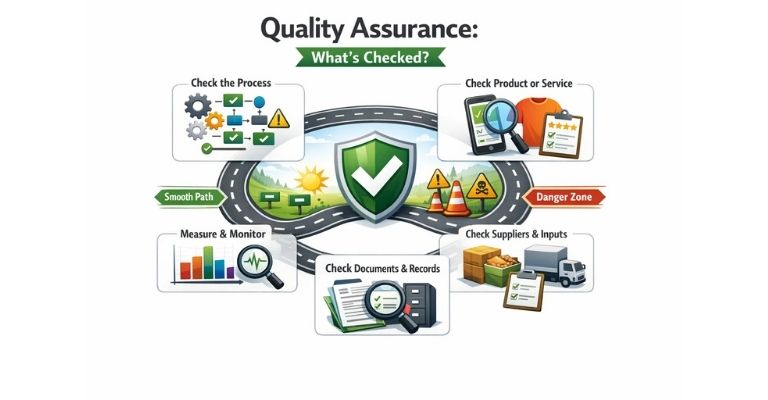
Quality assurance (QA) is not just checking work at the end. It’s about catching problems early and keeping everything running smoothly every day. Here’s what QA checks really mean in practice:
Check the process:
- Make sure everyone follows the right steps and instructions.
- Walk around, watch work, and do small audits to catch mistakes early.
Check the product or service:
- Look at work while it’s happening, not just at the final stage.
- Make sure the final product or service meets all the standards.
Measure and monitor:
- Keep track of mistakes, rework, scrap, cycle times, and customer complaints.
- Use this information to spot patterns and improve work.
Check suppliers and inputs:
- Confirm that suppliers provide the right quality and have the proper certifications.
- Inspect materials when they arrive to make sure they match the requirements.
- Record any issues and give feedback to prevent them from happening again.
Check documents and records:
- Always use the latest procedures, forms, and instructions.
- Remove outdated or old documents so nobody gets confused.
So, QA is like a shield for your work. It makes the right path easy and wrong moves difficult.
How Do You Make Sure Work Meets Standards?
Making sure work meets standards means helping people do their jobs correctly every day. First, set clear standards. These come from customer needs like contracts or drawings, from industry rules such as ISO, or from your company’s own policies and goals. Next, turn these standards into simple tools that everyone can use. For example, provide procedures, step-by-step instructions, checklists, forms, templates, and clear acceptance rules.
After that, make sure work follows these standards. Train staff and check their skills regularly. Also, use approved materials, proper tools, and calibrated equipment. High-risk steps, like peer reviews or first-article inspections, need sign-offs. Finally, keep checking and improving your work. Collect feedback, do audits, and review processes to make sure standards are still correct. In short, QA helps everyone do work the right way and makes it harder to make mistakes.
What Records Should QA Staff Keep?
QA records matter because they prove work was done right and highlight issues fast. To make this clear, here are the main types of records QA staff should keep:
Inspection and test records:
- Show that products or services passed checks.
- Include in-process checks and final tests to make sure nothing is missed.
Monitoring and measurement data:
- Track defects, rework, scrap, and key quality numbers.
- This helps find trends and prevent bigger problems.
Nonconformity and corrective-action records:
- Record what went wrong and why it did not meet standards.
- Include the fix, root cause and whether it worked.
Audit and review records:
- Keep internal audit results and management review notes.
- These show that standards are followed correctly.
Training and competence records:
- Show who was trained, when, and how their skills were checked.
- This makes sure everyone knows how to do their job properly.
Customer feedback and complaints:
- Track complaints, returns, warranty claims, and survey results.
- Use this information to find patterns and make improvements.
How Do You Spot and Prevent Quality Issues?
Spotting and preventing quality issues means stopping problems before they happen. First, track important data like defects, rework, scrap, complaints, and near-misses over time. Next, look for patterns to see if the same problems happen with a product, team, shift, supplier, or step in the process. Then, find the root cause using simple tools like 5 Whys, fishbone diagrams, or Pareto charts. This helps fix the real problem, not just the surface issue. Also, ISO 9001 says companies should remove the cause so the same problem does not happen again.
After that, use risk thinking to focus on the most important areas, like safety, rules, costly steps, or things that matter most to customers. Then, prevent problems by improving or redesigning processes, giving clear instructions, using automation, and adding error-proofing (poka-yoke). Also, train staff and watch their work to make sure they follow the right steps. Finally, check suppliers and adjust their processes if needed. Remember, stopping problems early also saves money because poor quality can cost 10–20% of operations.
How Do You Report Problems in QA?
In QA, problems are called nonconformities. ISO 9000 says a nonconformity happens when a product, process, or system does not meet an agreed requirement. In simple words, this can be a rule, procedure, law, or customer expectation. To report a problem, staff use a nonconformance report (NCR) or a similar form. The report should include:
- What happened
- Where and when it happened
- Which requirement was not met
- Immediate action was taken to control the problem
After filling the report, serious issues should be sent quickly to QA leaders, managers, or the project owner.
Next, all nonconformities are saved in a register or system. Then, the team finds the root cause to understand why it happened. They agree on solutions, put them into action, and check to make sure the problem does not happen again.
Finally, QA works best in a no-blame, improvement-focused culture. Staff should feel safe to report problems early instead of hiding them. Remember, reporting issues is a core QA responsibility. It keeps work safe, protects staff, and helps customers.
What Skills Help You Handle Quality Assurance Responsibilities?
Abilities that make quality work easier and accurate:
- Notice small mistakes: Look for tiny errors in data, documents, or products before they become bigger problems.
- Use data to improve work: Read charts and trends. Then use the information to fix problems and make it work better.
- Explain clearly: Tell others the quality rules in simple words. Give feedback without blaming. Also, work well with everyone, from workers to managers.
- Follow standards: Learn industry rules, customer needs and ISO 9001 requirements. Then use them in daily work.
- Solve problems carefully: Find the main cause of issues, not just the quick fix. Then take action so the same problem does not happen again.
- Keep clear records: Write accurate and easy-to-read records. This helps audits, shows trends, and guides improvement.
- Work as a team: Be professional and honest. Even when you have to say “no,” do it respectfully to protect quality.
Final Thoughts on Quality Assurance Responsibilities
Quality assurance responsibilities protect work in simple but important ways. When quality drops, problems start to appear. Money gets wasted through rework, errors and complaints. Over time, this loss can reach 15–20% of sales. That is why strong QA matters so much. It reduces mistakes and cuts waste. As a result, it protects profit and customer trust. It also makes daily work easier and less stressful for teams.
So, what does this mean in real life? In simple terms, quality assurance responsibilities are not just a final check. They guide work from the first step to the last. First, teams agree on clear standards. Next, they follow the right steps. Then, they check results, keep records and fix the real cause of problems. In short, quality is everyone’s job. Follow the process. Speak up early. And help improve how work gets done every day.
FAQs
1. What is the responsibility of quality assurance?
- Quality assurance makes sure work is done right from the start. It prevents mistakes, not just finds them later.
2. What are the 5 functions of quality assurance?
- Plan the work, control the process, check results, fix problems, and improve quality over time.
3. What are the 7 pillars of QA?
- Standards, processes, training, checks, records, problem-solving, and continuous improvement.
4. What are the 5 P’s of quality assurance?
- People, Processes, Procedures, Products, and Performance.
5. What are the 4 C’s of quality assurance?
- Clarity, Consistency, Control, and Continuous improvement.
6. What are QA roles?
- QA roles include setting standards, checking work, keeping records, finding problems and helping teams improve.
7. What is a QA skill?
- A QA skill helps you spot mistakes, follow standards, solve problems, and keep work accurate.