
No products in the basket.
Have you ever heard the word Asbestos? If not, here’s a simple idea. Asbestos is a natural material made of tiny fibres. In the past, people used it in many buildings. It was popular because it can resist heat and fire. You may still find it in old roofs, ceilings, pipes, and insulation. The danger starts when it gets broken or disturbed. Then it releases tiny fibres into the air. If people breathe them in, it can seriously harm the lungs. So now the question is, is Asbestos covered by COSHH?
The clear answer is no. Asbestos is not covered under COSHH in the UK. Instead, it has its own law called the Control of Asbestos Regulations 2012 (CAR 2012). This law focuses only on asbestos safety and control. It sets strict rules for people who own or manage buildings. On the other hand, COSHH covers chemicals, dust, fumes, gases, and germs. Because Asbestos is more dangerous, it needs its own stronger rules.
What is COSHH? Meaning, Purpose, and Legal Scope in UK Law
COSHH stands for Control of Substances Hazardous to Health Regulations 2002. It is a UK law that protects workers from harmful substances at work. The main goal is simple. It helps stop workers from getting sick because of dangerous materials at their job.
COSHH covers many common workplace dangers. It includes chemicals, dust, fumes, vapours, gases, and biological agents. It also covers harmful germs like Legionella. This germ can grow in water systems and cause serious illness.
Because of this law, employers must follow clear safety rules. First, they must do risk checks to find dangers. Then they must control exposure so workers do not come into contact with harmful substances. Next, they must give training so workers know the risks. After that, they must check workers’ health and keep work systems safe. Finally, they must plan for emergencies if something goes wrong.
So, COSHH plays a strong role in keeping workplaces safe. It controls many hazards under one law. However, it does not cover every danger. Some risks sit outside COSHH rules. Asbestos is one clear example.
What is Asbestos and Why Is It So Dangerous in Buildings?
Asbestos is a natural material made of very small fibres. People used it a lot in construction in the past. It became popular because it is strong, cheap, and fire-resistant. Even today, you can still find it in many older UK buildings. It often sits hidden in roofing sheets, pipe insulation, ceiling boards, and fireproof materials. Now, here is something many people do not know. Asbestos is not just one material. It comes in six natural types. White Asbestos was the most common in buildings. Brown and blue Asbestos were mostly used in heavy industry.
Next, let’s understand how it forms. Asbestos comes from certain rocks deep in the earth. It forms over millions of years under heat and pressure. So, it is a natural mineral, not made in a factory. On top of that, people did not only use Asbestos in buildings. They also used it in car brake pads, floor tiles, and some old home products. It became popular because it can handle high heat and friction very well.
Why Asbestos Is So Dangerous?
Asbestos becomes dangerous when people disturb it. When it breaks, it releases tiny fibres into the air. You cannot see them. You cannot smell them. Still, people can breathe them in without knowing. Once these fibres go inside the lungs, they stay there and slowly cause damage.
Because of this, Asbestos can lead to serious diseases. These include mesothelioma, lung cancer, and asbestosis. Every year, Asbestos is linked to about 5,000 deaths in the UK. On top of that, about 2.5 million buildings still contain Asbestos. So the risk is still present in many homes and workplaces.
The danger increases during renovation, repair, or demolition work. These jobs can easily disturb old materials. So, Asbestos may look safe when it stays in place. However, once it gets disturbed, it becomes a hidden health danger.
Is Asbestos Covered by COSHH? Clear Legal Answer
Here is the direct answer. No, Asbestos is not covered by COSHH in the UK.
Now let’s look at the legal rule. COSHH Regulation 5 clearly excludes Asbestos. Because of this, employers do not use COSHH risk checks for asbestos work. Instead, they must follow a separate asbestos law. This is an important point. Even though Asbestos is very harmful, COSHH does not apply to it. The law treats Asbestos as a special case. It needs stronger control and stricter safety rules.
So in simple terms, COSHH does not cover Asbestos at all. Each one works under its own legal system.
Why Asbestos is NOT Covered by COSHH Regulations?
Asbestos does not come under COSHH for one clear reason. It is too dangerous for normal workplace control. COSHH works for everyday risks, but Asbestos needs stronger and separate safety rules.
Control of Substances Hazardous to Health Regulations 2002 (COSHH) covers common workplace hazards. It includes chemicals, dust, smoke, gases, and harmful germs. These risks usually stay under control with basic safety steps at work.
However, Asbestos works in a different way. It can stay hidden inside buildings for many years. It only becomes dangerous when someone breaks or disturbs it. Because of this, the law places it under the Control of Asbestos Regulations 2012 (CAR 2012). COSHH Regulation 5 clearly removes Asbestos from COSHH rules.
Now here is the key point. Asbestos does not make you sick straight away. It can cause serious illness after 10 to 40 years. In the UK, it still causes thousands of deaths each year. So the danger stays hidden for a long time.
Because of this serious risk, the UK uses a special law just for Asbestos. It sets clear rules for checking buildings, managing risk, and ensuring safe work. At the same time, other risky materials like lead and coal dust also follow their own laws. This system helps keep safety clear and easier to follow.
What Law Covers Asbestos Instead? Control of Asbestos Regulations 2012 (CAR 2012)
Asbestos follows a separate law called the Control of Asbestos Regulations 2012 (CAR 2012). It is stricter than COSHH. This law focuses only on asbestos safety in buildings and workplaces. It sets clear rules to reduce risk and protect health.
Key Duties Under CAR 2012 Asbestos Regulations UK
This law gives simple but strict steps. Anyone responsible for a building must follow them. They must:
- Find Asbestos in the building
- Check its condition and risk level
- Keep an asbestos register updated
- Make an asbestos management plan (AMP)
- Stop people from breathing in asbestos dust during work
- Control removal and follow the legal notice rules
Each step helps stop harm. It also keeps workers, tenants, and the public safe.
Duty to Manage Asbestos
Now here is an important rule. The Duty to Manage applies to non-domestic buildings. This includes offices, schools, shops, and rented properties.
The law puts responsibility on:
- Building owners
- Landlords
- Employers
- Maintenance managers
They must take action and not ignore Asbestos. Regular checks are needed. They must also record it properly and manage it at all times.
COSHH vs CAR 2012: Key Differences Explained Simply
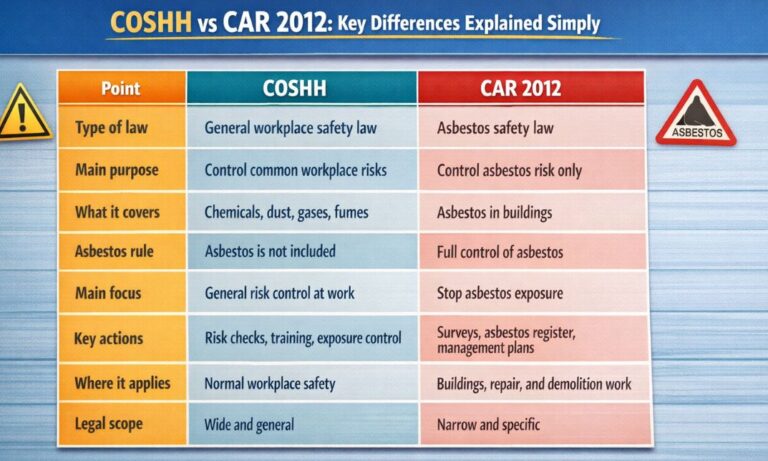
Do You Need a COSHH Assessment for Asbestos? Simple Answer
You do not need a COSHH assessment for Asbestos. This is because COSHH rules do not apply to asbestos work.
Control of Substances Hazardous to Health Regulations 2002 (COSHH) does not include Asbestos. So, COSHH risk checks will not work in this case.
However, you still need to follow safety rules. A risk assessment is still required. You must follow the law under the Control of Asbestos Regulations 2012 (CAR 2012). This law makes asbestos risk checks a legal duty.
Next, you need to take simple but important steps before any work starts. You must carry out an asbestos survey to find hidden materials. Then, you must keep the Asbestos register up to date. You also need to check the risk before repair or demolition work begins. These steps help reduce danger. They also keep workers and people nearby safe.
Duty Holder Responsibilities Under Asbestos Law (CAR 2012)
Under the Control of Asbestos Regulations 2012 (CAR 2012), duty holders have clear and ongoing duties. They must manage Asbestos properly to keep people safe. This is not a one-time task. It needs regular checks and careful control.
Main responsibilities
- Find Asbestos and record where it is in the building
- Manage it safely so it does not cause harm
- Tell workers, contractors, and building users about the risk
- Keep asbestos records clear and up to date
Workplace duty
- Stop any work that may disturb asbestos materials
- Make sure no harmful fibres go into the air
Legal expectation
- Check the condition of Asbestos on a regular basis
- Take action if anything changes or gets damaged
- Stay in control at all times and avoid delays
Each step helps lower risk. It also keeps workers and building users safe.
Penalties for Not Following Asbestos Regulations in the UK
Under the Control of Asbestos Regulations 2012 (CAR 2012), the law is very strict. If you break the rules, you can face serious consequences. You may have to pay unlimited fines. You can also face criminal charges. In some cases, you could go to prison.
Here’s why the law is strict. Asbestos can harm workers, visitors, and anyone in the building. Even a small mistake can release dangerous fibres into the air. These fibres can cause serious illnesses years later.
The main punishments are:
- Unlimited fines – There is no limit to how much you can be fined. Courts can make you pay very large amounts.
- Criminal charges – Serious rule-breaking can lead to being taken to court.
- Imprisonment – In the worst cases, people responsible can go to prison.
Final Answer to “Is Asbestos Covered by COSHH?”
The answer is simple: No, Asbestos is not covered by COSHH. COSHH looks after general hazards like chemicals, dust, and fumes. Asbestos is much more dangerous, so it has its own law called CAR 2012. Because of this, Asbestos needs stricter control. Even small exposure can make people very sick years later. That is why surveys, keeping proper records, and managing Asbestos safely are very important.
By following these rules, you keep workers, visitors, and everyone in the building safe. You also stay on the right side of the law. So, knowing the correct law is not just about rules. It prevents health risks and saves lives.
FAQs
1. Does COSHH apply to Asbestos?
- No. COSHH does not cover Asbestos. It has its own strict law, CAR 2012, because Asbestos is far too dangerous for general COSHH rules.
2. What is the 3-5-7 rule for asbestos sampling?
- The 3-5-7 rule helps decide how many asbestos samples to take: 3 for small areas, 5 for medium, and 7 for large areas. It makes sure the survey is safe and thorough.
3. What two substances are not covered by COSHH?
- Asbestos and lead. Both are handled under separate laws because they carry higher risks than normal workplace hazards.
4. What are the 5 main substances covered by COSHH?
COSHH mainly covers:
- Chemicals
- Dust
- Fumes
- Vapours
- Gases
These are the common hazards in most workplaces.
5. What are the 7 main hazardous substances?
The seven main hazards are:
- Chemicals
- Dust
- Fumes
- Vapours
- Gases
- Biological agents
- Germs like Legionella
6. What is a COSHH checklist?
- It’s a simple tool to check workplace risks. It lists substances, who handles them, what safety steps are in place, and what protective gear is needed.
7. What are the 10 golden rules for COSHH?
- Identify all hazardous substances
- Assess the risks
- Decide who might be harmed
- Choose control measures
- Provide proper training
- Use protective equipment
- Control exposure levels
- Monitor health regularly
- Keep records updated
- Review and improve safety measures