
No products in the basket.
In the UK, every worker deserves to feel safe. Sadly, over 130 people died at work last year. Therefore, COSHH and risk assessment are vital for every business. These tools help prevent accidents and long-term illnesses.
Moreover, this article answers common questions for all UK employers. We will explain how to follow the law easily. You will learn how to protect your team today. Let us explore these safety rules together now.
What Is COSHH and Risk Assessment?
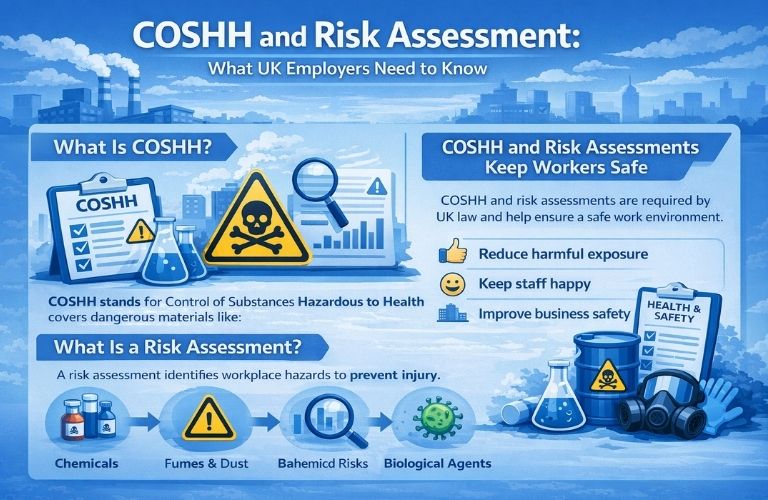
COSHH is a set of rules for dangerous things. Specifically, it focuses on substances that can make people ill. Risk assessment is a way to find workplace dangers. Together, they stop people from getting hurt at work.
Furthermore, these tools are important under UK law. Employers must use them to create a healthy environment. Actually, following these rules keeps your staff very happy. Consequently, your business will run much better every day.
What does COSHH stand for?
The designation for Control of Substances Hazardous to Health is COSHH. This law requires employers to control dangerous materials. For example, it covers chemicals, fumes, and even dust. It also includes biological hazards like germs or viruses.
Moreover, many common items are covered by these rules. Bleach, wood dust, and paint are good examples. Therefore, you must check everything used in your workplace. This helps you understand what might cause real harm.
What is a risk assessment in the workplace?
A risk assessment is a careful look at tasks. Firstly, you must identify what could cause an injury. Then, you evaluate how likely an accident is. Afterwards, you must put control measures in place.
Finally, you should review your findings every year. This process ensures that the workplace stays very safe. It helps you find problems before they happen. Thus, you can protect your staff from unnecessary pain.
Why Is COSHH and Risk Assessment Important for UK Businesses?
Legal compliance is the first reason to follow rules. If you ignore them, you might face big fines. Additionally, employee safety is the most important goal here. Safe workers are usually more productive and very loyal.
Furthermore, these assessments reduce accidents and sudden illnesses. Better workplace procedures make your daily tasks much smoother. You also lower the risk of government enforcement action. Truly, being safe is better than being sorry later.
What are the legal duties for employers in the UK?
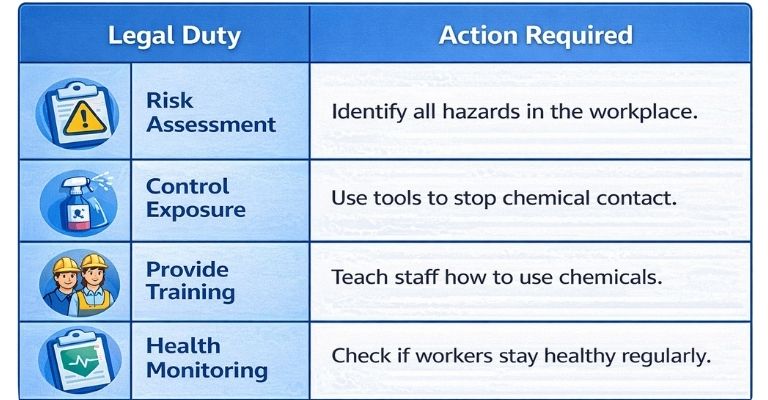
UK employers have many duties under the law. You must assess all risks to your staff. Furthermore, you should control exposure to nasty chemicals. Providing good training is also a legal requirement today.
Actually, you must follow the specific COSHH Regulations strictly. This involves giving workers the right safety equipment. Additionally, you must tell them about the risks involved. Clear information helps everyone stay safe while they work.
Who Needs to Carry Out a COSHH Assessment?
Employers carry the main weight of this responsibility. However, self-employed people must also follow these safety rules. Managers in charge of chemicals must lead the way. Occasionally, a “competent person” helps the business stay safe.
Actually, anyone managing hazardous substances must be cautious. You must understand the dangers of every single product. Furthermore, you need to share this knowledge with others. This process keeps the whole team safe from hidden dangers.
Which workplaces are most affected?
Many different industries must deal with hazardous substances. Construction sites often have lots of dust and fumes. Factories use many chemicals to make various new products. Cleaning companies use strong liquids to kill nasty germs.
Moreover, healthcare workers deal with many biological hazards daily. Hospitality staff use detergents to keep kitchens spotless. Beauty salons use dyes and sprays on their clients. Even warehouses have risks from forklift fumes or spills.
- Construction sites (dust and silica).
- Cleaning businesses (bleach and acids).
- Healthcare settings (blood and viruses).
- Beauty salons (nail products and hair dye).
- Manufacturing plants (industrial chemicals).
When Is a COSHH Assessment Required?
You need an assessment when hazardous substances appear. This applies when you handle, store, or move them. Furthermore, you must act when processes create thick dust. Vapours and mists also require a very close look.
Actually, biological agents like bacteria need an assessment too. Whenever a new task starts, check for hidden dangers. Even small changes in the workplace might cause risks. Therefore, always stay alert for any potential health hazards.
What substances are covered by COSHH?
Many different materials fall under these important safety rules. Cleaning agents like floor polish are very common examples. Solvents and paints are also covered by the law. Even welding fumes in a garage are quite dangerous.
Furthermore, wood dust and flour dust are hazardous substances. Bodily fluids in a clinic also require careful handling. Many chemicals used in farming need a COSHH check. Basically, if it can cause illness, it is covered.
How Do You Complete a COSHH Assessment Step by Step?
Firstly, you must identify every substance in use. Look at the labels on every bottle and box. Then, review the safety data sheet for each item. This paper tells you how to stay safe.
Secondly, understand how exposure can happen at work. Can someone breathe it in or touch it? Afterwards, decide who might be harmed by the substance. Think about cleaners, visitors, or your regular office staff.
Thirdly, choose suitable control measures for every single risk. Record your findings in a clear, written document. Then, train your staff to follow the new rules. Finally, review and update your assessment every single year.
What control measures should be used first?
You should try to eliminate the danger completely first. For example, stop using a very toxic cleaning liquid. If you cannot do that, try a substitution. Use a safer chemical that does the same job.
Furthermore, engineering controls like fans can help a lot. Safe systems of work define how to move carefully. Personal Protective Equipment (PPE) is the very last line. Only use gloves if other methods are not enough.
- Elimination: Remove the hazard from the building.
- Substitution: Use a less dangerous chemical instead.
- Engineering: Install better ventilation or closed tanks.
- Admin: Change how the work is actually done.
- PPE: Give workers masks, gloves, or goggles.
What Is the Difference Between a Risk Assessment and a COSHH Assessment?
A general risk assessment covers all workplace hazards. This includes trips, falls, or even fire safety risks. However, a COSHH assessment is much more specific today. It focuses only on substances that can harm health.
Actually, one does not always replace the other at work. You usually need both to be fully legally compliant. A COSHH check looks deeply at chemical safety data. Meanwhile, a risk assessment looks at the whole building.
Can COSHH be included in a general risk assessment?
Sometimes, small businesses combine these two safety documents. This might work if you only use one chemical. However, separate documents are usually much clearer for staff. They help people find specific safety information very quickly.
Furthermore, health and safety legislation often requires detailed chemical records. Separate forms make it easier to show the inspectors. You can list every chemical and its specific danger. This keeps your safety system organised and very easy.
How Often Should COSHH and Risk Assessment Be Reviewed?
You should review your assessments whenever something changes. For example, if you buy a new chemical brand. Or, if you change how you mix the liquids. Regular review intervals are also a very good idea.
Moreover, if an accident happens, you must look again. Near misses are a sign that things are failing. Updates to government guidance also mean you should check. Keeping things fresh prevents old mistakes from causing pain.
What triggers an immediate review?
Introducing a new chemical always requires a fresh look. If staff report skin rashes, check your assessments immediately. Changes in work methods might also create new dangers. For instance, using a spray instead of a brush can be more effective.
Additionally, equipment failure is a big warning sign for you. If a fan breaks, fumes might build up fast. Exposure incidents mean your current controls are not working. Therefore, fix the problem and update your records today.
What Are the Most Common COSHH Compliance Mistakes?
Many employers forget to check the safety data sheets. These sheets contain the most important safety facts available. Furthermore, poor staff training leads to many accidents. Workers must know exactly how to stay safe daily.
Actually, missing written records is a very common error. If it is not written down, it never happened. Some bosses also rely too much on basic PPE. This is risky because gloves can easily tear or leak.
- Ignoring the safety data sheet (SDS).
- Failing to train new employees properly.
- Keeping no written records of safety checks.
- Using only PPE without other safety controls.
- Forgetting to review assessments every single year.
- Not checking if workers are getting sick.
How can employers avoid these issues?
Always keep your safety records current and very tidy. Train your teams every few months to stay sharp. Moreover, audit your procedures to find any hidden gaps. Monitoring exposure risks helps you stay ahead of trouble.
Actually, talk to your workers about their daily health. They might notice smells or dust that you miss. Reviewing your control measures regularly keeps everyone much safer. A proactive boss is always a very good boss.
What Documents Should Be Included in a COSHH System?
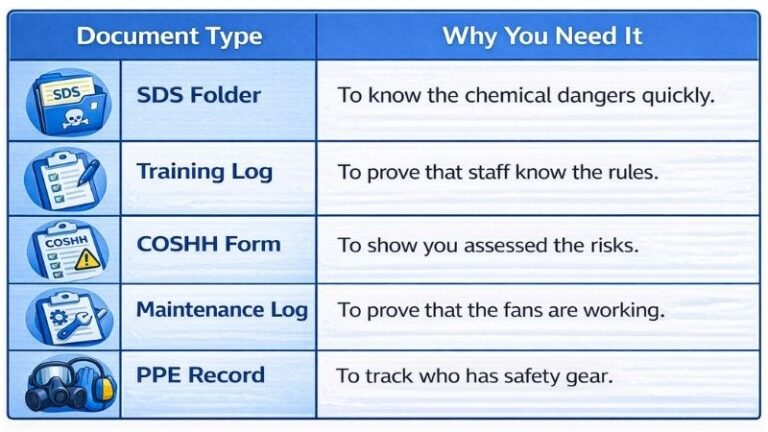
You should have clear COSHH assessment forms for every substance. Risk assessments for general tasks are also quite necessary. Furthermore, keep the safety data sheets in a folder. These should be easy for all staff to identify.
Additionally, please maintain a log of all employee safety training. PPE issue logs show who received gloves or masks. Maintenance records for fans and extractors are also vital. Finally, keep health surveillance records if your doctor suggests them.
How Can UK Employers Improve COSHH Compliance?
Create a clear register of every hazardous substance used. This makes it easy to see what you have. Then, train all employees who handle these chemicals daily. Make sure the assessments are very easy to access.
Furthermore, use clear signage near any dangerous storage areas. Securely lock away chemicals that are not being used. If you feel confused, get expert advice from professionals. Taking small steps today prevents huge problems in the future.
Actually, you can use colour-coded labels for different chemicals. This helps workers who might struggle with reading English. Ensure that everyone understands the warning symbols on bottles. Simple visual aids are very effective for workplace safety.
Final Thoughts
COSHH and risk assessment are essential for safe UK workplaces. They help you stay legal and keep people healthy. By identifying substances and controlling exposure, you prevent many accidents. Always remember to review your safety plans very regularly.
Summarise your risks and keep your training records updated. This simple approach will protect your business and staff. If you want to learn more, we can help. Please read ‘What Is a COSHH Assessment? A Simple Guide for Workplace Safety’ today.
FAQs
1. Does COSHH require risk assessments?
- Yes, employers must carry out risk assessments under the Control of Substances Hazardous to Health Regulations 2002 to identify and control hazardous substances.
2. What are the 5 steps of COSHH risk assessment?
- The five steps are identifying hazardous substances, assessing the risks, implementing control measures, recording findings, and reviewing the assessment.
3. What are the 5 P’s of risk assessment?
- The 5 P’s are people, premises, processes, products, and procedures.
4. What are the 4 types of risk assessment?
- The four types are qualitative risk assessment, quantitative risk assessment, generic risk assessment, and site-specific risk assessment.
5. How often should a COSHH risk assessment be done?
- A COSHH risk assessment should be reviewed regularly and whenever there are changes to substances, work processes, or regulations.
6. What are the 5 main steps of a risk assessment?
- The five main steps are identifying hazards, deciding who may be harmed, evaluating risks, recording the findings, and reviewing the assessment.
7. How long should COSHH records be kept?
You should keep these records for many years, usually. Some health records must be kept for forty years. This is because some illnesses take time to show. For precise timetables, visit the official UK government page.