
No products in the basket.
The best paying jobs UK workers can aim for are found in medicine, law, finance, technology, leadership and risk management. Many of these roles can pay more than £100,000 but reaching that level usually takes time. Some careers need a degree, licence or professional approval, while others rely on experience, specialist skills and proven results. Pay can also change by location, company size and level of responsibility. The right choice is not always the job with the highest salary. The right choice is the one that matches your skills and long-term plans.
Now, let’s dive in and explore 15 best paying jobs UK, including their salaries, qualifications, career routes and real working challenges.
What Should You Know Before Comparing High Salaries?
A high salary can describe several types of pay. It may mean fixed annual pay or a London market range. It may also show the top point on a public pay scale. Some websites mix these figures with bonuses and shares.
A starting salary does not always mean beginner pay. For example, a new Chief Financial Officer may already have fifteen years of experience. They are new to the CFO position, not to finance. That means career stage matters as much as salary.
These terms will help you understand the figures:
- Starting salary: Pay near the start of a career stage.
- Established salary: Pay after gaining useful experience in the role.
- Senior salary: Pay linked to greater skill or responsibility.
- Basic salary: Fixed gross pay before bonuses and benefits.
- Total compensation: Salary plus bonuses, shares and other rewards.
- Private income: Extra earnings outside the main employed role.
- London range: Pay that may sit above regional salaries.
- Official pay scale: A set salary system used by public bodies.
- Salary-guide range: A market guide from a named recruiter.
Location can make a huge difference. London often pays more in finance, law and technology. Yet rent, transport and food can also cost more. As a result, a higher salary may not always leave you with more spending money.
The source type matters as well. For example, public bodies publish set pay scales for judges and doctors, while private employers choose their own salaries. Meanwhile, trusted recruiter guides help show how pay compares across the wider market.
Which Best Paid Jobs UK Careers Offer the Strongest Salary Potential?
No single source ranks every high-paying UK career. Public jobs often use national scales or public appointment salaries. Private companies set their own pay packages. So, this guide uses several trusted source types.
The figures below show gross annual pay before tax. Bonuses, shares and private work stay separate. Extra medical duties also stay outside basic pay. That keeps the comparison clear and fair.
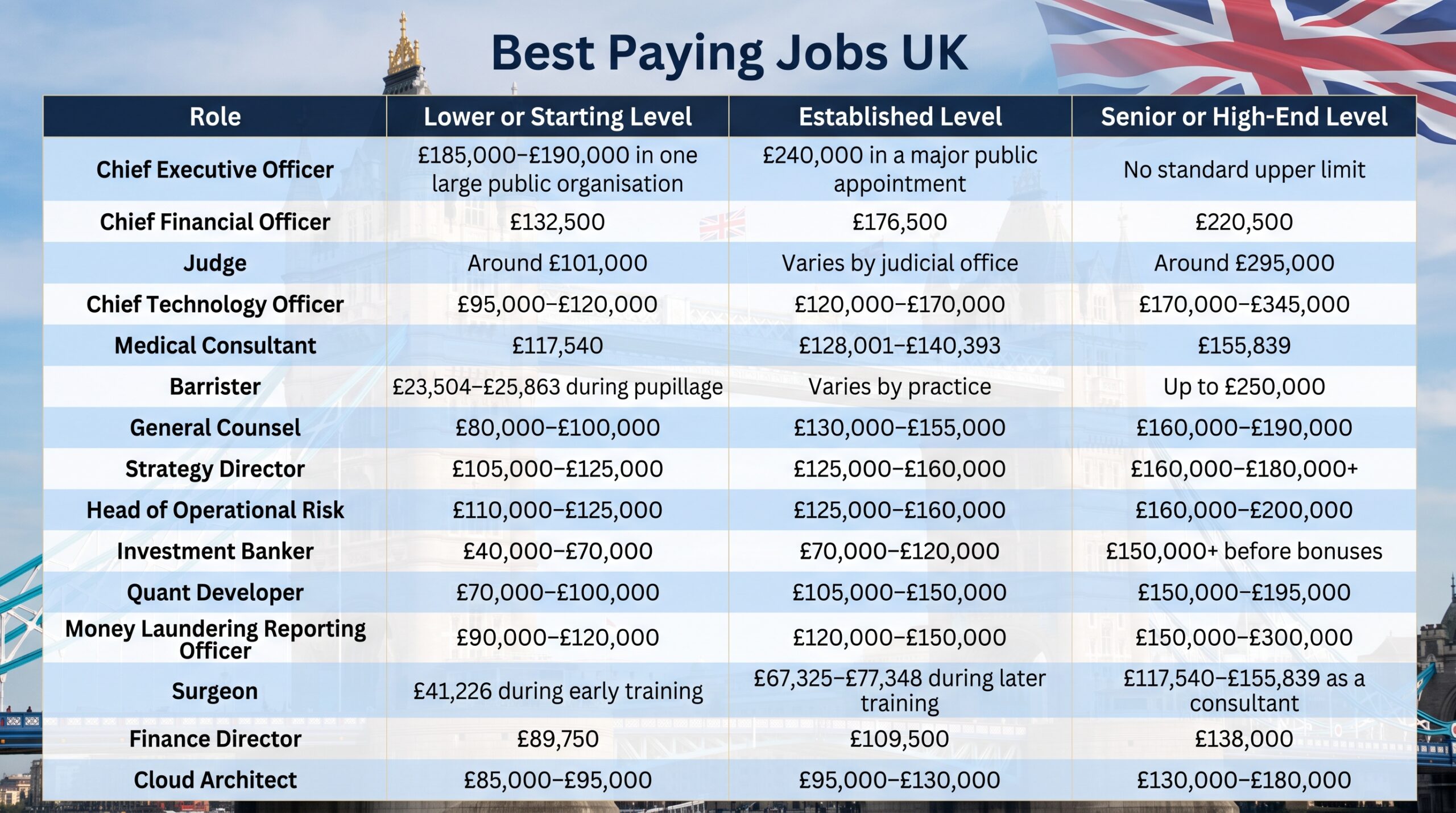
The table gives a quick comparison. However, each lower figure means something different. More specifically, a surgeon’s lower figure shows medical training pay. On the other hand, a CFO’s lower figure shows pay after a long finance career.
You should not rank these roles by one number alone. After all, training time, bonuses and legal duties also affect the overall value of a role. Employer size can make a big difference to the salary as well.
With that in mind, the sections below explain each of these points in more detail.
What Are the Best Paying Jobs UK Workers Should Compare?
-
Chief Executive Officer
How Much Can a Chief Executive Officer Earn?
Chief Executive Officer pay has no single national scale. One large public organisation paid between £185,000 and £190,000. A major government-owned organisation advertised a £240,000 salary. The role also included possible performance pay.
Private-company packages can reach much higher levels. However, the total may include bonuses, company shares and long-term reward plans. As a result, these extras should not be presented as normal basic salary.
Company size also has a major effect on pay. Turnover, staff numbers and public duties can all change the level of responsibility. For that reason, a small charity may not offer the same salary as a large national business. After all, greater organisational risk usually brings greater pressure and accountability.
What Experience and Skills Lead to a CEO Position?
There is no protected qualification for becoming a CEO. Normally, employers want strong senior leadership experience. They also want clear proof of good results. Academic study can help but it is not enough alone.
The main requirements for becoming a CEO include:
- Several years of senior management experience
- Responsibility for large teams and departments
- Strong budgeting and financial-control skills
- Board reporting and governance knowledge
- Evidence of business growth or successful change
- Risk and crisis-management experience
- Strong knowledge of the organisation’s sector
- Clear communication with investors and stakeholders
- Commercial and strategic decision-making skills
- A degree, MBA or senior leader apprenticeship where useful
Many people progress into CEO positions through director-level roles. During this stage, they may lead sales, finance or daily operations. Through this experience, they gain a wider understanding of how the whole organisation works. This experience then prepares them to take on greater responsibility.
What Makes the CEO Career Difficult?
Most people take many years to reach CEO level. Once appointed, they carry full responsibility for the organisation’s results. At the same time, they shape workplace culture and public trust. For this reason, one poor decision can affect thousands of people.
The pressure often grows during difficult times, especially when boards still expect business growth. Yet CEOs may need to make major decisions without having all the information. Their job security can also depend on delivering quick results. The role brings authority but it comes with constant pressure and accountability.
-
Chief Financial Officer
How Does CFO Pay Change With Experience?
A UK Chief Financial Officer can earn around £132,500 to £220,500. The national midpoint stands at £176,500. London pay can reach £300,000 at the upper level. These amounts show projected basic salary.
The figures do not include bonuses or company shares. Pension and other benefits also sit outside them. That means total pay may be higher. However, employers do not guarantee every extra reward.
The lower figure does not show beginner finance pay. Most CFOs already have long accounting careers. They may have worked as Finance Directors before. Employer size and sector also affect the offer.
Which Qualifications Support a CFO Career?
Most CFOs build their careers through accounting roles. Employers need someone who understands reports and cash flow. The person must also support long-term growth. Clear communication matters greatly at this level.
The road to becoming a CFO often involves:
- ACA, ACCA, CIMA or equivalent professional status
- Experience in financial reporting and control
- Strong cash-flow and treasury knowledge
- Audit, tax and compliance experience
- Work as a Financial Controller
- Work as a Finance Director
- Investor-relations and fundraising knowledge
- Merger and acquisition experience
- Budgeting and long-term forecasting
- Board-level communication
- Strong commercial judgement
Professional qualifications provide technical knowledge. Still, a CFO also needs leadership skills. They must explain complex numbers in plain English. Then, they must help the board act on them.
Where Does CFO Work Become Most Difficult?
A CFO turns financial data into business decisions. However, weak forecasts can cause serious cash-flow problems. Poor advice may also lead to costly investments, while strict reporting deadlines leave little room for error.
The role becomes even harder during rapid business growth. At that stage, other directors may want to increase spending but the CFO must protect the company’s long-term future. This responsibility can sometimes mean saying no to senior colleagues.
-
Judge
What Salary Can a Judge Earn?
Judicial pay broadly ranges from £101,000 to £295,000. The exact figure depends on the judicial office. Court level and responsibility also affect pay. Judges normally work around 37 to 42 hours weekly.
The word “judge” covers several different roles. District Judges and Circuit Judges follow different pay rules. Tribunal and High Court Judges also receive different salaries. That means one average can easily mislead readers.
Some judges work on a fee-paid basis. They receive money for each approved court sitting. Their payment depends on the exact office. It does not work like a full-time salary.
What Legal Experience Is Needed to Become a Judge?
Judges usually come from experienced legal careers. Applicants must meet the rules for their chosen office. They must also show sound judgement and clear communication. Personal honesty matters throughout the process.
The route to becoming a judge often requires:
- Qualification as a solicitor or barrister
- Chartered legal executive status where eligible
- Five years of post-qualification legal experience
- Seven years for Circuit Judge and more senior roles
- A strong record of law-related work
- Clear written and spoken reasoning
- Judicial Appointments Commission selection
- Character and suitability checks
- Security and background checks
- Relevant nationality and right-to-work status
The Judicial Appointments Commission uses five years for many roles. It requires seven years for some senior posts. Experience opens the door but it does not confirm appointment. Candidates must pass a competitive process.
Why Is a Judicial Career Difficult?
Judicial appointments remain highly competitive. Even experienced lawyers may not gain a place. Judges must understand complex legal arguments. They must also treat every person fairly.
Their decisions can affect someone’s freedom or family life. Some cases also involve painful or upsetting evidence, while public attention can add more pressure. A judge must stay calm and independent at all times.
-
Chief Technology Officer
What Pay Can a Chief Technology Officer Reach?
London CTO salary bands start at £95,000 to £120,000. Established CTOs earn around £120,000 to £170,000. Highly experienced leaders may receive £170,000 to £345,000. These figures cover the permanent annual salary.
The figures exclude bonuses and company shares. They also show time spent at CTO level. They do not show total technology experience. Most CTOs have already worked in tech for many years.
Company size can change the package. A young company may offer shares with lower pay. A large bank may pay more for security skills. Technical risk also affects the final amount.
Which Skills and Experience Build a CTO Career?
A CTO needs more than technical skills. They must know how technology supports customers and sales. They also need strong leadership skills. Board members may need simple explanations of technical risks.
The road to CTO level often involves:
- Software engineering or systems development
- Infrastructure and cloud-platform knowledge
- Cybersecurity and data-protection awareness
- System and enterprise architecture
- Product-development leadership
- Management of technical teams
- Budget and supplier responsibility
- Digital-transformation experience
- Technology governance
- Board-level communication
- Commercial and business understanding
- A computing degree or technical certification where useful
Many CTOs progress through management positions. They may lead engineers or large digital projects. This work teaches them to balance speed and safety. It also builds strong business judgement.
Which Pressures Make CTO Work Difficult?
Cyberattacks and system failures can happen without warning. When a major service stops, people want a quick fix. Yet rushed repairs can create more problems. The CTO must act fast without losing control.
Technology also changes all the time. Boards may want every new tool. Budgets rarely support every idea. That’s why a CTO must know when to say no.
-
Medical Consultant
What Is the NHS Consultant Salary Scale?
An NHS consultant in England starts at around £117,540. Established pay points rise to about £128,001 and £140,393. The highest threshold reaches around £155,839. These figures show current basic annual pay.
The scale does not include every extra payment. On-call work can increase earnings. Extra duties and agreed awards may also add money. Some consultants also carry out private work.
Private income should remain separate from NHS salary. It can change by speciality and location. Workload also makes a major difference. So, it should never appear as guaranteed pay.
What Training and Registration Does a Consultant Need?
A consultant follows a regulated medical route. Doctors need approved education and supervised work. They must also gain professional registration. Their knowledge must remain safe and current.
Doctors progress to consultant level through:
- A recognised medical degree
- Foundation medical training
- Approved specialist training
- Relevant postgraduate examinations
- Full General Medical Council registration
- A current licence to practise
- Entry on the Specialist Register
- A Certificate of Completion of Training
- An accepted registration route where applicable
- Ongoing appraisal and revalidation
- Continued professional development
Medical school provides the academic base. From there, doctors move into foundation training before starting specialist training. With each stage, they take on more responsibility.
Why Does Becoming a Consultant Take So Long?
Medical school is only the beginning of the journey. Doctors then move into foundation training before starting several years of specialist training. Some areas attract many applicants, so competition can be tough.
Consultants make difficult decisions about patient care and often guide other doctors and nurses. They may also work on call which can affect their home and family life. The long training route reflects the high level of trust and responsibility placed on them.
-
Barrister
How Do Pupillage and Senior Barrister Earnings Differ?
Barrister pay often begins with the minimum pupillage award. This stands at £25,863 in London and £23,504 outside London. Pay can increase sharply as a barrister gains experience. Broad career guidance suggests that some barristers may earn up to £250,000.
The top figure does not show normal early pay. Commercial and tax barristers may earn more. Publicly funded legal work may pay less. Chambers and reputation also affect income.
Many barristers work for themselves, so their monthly earnings can rise and fall. Payment may also arrive only after a case ends. This makes careful money planning very important.
What Qualifications Do You Need to Become a Barrister?
The Bar route combines study and supervised practice. A law degree alone does not allow someone to work as a barrister. Candidates must complete every required stage. They must also meet conduct rules.
The path to barrister qualification follows these stages:
- A law degree or approved conversion route
- The academic component of Bar training
- Approved vocational Bar training
- Membership of an Inn of Court
- Required qualifying sessions
- Character and suitability checks
- A competitive pupillage
- Completion of supervised practice periods
- Professional ethics requirements
- A valid practising certificate
- Continued professional development
Pupillage gives practical experience under supervision. After that, the barrister needs the correct certificate. The Bar Standards Board controls these rules. They help protect clients and the courts.
What Challenges Come With the Barrister Route?
Pupillage places remain limited, so many strong candidates compete for each one. Early income can also change from month to month. At the same time, building a steady flow of cases takes time.
Court work brings a different kind of pressure. Barristers must prepare detailed arguments and answer difficult questions during hearings. On top of this, late client payments can create cash-flow problems.
-
General Counsel
What Is the General Counsel Salary Range?
London General Counsel salaries start at £80,000 to £100,000. Established professionals earn around £130,000 to £155,000. Highly experienced roles may pay £160,000 to £190,000. These are permanent market salary bands.
The lower band does not show newly qualified solicitor pay. General Counsel is already a senior role. Normally, a lawyer reaches it after years of practice. International businesses may offer more.
Heavy regulation can also push pay higher. A large legal team brings greater responsibility as well. On top of the basic salary, some employers may offer bonuses or company shares. However, the final package will depend on the employer.
What Legal Background Leads to General Counsel?
Most general counsel professionals qualify as lawyers and then build strong business knowledge. Employers usually want someone who understands both law and company goals. They must also be able to lead other legal staff.
Reaching the general counsel level usually takes:
- Qualification as a solicitor or barrister
- Several years of legal practice
- Commercial-contract experience
- In-house legal work
- Regulatory and compliance knowledge
- Employment-law understanding
- Data-protection awareness
- Litigation and dispute management
- Management of external law firms
- Leadership of an internal legal team
- Board-level communication
- Strong knowledge of the employer’s sector
Under the SQE route, solicitors need a degree or equivalent. They must pass both SQE stages. Two years of qualifying work experience also apply. Suitability rules form part of the process.
Why Is General Counsel More Than a Legal Job?
A General Counsel must protect the business from legal risk without blocking every new idea. At times, they may need to challenge powerful directors under tight deadlines.
International work adds another layer of difficulty. One decision may involve several legal systems, along with contracts, staff and data. The advice must therefore remain both legal and practical.
-
Strategy Director
How Does Strategy Director Pay Rise With Seniority?
Strategy Director pay in London usually ranges from £105,000 to £125,000 at the lower end. Earnings can rise to around £125,000 to £160,000 with more experience. Highly experienced professionals may earn £160,000 to £180,000 or more. These figures reflect senior-level market salaries rather than entry-level pay.
Most Strategy Directors already have years of business experience before taking the role. Many move into strategy from finance, consulting or operations. A strong record of delivering results can then lead to better salary offers.
Specialist industry knowledge can make a Strategy Director more valuable. This is often true in finance and technology where sector experience can shape major decisions. Pay may rise further when the role covers large transformation projects or a wider team.
What Skills and Experience Do You Need to Become a Strategy Director?
Strategy work brings together research and business planning. Directors need to understand the current situation. They also need to plan the best future route. And more importantly, strong people skills help bring the strategy to life.
Most Strategy Director careers grow from experience in:
- Strategy consulting or business analysis
- Operations or commercial management
- Market and competitor research
- Financial modelling
- Business-case development
- Project and programme leadership
- Change-management experience
- Senior stakeholder communication
- Board-level presentations
- Risk and scenario planning
- Evidence of measurable business results
- A relevant degree or MBA where helpful
Good research helps a business choose the right direction. Clear communication helps everyone understand the plan. But even a good strategy means little if nobody acts on it. That is why a Strategy Director must know how to plan and get things done.
What Challenges Do Strategy Directors Face?
Strategy Directors often make important decisions without having every detail. Different teams may compete for the same budget or push for different goals. Senior leaders can also disagree about when changes should happen. Finding a plan that everyone supports can take time.
The challenge does not end when the plan is approved. A team may lack the money, skills or staff needed to deliver it. The Strategy Director may not directly manage everyone involved but they are still expected to keep the work moving. When results fall short, they may carry the blame even if some problems were outside their control.
-
Head of Operational Risk
How Much Does a Head of Operational Risk Earn UK?
A Head of Operational Risk in London can earn £110,000 to £125,000. Pay may move into the £125,000 to £160,000 range as their experience and responsibility grow. At the top end, seasoned professionals can command £160,000 to £200,000. These figures reflect permanent annual salary bands for senior risk roles.
Most professionals reach this level after spending years in risk management. Many begin their careers in audit, compliance or financial control. Therefore, the lower salary range does not represent beginner pay. It usually applies to someone who already holds a senior position.
Banks and insurance companies may offer higher salaries because they face strict regulations and serious financial risks. A single failure can cause major losses and damage public trust. For that reason, employers often pay more for experienced leaders who can identify problems early and protect the business.

What Skills and Approvals Does a Head of Operational Risk Need?
Operational risk leaders need knowledge and confidence. They often challenge managers who control valuable business areas. They must explain risks before a failure happens. This can create difficult talks.
A strong background for a Head of Operational Risk role is usually built through:
- Operational-risk management experience
- Risk-framework design
- Control testing and assurance
- Internal-audit knowledge
- Incident and loss-event analysis
- Business-continuity planning
- Regulatory understanding
- Risk-data reporting
- Committee and board presentations
- Confidence challenging senior managers
- Relevant professional risk qualifications
- FCA approval where the exact function requires it
Not every risk head needs the same approval. The employer and duties decide the rule. Candidates should check each vacancy carefully. The job title alone may not give the answer.
Why Is Operational Risk Leadership Difficult?
Operational risk is difficult because the biggest problems often appear without warning. A cyberattack can shut down key services, while one weak process can harm customers or trigger major losses. Risk leaders must spot these threats before they become visible to everyone else.
The role becomes even harder when safety and profit pull in different directions. A risk leader may need to pause work that earns the company money, even when commercial teams strongly disagree. They often make that call with limited facts and little time. That demands courage, clear judgement and the confidence to defend an unpopular decision.
-
Investment Banker
How Much Do Investment Bankers Earn Before Bonuses?
Corporate investment banking salaries start between £40,000 and £70,000. Pay may reach £70,000 to £120,000 after 3 to 5 years. Senior bankers and directors can earn £150,000 or more. These figures show basic pay before bonuses.
Bonuses form a major part of some packages. A strong bonus may match or exceed basic salary. However, business results and market conditions affect it. The payment is never fully guaranteed.
Large London banks often pay the most. Smaller firms may offer lower packages. Long hours also come with many roles. Staff may work late during important deals.
What Skills and Qualifications Do Investment Bankers Need?
Banks recruit people from many subjects. Strong maths and business knowledge remain important. Internships can improve a candidate’s chance. Degree apprenticeships also provide another route.
The road into investment banking often starts with:
- A strong degree or degree apprenticeship
- A 2:1 result for many graduate programmes
- Finance, economics, maths or STEM knowledge
- Financial-modelling skills
- Company-valuation knowledge
- Commercial awareness
- Internship or insight-programme experience
- Strong numerical reasoning
- Spreadsheet and presentation ability
- Client communication
- Understanding of financial markets
- Relevant professional study after entry
A finance degree may help but it gives no guarantee. Banks also hire maths and engineering graduates. The person must work accurately under pressure. They must also learn very quickly.
Why Is Investment Banking Hard to Sustain?
Investment bankers may work 50 to 80 hours a week. Deadlines can change at any moment, so evenings and weekends often become part of the job. The hardest part is not always the workload itself. It is the feeling that your time no longer belongs to you.
Junior bankers spend hours checking figures, preparing presentations and updating financial models. Senior staff then review every detail, because one small mistake can affect a major deal. Even after the work ends, the pressure may continue through targets, reviews and bonus expectations. The salary can be high, but the job can take a real toll on sleep, health and family life.
-
Quant Developer
What Is the Quant Developer Salary Range?
London Quant Developer salaries start at £70,000 to £100,000. Established workers earn around £105,000 to £150,000. Highly experienced specialists may reach £150,000 to £195,000. Trading bonuses stay separate from these figures.
Banks and trading firms often offer the highest salaries because they need an unusual mix of skills. Quant developers must combine strong coding with advanced maths and a solid understanding of financial markets. That blend sets the role apart from standard software development.
Their work can shape pricing, trading and major risk decisions. Since these systems handle huge sums of money, one small coding error can lead to serious losses. Every calculation must therefore be checked with care.
What Skills and Qualifications Do Quant Developers Need?
A Quant Developer needs strong coding and maths skills. Employers often test both during interviews. Candidates also need financial knowledge. Their systems must work quickly and safely.
A competitive Quant Developer profile is built around:
- Python, C++, or Java
- Algorithms and data structures
- Probability and statistics
- Calculus and linear algebra
- Financial-market understanding
- Pricing and risk models
- Low-latency system knowledge
- Model testing and validation
- Production-code quality
- Large-data handling
- A strong STEM degree
- A master’s degree or doctorate for some roles
- A portfolio of relevant technical work
Academic study provides a strong base. However, firms also want working code. A clever model has little value if it fails. Real project experience can make a big difference.
Why Is Quant Development Difficult to Enter?
Quant development is hard to enter because employers look for a rare mix of skills. Candidates must often prove their coding, advanced maths and financial knowledge in the same interview process. Many applicants also hold strong STEM degrees, while some have master’s degrees or doctorates. This makes competition for specialist roles very tough.
The responsibility also raises the entry standard. Quant developers build systems that can influence pricing, risk and trading decisions. A small coding error may lead to a large financial loss, so firms need people who can work carefully under pressure. The field also changes quickly, which means developers must keep learning new tools, models and market methods.
-
Money Laundering Reporting Officer
How Much Does MLRO Earn in the UK?
A London Money Laundering Reporting Officer earns £90,000 to £120,000. Established MLROs receive around £120,000 to £150,000. Highly experienced workers may reach £150,000 to £300,000. These figures show permanent market salary bands.
Many people move through compliance roles beforehand. A Deputy MLRO position may come before the senior role. The upper range often appears in complex financial firms. Company size and risk level also affect pay.
The role may bring personal legal responsibility. A poor decision can lead to fines. It may also expose the business to crime. That helps explain the high salary.
What Training and Approval Does an MLRO Need?
An MLRO needs deep financial-crime knowledge. A short basic course is not enough. The FCA looks for suitable training and experience. The person must understand the firm’s real risks.
Stepping into an MLRO role usually calls for:
- Anti-money laundering experience
- Financial-crime knowledge
- Customer due diligence
- Enhanced due diligence
- Suspicious-activity reporting
- Sanctions awareness
- Regulatory reporting
- Board and senior-management communication
- Detailed and current professional training
- Experience suited to the firm’s risk profile
- FCA approval for SMF17 where required
- Ongoing professional development
The exact approval depends on the business. Many regulated firms need FCA approval. Candidates must show enough skill for the role. They must also keep their knowledge current.
Why Does the MLRO Carry Personal Pressure?
An MLRO may need to act when they suspect money laundering or other criminal activity. This can mean reporting concerns or ending a valuable customer relationship. Commercial teams may push back because the decision could affect revenue. Still, the MLRO must put legal duties and financial safety before profit.
The pressure grows because every decision needs clear evidence and accurate records. Weak reporting can expose the firm to investigations, fines and serious damage to its reputation. Regulators may also question how the MLRO reached a decision. The role therefore demands courage, care and strong judgement.
-
Surgeon
What Do Surgeons Earn During Training and at Consultant Level?
Surgeons earn different salaries at each stage of their careers. Foundation Year 1 pays £41,226, while Foundation Year 2 pays £47,610. During later specialist training, basic salaries range from £67,325 to £77,348. After completing this training, consultant surgeons can earn between £117,540 and £155,839 in basic NHS pay.
Night and weekend work can raise earnings. On-call duties may add further pay. The amount depends on the doctor’s rota. Private work also stays separate.
What Training Is Needed to Become a Consultant Surgeon in the UK?
Surgery follows a long medical route. Every stage builds knowledge and practical skill. Doctors take on more responsibility over time. They must also keep their registration active.
Doctors reach consultant surgery once they complete:
- A recognised medical degree
- Two-year foundation programme
- Core surgical training
- Required professional examinations
- Competitive specialist surgical training
- Full GMC registration
- A current licence to practise
- Specialist Register entry
- A Certificate of Completion of Training
- A consultant appointment
- Ongoing appraisal and revalidation
- Continued professional development
Medical graduates enter foundation training after their degree. Core and specialist surgery come after that. The whole route may take over ten years. Training places can also be competitive.
Why Is Surgical Training So Difficult in the UK?
Surgical training is hard because doctors must balance long shifts, study and exams. Their work schedule can affect sleep, family time and personal life. Competition is also tough, especially in popular areas with fewer training places.
The job becomes more demanding as doctors take on harder procedures and more responsibility. Surgery needs steady hands, full attention and physical strength. A small mistake can seriously harm a patient. Even after becoming a consultant, surgeons still face pressure from difficult cases and major decisions.
-
Finance Director
How Does Finance Director Pay Change With Experience?
National Finance Director salaries start at £89,750. The midpoint reaches £109,500 and the advanced level rises to £138,000. London salaries range from £122,000 to £187,750.
These figures show projected basic salaries. So bonuses, pensions and other benefits are not part of them. The final offer can also change depending on the size of the company.
A Finance Director often works below the CFO. However, smaller companies may use these job titles in different ways. That is why readers should check the actual duties, as the title alone may not show the true level of the role.
Which Qualifications Lead to Finance Director?
Finance Directors normally progress through accounting roles. Employers want technical skill and business understanding. They also need someone who can lead staff. Not only that, clear communication remains very important.
A Finance Director career often grows from:
- ACA, ACCA, CIMA or equivalent status
- Finance-management experience
- Financial Controller experience
- Budgeting and forecasting
- Cash-flow management
- Audit and tax knowledge
- Financial reporting
- Cost-control experience
- Team leadership
- Board communication
- Commercial decision-making
- Finance-system knowledge
- Acquisition or due-diligence experience where relevant
Professional study builds technical knowledge. Yet people skills matter too. Finance Directors often challenge senior colleagues. They must do this without damaging trust.
What Challenges Do Finance Directors Face?
A Finance Director’s hardest moments often come when the numbers show bad news. Their reports help the board make important decisions, so even a small mistake can cause confusion. Busy reporting periods can make the pressure worse, especially at the end of the month or year.
The job can also involve difficult talks with other directors. Someone may strongly support an expensive project, even when the company cannot afford it. The Finance Director may then need to say no and explain why. Clear facts and calm communication help protect the business without damaging trust.
-
Cloud Architect
How Does Cloud Architect Pay Rise With Experience?
Cloud Architects in London may earn between £85,000 and £95,000 at the lower end of the market. With more experience, salaries can rise to around £95,000 to £130,000. Highly experienced professionals may earn between £130,000 and £180,000. These figures reflect permanent annual salaries rather than bonuses or contract rates.
Most people do not start as Cloud Architects. Normally, they begin in engineering or networking. DevOps, security and system support are also common routes. Employers want proof of successful live projects.
Pay rises when someone can balance cost and security. Large firms may pay more for complex systems. International systems also bring more risk. Bonus rules depend on each employer.
What Skills and Certifications Do Cloud Architects Need?
Cloud architecture links technology with business needs. Architects must understand systems, data and security. They also need to control costs. Professional certification can support this work.
Cloud Architects usually build their expertise across:
- Cloud administration
- Networking and virtualisation
- Identity and access management
- Cybersecurity
- Storage and databases
- System monitoring
- Business continuity
- Disaster recovery
- Cloud governance
- Cost management
- Infrastructure as code
- DevOps methods
- Stakeholder communication
- AWS, Microsoft Azure or Google Cloud
- Production-migration experience
Microsoft’s Azure expert route needs Azure Administrator Associate status. Candidates must also pass the AZ-305 exam. The route covers networking and security. It also covers governance and service recovery.
What Makes Cloud Architecture High Risk?
A cloud system can seem fine until one small mistake causes a major problem. Staff may lose access, private data may become unsafe, or costs may rise much faster than expected. In some cases, customers may not be able to use important services. That is why one poor decision can affect the whole business.
The job is also hard because cloud technology changes all the time. Architects must keep live systems safe while learning new tools and security methods. They also need to explain technical risks in simple words. Business leaders rely on that advice before making costly decisions.
Which Best Paying Jobs UK Roles Need Registration or Approval?
Some people may get lucky and find high paying jobs with no experience. At the same time, others may find well-paid jobs without qualifications UK employers genuinely offer far harder to secure. But the truth is that most high-paying careers require recognised training, professional registration, a licence or formal approval.
Registration and approval rules:
- Medical Consultant: GMC registration and a licence to practise. Specialist registration is generally needed for UK consultant posts.
- Consultant Surgeon: GMC registration, a licence to practise and specialist registration are generally required.
- Barrister in England and Wales: Bar training, pupillage and a valid practising certificate.
- Judge: Legal roles require the relevant qualification, experience and formal appointment. Some tribunal member roles are open to non-lawyers.
- General Counsel: No separate licence applies to the title. However, someone practising as a solicitor may need an SRA practising certificate.
- MLRO: FCA or PRA approval for SMF17 applies in many regulated financial firms.
- Head of Operational Risk: No automatic licence applies. SMF4 approval may apply if the role covers the Chief Risk function in a regulated firm.
- CEO or CFO: No general licence applies. SMF1 or SMF2 approval may apply in regulated financial firms.
- Investment Banker: No single licence covers every role. Some regulated duties require qualifications or employer certification.
- Quant Developer: No general licence applies. Certain algorithmic-trading responsibilities may fall under the FCA Certification Regime.
- Finance Director: No universal licence applies. Accountancy qualifications are often employer preferences, although SMF2 approval may apply in regulated firms.
- CTO, Strategy Director and Cloud Architect: No profession-wide legal registration normally applies. Sector-specific rules may still affect certain duties.
A short online course can build knowledge. It may also improve confidence and awareness. However, it cannot replace professional registration. Regulated routes exist to protect the public.
What Factors Change UK Salaries?
Two employees can hold the same position and still earn different amounts. But why?
The main factors that affect salaries in the UK are:
- Experience in the exact position
- Total career experience
- London or regional location
- Employer size
- Public or private sector
- Regulatory responsibility
- Specialist qualifications
- Team size
- Budget responsibility
- Bonus structure
- Private work
- Industry demand
- Technical specialisation
- International responsibility
- On-call duties
- Unsocial working hours
Sector can also make a clear difference. Financial firms may pay more for risk skills. However, they may also place more pressure on staff. Higher pay often comes with tougher duties.
Which UK Salary Claims Could Be Misleading?
Salary articles often mix very different figures. One number may show fixed salary. Another may include bonuses or private income. Clear labels help readers compare them fairly.
Salary claims that may mislead jobseekers:
- “Up to” usually shows the highest possible amount. Not the typical pay.
- A bonus is not guaranteed salary.
- London salaries do not represent every UK region.
- Private earnings may be shown before business costs are deducted.
- Total compensation covers more than basic salary.
- Senior-level pay does not represent early-career earnings.
- The same job title may cover organisations of very different sizes.
- Outdated public-sector pay scales can mislead readers.
- Short courses cannot replace the training required for regulated careers.
- Training salaries and qualified salaries should remain separate.
- Monthly pay should not be estimated by simply dividing annual salary.
- Hourly pay should not be estimated without reliable working-hour data.
Similar figures may measure very different things. An NHS salary does not work like a banker’s package. A private barrister’s income may also rise and fall. That’s why every figure needs a clear label.
Are the Best Paying Jobs UK Worth the Time, Training and Pressure?
The best paying jobs UK workers can aim for may be worth the effort but only when the career matches their skills and lifestyle. These roles often bring strong salaries, better career growth and greater responsibility. However, reaching the top can take years of training, exams and hard work.
Regulated careers may require approved education, professional registration and a licence to practise. Business and technology roles can offer more flexible routes but employers still expect proven skills and strong results. The highest salary may look attractive, yet it can also come with long hours, tough decisions and constant pressure.
Before choosing a career, compare the full journey rather than the final salary. Look at the training time, working hours, daily duties and effect on your personal life. A high-paying job is truly worth it when the rewards match the effort you are ready to give.
Frequently Asked Questions (FAQs)
What Jobs Pay £1,000 a Week?
- £1,000 a week equals about £52,000 a year before tax. Experienced solicitors, engineers, stockbrokers and business development managers can reach or exceed this level.
What Jobs Pay $500,000 a Year in the UK?
- Jobs paying $500,000 a year are extremely rare in the UK. Top company CEOs, senior finance professionals and successful business owners may reach this level but much of the money may come from bonuses or company shares rather than basic salary.
What Jobs Pay £30k a Year Without a Degree?
- Train drivers, immigration officers and Civil Service executive officers can earn £30,000 or more without a university degree. However, you may still need GCSEs, workplace training, an apprenticeship or entrance tests.
What Jobs Earn £100k a Year in the UK?
- Judges, experienced barristers, surgeons, airline pilots, stockbrokers and air traffic controllers can earn around £100,000 or more. Most people only reach this salary after specialist training and several years of experience.
What Is a Fun but High-Paying Job?
- Becoming an airline pilot can offer excitement, travel and strong earning potential. However, the most enjoyable job depends on your interests, skills and preferred lifestyle.
What Is the Best-Paying Lazy Job?
- There is no truly lazy job that guarantees high pay. Some flexible or remote careers may feel easier but they usually require valuable skills, experience and reliable results.
What Is the Number One Happiest Job?
- There is no single happiest job for everyone. The best choice is usually a role that matches your personality and offers fair pay, respect, purpose and a healthy work-life balance.