
No products in the basket.
What if the career most people overlook could pay more than the one everyone chases? That possibility becomes more realistic when you look at jobs that no one wants to do but pay well. These roles usually come with a clear trade-off. The salary may be attractive, yet the work can involve pressure, difficult shifts, physical strain or long periods away from home. That is why careers such as air traffic control, railway signalling, offshore drilling and specialist welding often offer stronger pay. Even so, the highest figure in a job advert does not always reflect normal earnings. Experience, location, hours and allowances can all change the real value of the salary.
This guide compares ten overlooked UK careers using honest pay figures and real working conditions.
What Should You Know Before Reading This Guide?
- Salaries in this guide range from £25,000 to £100,000.
- Air traffic control has the highest confirmed median salary.
- Location, shift work and experience can raise total earnings.
- Some top salary figures sit well above normal pay.
- Dangerous work does not always mean above-average earnings.
What if an overlooked career paid far more than you expected?
The idea behind jobs that no one wants to do but pay well UK is not that nobody wants them. These roles still attract skilled and committed workers. Still, pressure, isolation, difficult shifts and physical strain can make them less appealing to many people.
Median UK full-time earnings reached £39,039 in April 2025. That works out at around £3,253 per month or £766.60 per week. Median hourly earnings reached £19.67 before overtime. These figures give us a useful benchmark. They show which careers genuinely pay well and which ones only look impressive at the top end.
Many guides focus on the highest possible salary. That can give readers the wrong impression. This article takes a more honest approach by comparing annual, monthly and weekly pay. It also explains what each job demands in return.
What Are Jobs That No One Wants to Do but Pay Well?
The better-paid roles in this guide usually ask for something many workers would rather avoid. That could mean long shifts, heavy physical work, strict responsibility or weeks away from home.
These working conditions can make vacancies harder to fill. Employers may then offer better pay to attract people who can handle the role. Still, a difficult job does not always come with a high salary. Pay usually depends on:
- How rare the required skills are
- How much responsibility does the role carry
- How difficult is the vacancy to fill
- Whether the job includes nights or remote work
- The worker’s experience, grade or rank
Some of these careers do not require a university degree. Even so, licences, medical checks or technical training may still apply.
So, the key question is not whether a job looks difficult. It is whether the pay fairly reflects the hours, pressure and working conditions.
So, Which Jobs That No One Wants to Do but Pay Well?
The table below compares gross annual, monthly and weekly earnings for ten overlooked UK jobs. These figures show pay before tax, National Insurance and pension deductions, so take-home income will be lower. Monthly pay is based on the annual salary divided by 12, while weekly pay uses 52 weeks. Salary ranges show possible earnings at different career stages, not what every worker will receive.
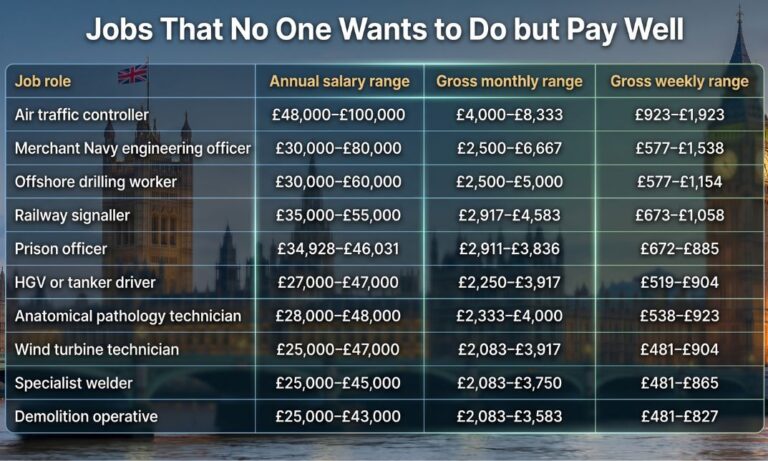
Air traffic control leads to typical earnings while railway signalling offers a clear path to higher salary grades. Wind turbine technicians also perform well, with median pay sitting slightly above the UK full-time benchmark. By comparison, HGV driving, welding and demolition fall below that level. Merchant Navy engineering and offshore drilling need a little more care, as the available figures use salary-range midpoints. These numbers support a broad comparison, but they do not show what the typical worker earns.
Why Can Difficult Jobs Pay More?
Difficult careers may pay more when employers struggle to recruit suitable workers. Yet danger forms only one part of the picture. Responsibility, scarcity and working patterns usually matter more.
- High responsibility: A small mistake could affect lives or disrupt an essential service.
- Rare skills: Only a limited number of people can do the work safely and well.
- Unsocial hours: Night shifts, weekends and public holidays put many applicants off.
- Tough conditions: Height, noise, bad weather and isolation can make the job harder.
- Retention pressure: Employers may offer better pay when skilled workers are difficult to replace.
Demolition proves why danger alone does not guarantee high pay. Despite its serious risks, the median salary is £27,597, which sits below typical UK full-time earnings.
The clearest point is that higher pay usually comes from a mix of responsibility, scarce skills, difficult hours and staff shortages. Risk may play a part, but it rarely explains the full salary.
Which Overlooked UK Jobs Offer the Highest Pay?
Before the salary catches your eye, look at what each role demands in return, from long hours to the pressure that puts many people off.
Air Traffic Controller
Air traffic controllers earn between £48,000 and £100,000, placing the role at the top of this list. That works out at roughly £4,000 to £8,333 in gross monthly pay. More importantly, the £74,044 median gives a clearer picture of established earnings. At larger airports, experienced controllers can earn more than £70,000. At the senior level, salaries may rise beyond £100,000.
Most controllers work 35 to 45 hours weekly. Their schedules cover days, nights and weekends. Airport size and operational responsibility also affect pay.
But after all that, why do people still avoid air traffic control?
The answer lies in the pressure. Controllers must keep aircraft safely separated while tracking changing weather, delays and traffic levels. Although some periods may seem quiet, the situation can become urgent within seconds.
That level of concentration can be mentally exhausting. Rotating shifts may disrupt sleep and family routines, while strict medical and security checks add further pressure.
So, the salary is not only the payment for technical knowledge. It reflects sharp judgement, steady focus and the responsibility of protecting thousands of passengers. Air traffic control pays well because the working day rarely feels easy.
Merchant Navy Engineering Officer
Merchant Navy engineering starts at nearly £30,000. Senior officers can move towards £80,000 as their rank grows. That gives a monthly range from £2,500 to £6,667. The range midpoint is £55,000, though this is not an official average.
Vessel type, voyage length and employer can change earnings. Chief engineers carry wider responsibility for machinery, repairs and technical teams. Their decisions can affect the whole ship.
Working hours vary because ship systems operate around the clock. Emergency repairs may also interrupt normal rest periods.
A useful tax detail often gets missed. Eligible seafarers may qualify for the Seafarers’ Earnings Deduction, but only when they meet strict HMRC rules. In most cases, that means building a qualifying period of at least 365 days. The relief can reduce taxable income. But it does not increase the salary itself.
Even then, the hardest cost may not appear on the payslip. Engineering officers can spend long stretches away from home, while engine rooms are often hot, loud and cramped.
For some workers, the higher salary makes the role worthwhile. For others, the time away from home outweighs the financial reward.
Offshore Drilling Worker
Offshore drilling offers yearly earnings of up to £60,000, with starting pay near £30,000. Yet its rotation pattern changes how that salary feels. Monthly earnings range from £2,500 to £5,000. The range midpoint is £45,000 but actual pay changes by role. Drillers and senior rig staff may earn more than derrickhands or entry-level workers. Greater responsibility for equipment and safety can raise earnings.
Shifts often last 10 to 12 hours. A common pattern involves two weeks offshore followed by two weeks away from the rig. Those working periods may include nights, weekends and public holidays.
The tax position also differs from that of qualifying maritime work. Offshore installations do not normally count as ships for Seafarers’ Earnings Deduction. Rig workers cannot assume they receive seafarer tax relief.
The toughest part often begins after the helicopter leaves. Workers spend long stretches in a loud, cramped setting, while rough weather can make an already demanding shift feel heavier.
The break between rotations may sound generous. Still, that time off comes after days of physical strain and long hours far from normal family life.
Railway Signaller
Railway signaller pay starts at around £35,000. Higher Network Rail grades can reach £59,391. The general monthly range sits between £2,917 and £4,583. However the grade structure tells a clearer story.
- Grade 2 pays £36,196
- Grade 3 reaches £40,465
- Grade 5 rises to £47,067
- Grade 7 pays £53,788 and
- Grade 9 reaches £59,391.
Higher grades usually control larger or more complex operating areas. More traffic and wider responsibility can bring higher pay.
New signallers receive Grade 2 pay during initial training. Workers joining a higher-grade post receive the full grade’s salary after gaining competence.
The working week normally lasts 42 to 46 hours. Shifts include evenings, weekends and public holidays.
The job can feel slow one moment and urgent the next. During quiet periods, signallers still need to stay fully focused. Then a fault, delay or safety issue may suddenly need a quick decision. Night shifts and working alone can also feel tiring. The higher pay rewards people who can stay alert, calm and ready, even when very little seems to be happening.
Prison Officer
Prison officer salaries range from £34,928 to £46,031. Yet hours and location decide the final figure. Trainees begin on 37-hour contracts. Qualified officers can choose 39 or 41 hours. Published figures already include a 20% unsocial-hours allowance. Inner London officers working 41 hours can reach £46,031. Some prisons also offer supplements from £1,500 to £3,500.
These payments arrive monthly. However, they do not form part of pensionable base pay. They may also change when recruitment improves. That means the highest figure is not a normal national starting salary.
Prison officers manage routines, safety and conflict. Their shifts cover nights, weekends and public holidays. Some situations involve angry or distressed people.
Most applicants avoid the emotional strain. Officers must stay calm when tensions rise, while also keeping firm boundaries without losing patience. Even with higher pay, the daily pressure of working in a secure environment never fully disappears.
HGV and Fuel Tanker Driver
HGV driving pays between £27,000 and £47,000. That equals £2,250 to £3,917 gross per month. The £37,320 median sits slightly below typical UK full-time earnings. Night shifts, long routes and specialist loads may lift total pay. Fuel tanker work can pay more in some vacancies. However, there is no fixed UK-wide tanker premium. Employers set their own rates.
Drivers usually work 38 to 52 hours weekly. Driving limits do not cover every duty. Vehicle checks, loading and waiting can extend the working day. Most covered drivers can drive for nine hours daily. This may rise to ten hours twice weekly. The normal weekly driving limit is 56 hours.
Many people avoid HGV work because the job can feel lonely and unpredictable. Nights away from home may mean sleeping in the cab, while traffic, delivery deadlines and long waits at depots can stretch the day. Safe parking and access to clean rest facilities can also become a daily problem. Long hours behind the wheel may affect sleep, fitness and family life.
Anatomical Pathology Technician
Anatomical pathology technicians can earn £28,000 to £48,000. However, NHS bands give a clearer view of early pay. Band 4 salaries run from £28,392 to £31,157 in England. That equals £14.52 to £15.93 per hour. Inner London Band 4 pay rises to £34,186–£37,389 after the local supplement. Location plays a major part in the final salary. Senior technicians may move into higher bands. Still, not every experienced worker reaches £48,000.
Most technicians work 37 to 42 hours weekly. Short-notice evenings or weekend duties may arise. The role supports pathologists during examinations after death. Technicians also manage samples, records and infection controls.
This career asks for more than technical skill. Technicians work closely with death, while also supporting families during deeply difficult moments. That emotional pressure can build over time. At the same time, every task demands care, accuracy and respect. The role suits people who can stay calm, focused and compassionate in situations many others would find hard to face.
Wind Turbine Technician
Wind turbine technicians start near £25,000 and may reach £47,000. Yet the £40,514 median shows stronger established pay. The annual range equals £2,083 to £3,917 per month. The median also sits slightly above typical UK full-time earnings. Pay may rise through technical responsibility, offshore duties or greater authorisation. Most technicians work 37 to 40 hours weekly. Some roles include emergency call-outs.
Why do people avoid becoming wind turbine technicians?
- Working at height: Wind turbine technicians may climb several times a day while carrying tools through narrow spaces.
- Strong weather: Wind, rain and cold can make repairs slower, harder and more tiring.
- Remote locations: Some sites require long journeys, early starts and time away from normal routines.
- Limited support: Help may not be close by when a problem happens at an isolated site.
- Rescue risk: If a technician becomes injured or unwell inside a turbine, bringing them down safely can take time.
Specialist Welder
Specialist welders are paid £25,000 to £45,000. However, the £32,125 median sits closer to normal earnings. That creates a £12,875 gap between central pay and the experienced ceiling. Monthly earnings range from £2,083 to £3,750. Pay fully depends on the process, material and industry. MIG, TIG, pipe, plate and coded welding can carry different rates.
Marine, nuclear and pressure-system work may follow stricter technical standards. These sectors may offer higher rates, but pay varies between employers and contracts. Welders usually work 40 to 46 hours weekly. Evening and weekend shifts may apply.
Underwater welding needs a clear warning. It is a commercial-diving specialism, not a normal welding job. Rare underwater earnings should never represent typical UK welder pay.
Many people avoid becoming a specialist welder because the work can be physically demanding and uncomfortable. Intense heat, welding fumes and heavy protective clothing can make long shifts exhausting, while some projects require working at height or inside tight, poorly ventilated spaces. These conditions explain why skilled welders can be hard to replace, especially in sectors where accuracy and safety standards remain high.
Demolition Operative
Demolition pay can reach £43,000. Yet its £27,597 median gives a far more cautious picture. The full salary range runs from £25,000 to £43,000. Monthly gross pay sits between £2,083 and £3,583. The median is only £2,597 above the starter figure. That gap shows why maximum salaries need careful reading.
Advanced plant work, supervision and specialist cutting can increase earnings. Most operatives work 40 to 44 hours weekly. The UK demolition sector includes more than 650 companies. These range from small regional firms to major contractors.
The salary may catch the eye, but the site conditions tell a harder story. Demolition operatives face dust, heavy noise and constant vibration throughout long shifts. Falling materials, hot metal and powerful machinery add serious risk, while bad weather and confined spaces make the work even tougher. That mix of danger and physical strain explains why many people avoid demolition work.
What Can Change an Advertised Salary?
A salary advert may combine several types of income. Identify how much pay remains guaranteed before comparing jobs.
- Experience: The highest figure usually goes to workers with several years of experience.
- Location: Jobs in London or remote areas may offer higher pay.
- Shift allowance: Night shifts, weekends and public holidays can increase total earnings.
- Overtime: Extra hours may boost your income but they are not always guaranteed.
- Grade or rank: Some careers have clear pay levels. So earnings rise as responsibility grows.
- Contract type: A higher day rate may look attractive but it could exclude holiday pay or pension benefits.
- Specialist work: Technical duties, extra licences or harder assignments can lead to better pay.
Some UK job adverts make the biggest possible salary hard to miss. The guaranteed basic pay often sits lower down in the smaller details.
Prison officer supplements highlight another issue. They can increase current earnings without raising pensionable base pay. Over time, this means the headline salary may contribute less towards retirement benefits than readers first expect.
Which Roles Genuinely Beat Typical UK Pay?
Air traffic control pays far more than most UK jobs. Its median salary is £74,044, compared with the UK full-time figure of £39,039. Wind turbine technicians also earn slightly more than the national benchmark, with a median salary of £40,514. Railway signallers can also pass £40,000, depending on their grade. Grade 3 pays £40,465, while Grade 9 reaches £59,391.
Prison officers may earn more than £40,000 too. However, this often depends on working longer hours, being based in London or receiving extra payments. HGV drivers earn a median salary of £37,320, while welders earn £32,125 and demolition operatives earn £27,597.
Merchant Navy engineers and offshore drilling workers do not have clear median salary figures in this comparison. Their salary ranges are still useful, but the middle figure should not be treated as an average. In the end, typical earnings give a more honest picture than the highest salary shown in a job advert.
What Should You Check in a Salary Advert?
A job advert rarely gives the full pay picture in one line. So, before deciding whether a role is worth applying for, check what the salary actually includes.
- Is the figure the basic salary or the highest possible pay?
- Does it already include night or weekend allowances?
- How many hours will you work each week?
- Is overtime guaranteed or only offered when needed?
- Does the role include extra London pay?
- Will any bonus or allowance count towards your pension?
- Do you need senior duties or years of experience to reach the top figure?
The hours can make a big difference. A £45,000 salary based on 52 hours a week may offer poor value for your time. Meanwhile, a £40,000 salary for 37 hours could give you better pay per hour and a healthier work-life balance.
It is also worth checking the experience level. In most job adverts, the highest salary is reserved for workers with several years of experience. Entry-level applicants will usually start closer to the lower end of the range.
Which Job Offers the Strongest Salary Value?
No career wins every comparison. The best choice depends on what the worker gives up for the salary.
- Highest overall pay: Air traffic controller
- Strongest maritime ceiling: Merchant Navy engineering officer
- Clearest salary ladder: Railway signaller
- Strongest green-sector median: Wind turbine technician
- Largest location effect: Prison officer
- Biggest maximum-pay warning: Demolition operative
Air traffic control offers the highest pay with fairly reasonable weekly hours. However the mental pressure can be intense.
Railway signalling gives workers a clear route through higher pay grades. Wind turbine maintenance also offers solid typical earnings, but working at height remains a major barrier for many people.
The highest-paying UK job is not always the best personal choice. Sleep, health, family time and daily stress matter just as much as the salary.
Are Jobs That No One Wants to Do but Pay Well Really Worth It?
Jobs that no one wants to do but pay well can look like an easy route to a higher income. In reality, the higher salary often comes with a trade-off. You may face long shifts, stressful decisions, dangerous settings or weeks away from home.
The strongest option depends on what you can handle. Air traffic control offers excellent pay but brings intense mental pressure. Railway signalling has a clear pay ladder while wind turbine work provides solid earnings for people who are comfortable with height and travel. Demolition work proves that a tough or risky job does not always bring the highest salary.
So, do not judge a role by the headline figure alone. Check the usual pay, weekly hours, overtime rules and benefits. A job is only worth it when the money matches the effect it may have on your health, routine and family life.
Frequently Asked Questions (FAQs)
What Is the Easiest Job That Pays Well?
- There is no truly easy job, but roles such as driving instructor, bookkeeper and IT support can offer good pay without heavy physical work. Still, the best choice depends on your skills and confidence.
Which Three Jobs Are Most Likely to Survive AI?
- Care work, skilled trades and emergency roles still depend heavily on human judgement, practical skill and trust. These roles still need human judgement, trust and hands-on work.
What Are the Highest-Paid Unskilled Jobs?
- Some HGV driving, construction, offshore and railway roles can pay well without a university degree. However, you may still need training, licences or safety checks.
How Can You Earn £70,000 a Year Without a Degree?
- Air traffic control, senior train driving, specialist sales and some technical contract roles can reach £70,000. Even so, this level usually takes experience, strong performance or extra responsibility.
What Jobs Pay £500 a Day?
- Specialist contractors in IT, engineering, medicine and construction may earn £500 a day. Yet this is often a day rate before tax, pension, holiday pay and other costs.
What Jobs Pay £50,000 a Year?
- Air traffic controllers, railway signallers, train drivers, sales managers and experienced tradespeople can reach £50,000. In most cases, higher pay comes after several years of experience.