
No products in the basket.
Easy jobs that pay well UK include train driving, bookkeeping, pensions administration, IT support and driving instruction. These roles can pay from about £20,000 to £65,000 a year. Most do not require a university degree. However, each job has a different kind of pressure. Some need accuracy while others require patience, customer care or strong concentration. This guide compares ten realistic options using current UK salary, training, licence and tax information. You will also see working hours, entry costs, take-home pay and the main drawback of each role. The best choice is not simply the highest salary. It is the job that matches how you prefer to work.
What Does an Easy Job Really Mean?
An easy job is usually one that suits your natural strengths. You may enjoy working with numbers but dislike difficult customer calls. Another person may prefer driving, fixing computers or working alone. The same role can therefore feel simple to one worker and exhausting to another.
A job may also feel easy in one area but difficult in another. Bookkeeping involves little physical effort but one wrong figure can cause problems. Security work may feel quiet at one site but officers still need to respond during an emergency. Train driving involves set routes and strict procedures but drivers must stay focused for long periods. So in this guide, easy means manageable for the right person rather than effortless for everyone.
What Makes Easy Jobs That Pay Well Manageable?
Easy jobs that pay well often have clear duties, repeated processes and limited physical effort. Some also give workers more control over their hours. However, employers rarely offer strong pay without some form of pressure. In many cases, that pressure comes from safety, accuracy, deadlines, customer conflict or changing income.
Before choosing a role, compare its physical effort, mental pressure, training time and entry difficulty. You should also check customer contact, safety responsibility, working hours and task structure.
How Do Easy Jobs That Pay Well Compare in 2026?
Bookkeeping and pensions administration rank highest for a steady daily routine. Both roles follow clear systems and involve little physical work. Train driving offers the highest salary in this guide. However, it ranks lower for day-to-day manageability due to strict safety rules and constant concentration.
The scores below reflect our comparison of working hours, routine, pressure and physical demands. They are not official government ratings. A higher score suggests the daily work may feel more predictable. However, every role can still feel challenging for the wrong person.
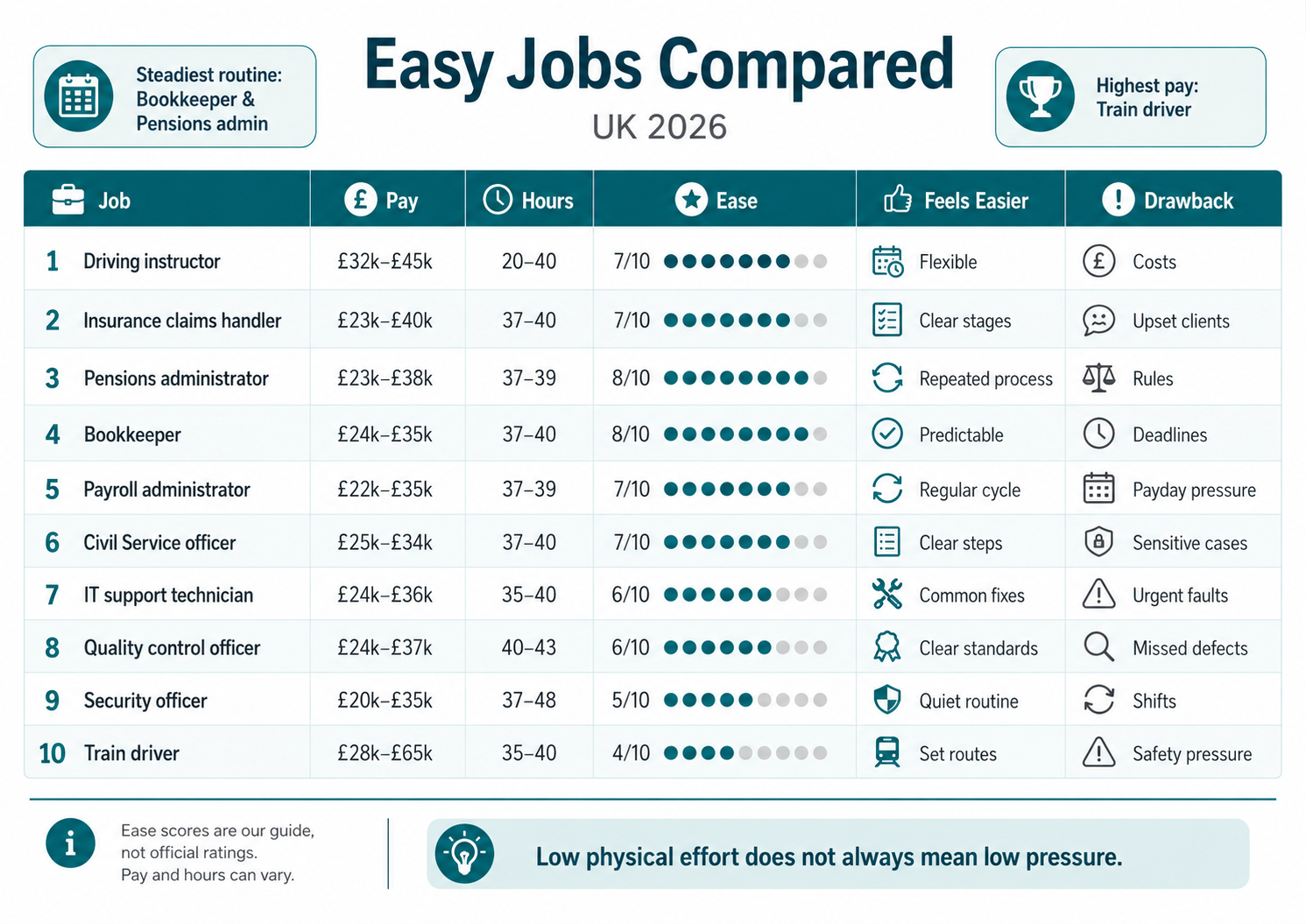
The National Careers Service provides the salary and working-hour ranges for these roles. However, actual pay can change by employer, location, experience and shift pattern.
The main point is that physical comfort does not always mean lower pressure. A desk job may involve strict deadlines and constant checking. In contrast, a quiet security role may become demanding within seconds. Therefore, compare the full working day rather than looking at physical effort alone.
What Is a Good UK Salary in 2026?
A good salary should cover your main living costs and leave some money for savings. The latest full-year ONS data shows that full-time workers earned a median salary of £39,039 in April 2025. That equals about £3,253 before tax each month. It is the most recent full annual figure available.
At the same time, the National Living Wage rose to £12.71 an hour on 1 April 2026. This pay rate covers workers who are 21 or older. Someone working 37.5 paid hours a week would earn about £24,785 a year. At 40 paid hours, the yearly amount would be around £26,437.
However, some workers may legally earn less than these yearly totals. They may work part-time, follow a younger worker rate or receive an apprenticeship rate. Unpaid breaks can also reduce the number of paid hours.
Before applying, check what the job advert actually shows. It may list an annual salary, hourly pay or possible self-employed turnover. You should also check paid hours, unpaid breaks, overtime rates, bonuses and shift allowances. These details often tell you more than the headline salary.
What Are the Best Easy Jobs That Pay Well in the UK?
None of these jobs is completely stress-free. However, each role has a feature that the right worker may find manageable. The following sections explain the pay, duties, entry route and main drawback for every option.
-
Driving Instructor
Driving instruction suits patient people who want more control over their working hours. Qualified instructors may earn between £32,000 and £45,000 a year. Most work around 20 to 40 hours each week. You usually teach one learner at a time and cover road safety, parking, junctions and test preparation. One major positive side is that you can select bookings based on your availability. However, evenings and weekends are often the busiest times.
How Can You Become a Driving Instructor in the UK?
To become a driving instructor in the UK, you must join the Approved Driving Instructor register. You normally need to be at least 21 and hold a full driving licence for three years. You must also pass eyesight, driving record and criminal record checks. The three official tests cost £303 in total. First registration costs £300 which brings the fixed government fees to £603. An optional trainee licence costs another £140. You must usually renew your registration every four years.
However, government fees are only part of the full cost. You may also need professional training, a suitable car, dual controls, insurance, fuel, repairs and marketing. Cancellations can reduce your monthly income as well. This career suits patient people who enjoy teaching and flexible work. It may not suit anyone who needs the same income every month.
-
Insurance Claims Handler
Insurance claims handling offers structured office work with salaries from £23,000 to £40,000. Most handlers work around 37 to 40 hours each week. They check policies, reports, photographs, invoices and other evidence. They may also speak with customers, repairers, doctors and legal teams. Routine claims often follow clear steps. However, serious or disputed cases can become stressful.
What Is the Best Route to Become an Insurance Claims Handler?
You can become an insurance claims handler in the UK through direct applications, customer service experience or an apprenticeship. A Level 3 Insurance Practitioner apprenticeship usually takes around 12 months and may include a claims-handling pathway. A Level 4 insurance apprenticeship can take around 24 months plus an assessment period. Employers often look for clear communication, attention to detail and the ability to stay calm with customers. Insurance companies must also follow FCA rules and handle claims fairly without unnecessary delays.
Some UK employers offer hybrid work, workplace pensions and performance bonuses. However, the benefits depend on the company and the role. Automation can process simple claims but people still need to review unusual evidence, possible fraud and disputed cases. This career suits calm communicators who can follow insurance rules while treating customers with care.
-
Pensions Administrator
Pensions administration suits people who prefer steady desk work and clear rules. Salaries usually range from £23,000 to £38,000 for around 37 to 39 hours a week. The role includes updating member records, processing contributions and preparing pension quotes. Administrators also handle transfers, retirement payments and written enquiries. The work often follows the same monthly cycle. Even so, every figure must be correct.
There are two common workplace pension types in the UK:
-
Defined contribution pension: Builds a personal retirement pot.
-
Defined benefit pension: Pays an income based on the scheme’s rules.
How Do You Start a Career as a Pensions Administrator?
You can start a career as a pensions administrator through direct applications, office experience, college study or an apprenticeship. Employers often look for strong numerical skills, attention to detail and clear written communication. Some companies may also pay for professional pension qualifications.
Pensions administrators must understand which pension system applies. However, they do not give personal financial advice. This job may suit you if you enjoy numbers, detailed records and clear procedures. The daily routine can feel calm and predictable. Still, pension rules can seem complex at first. One small mistake could affect someone’s retirement income. Careful checking is therefore one of the most important parts of the job.
-
Bookkeeper
Bookkeeping offers strong earning potential for a role that does not require a university degree. Bookkeepers usually earn between £24,000 and £35,000 a year while working around 37 to 40 hours each week. Their main tasks include recording invoices, payments, expenses, bank transactions and VAT details. They may also check accounting software and prepare records for an accountant or a tax return. Most duties follow a regular pattern. However, month-end and tax deadlines can make some weeks much busier.
What Do You Need to Become a Bookkeeper in the UK?
There is no single path into bookkeeping. You can start through direct employment, a college course or an apprenticeship. AAT study can also strengthen your skills and improve your job chances. Employers often value computerised accounting knowledge, accuracy and confidence with financial records.
Self-employed bookkeepers may need accounting software, professional insurance and anti-money laundering supervision. Where HMRC supervision applies, the one-off application fee is £300. A premises fee and other charges may also apply. For this reason, check the full cost before starting your own bookkeeping business.
Making Tax Digital may create more work for skilled bookkeepers. From April 2026, some sole traders and landlords must keep digital financial records. They must also use compatible software to send updates to HMRC. Bookkeepers can help clients organise these records and use the right systems. This makes digital accounting skills more valuable. Overall, the role suits careful people who enjoy working independently with clear financial records.
-
Payroll Administrator
Once the pay cycle feels familiar, payroll administration becomes easier to manage. Payroll administrators usually earn between £22,000 and £35,000 a year. Most work around 37 to 39 hours each week. They check working hours, calculate wages and process tax, National Insurance and pension deductions. They also prepare payslips and manage starters, leavers, overtime and statutory pay. The monthly cycle soon becomes familiar. Still, payday leaves no room for careless mistakes.
How to Become a Payroll Administrator in the UK?
You can become a payroll administrator in the UK through direct applications, office experience, college study or a Level 3 payroll apprenticeship. You do not need a personal payroll licence. However, employers usually look for strong numerical skills, accuracy and confidentiality. You also need to understand PAYE. This process ensures employers collect tax and National Insurance before paying employees.
UK employers usually submit a Full Payment Submission to HMRC on or before each payday. Most employers paying electronically must send their PAYE payment by the 22nd of the following tax month. Some smaller employers may receive permission to pay quarterly. Therefore, payroll administrators must understand UK payroll rules and meet strict HMRC deadlines.
This role suits calm and organised people who enjoy clear monthly routines. The biggest pressure comes when timesheets arrive late or incorrect details affect several employees. Payroll software handles much of the calculation work. Even so, a skilled administrator must check the figures and solve unusual cases. That mix of routine and responsibility makes payroll a strong choice for careful workers.
-
Civil Service Administrative Officer
A Civil Service administrative officer in the UK usually earns between £25,000 and £34,000 a year. Most officers work around 37 to 40 hours each week. Their daily duties often include checking applications, updating records and preparing letters. They may also answer public enquiries and process official documents. The workload depends on the government department. Some roles follow a calm routine while others involve sensitive or urgent cases.
What Is the Entry Route for a Civil Service Administrative Officer?
To become a Civil Service administrative officer in the UK, you can apply through direct recruitment, an apprenticeship or internal promotion. Some vacancies ask for GCSEs or similar qualifications. Others focus more on practical skills and work experience. The application process may include online tests, Civil Service behaviour examples and an interview. Certain roles also have nationality, residency or security rules. Therefore, always read the full job advert before applying.
Civil Service administrative officer jobs also offer strong workplace benefits. Annual leave usually starts at 25 days and may rise to 30 days after several years of service. The published employer pension contribution is 28.97%. These roles suit organised people who enjoy clear procedures, stable working hours and public-service work. They can also lead to higher Civil Service grades and better-paid management roles
-
IT Support Technician
IT support can pay well without a university degree. Technicians usually earn £24,000 to £36,000 while working about 35 to 40 hours a week. They solve problems with computers, accounts, printers, software and networks. They also manage support tickets and explain fixes to users. Common issues follow known steps but a major outage can create sudden pressure.
How Do You Become an IT Support Technician Without a Degree?
A university degree is not the only route into IT support. You can start through a college course, trainee job or apprenticeship. Popular UK options include the Digital Support Technician and Information Communications Technician apprenticeships. Training often takes around 15 to 18 months depending on the route. Vendor certificates can also improve your job chances but employers do not legally require them.
Technical knowledge is only part of the job. IT support technicians must also listen carefully and explain solutions in simple language. Some roles include evening shifts or on-call work. With experience, you can move into network support, cloud systems, cybersecurity or IT management.
-
Quality Control Officer
A quality control officer in the UK usually earns between £24,000 and £37,000 a year. Most work around 40 to 43 hours each week. Their job is to inspect products, test samples and record faults before items reach customers. They may also review production records and support workplace audits. These jobs are common in factories, laboratories, food production, pharmaceuticals and engineering. However, the checks and risks can change between industries.
What Qualifications Do You Need for a Quality Control Officer Job?
There is no single qualification for every quality control role. Some UK employers accept people with practical experience while others prefer a college course or technical background. A Level 4 Quality Practitioner apprenticeship is another strong route. It usually takes around 14 months and has a maximum funding band of £6,000. Employers in food, engineering or pharmaceuticals may also ask for industry knowledge. Strong observation skills and clear record-keeping can improve your job chances too.
Quality control focuses on finding faults in products or production batches. Quality assurance looks at the wider process and tries to stop those faults from happening again. Most checks follow clear steps which can make the daily work feel steady. Still, missing a serious defect may cause safety problems or cost the company money. Cameras and software can spot simple faults but people still need to investigate the cause and approve the solution. This role suits careful workers who notice small details and take pride in getting things right.
-
Security Officer
A security officer in the UK usually earns between £20,000 and £35,000 a year. Most officers work around 37 to 48 hours each week. Their main duties include patrolling buildings, checking visitors, watching CCTV and responding to alarms. The daily routine depends on the workplace. A quiet office may feel calm while a hospital or shopping centre can become much busier.
How Can You Become a Licensed Security Officer in the UK?
To work in most contracted frontline security roles, you need a licence from the Security Industry Authority or SIA. You must complete an approved security qualification and pass identity, right-to-work and criminal record checks. From 1 April 2026, the SIA licence fee is £204. Most licences last for three years. Security guards and door supervisors may also need refresher training and suitable first-aid training when they renew.
The biggest challenge is often the shift pattern. Long hours, night work and sudden incidents are common in some roles. Quiet daytime jobs can also attract more applicants. Even so, security work may suit people who stay alert, follow clear rules and remain calm during conflict. It can be a practical route for UK jobseekers who want short training and a direct path into paid work.
-
Train Driver
A train driver in the UK can earn between £28,000 and £65,000 a year. Most drivers work around 35 to 40 hours each week. Their main duties include checking the train, following signals and controlling speed. They also report faults and respond to unusual situations. The routes follow strict rules. However, drivers must stay fully focused because passenger safety depends on every decision.
What Is the Process for Becoming a Train Driver in the UK?
UK train operators usually recruit and train new drivers themselves. Training often takes around 12 to 18 months. It includes classroom lessons, route knowledge and supervised driving. Applicants must also pass concentration tests, medical checks and a psychological assessment. From 30 June 2026, the minimum age for a domestic train-driving licence in Great Britain fell from 20 to 18. However, drivers under 20 cannot operate in the British Channel Tunnel zone.
A train-driving licence from the Office of Rail and Road can remain valid for up to ten years. Drivers must continue meeting the required medical and professional standards. Be careful with private courses that promise a guaranteed train driver job because operators control their own recruitment. This career suits people who can work shifts, stay calm and maintain strong concentration for long periods.
How Much Could You Take Home After Tax?
Take-home pay depends on your tax code, pension, student loan and other deductions. The estimates below use 2026/27 Income Tax and employee National Insurance rules for England, Wales and Northern Ireland. They assume a standard Personal Allowance with no pension contribution or student loan. Scotland uses different Income Tax bands.
-
£25,000 salary: Around £1,793 a month after tax.
-
Earning £30,000: Monthly take-home pay is about £2,093.
-
At £35,000 a year: Expect roughly £2,393 each month.
-
For a £40,000 salary: Net monthly pay is close to £2,693.
-
Once earnings reach £45,000: Take-home pay rises to around £2,993 a month.
-
On £65,000 annually: Monthly income after tax is about £4,021.
The standard UK Personal Allowance is £12,570 for the 2026/27 tax year. Employee National Insurance is normally 8% within the main earnings band and 2% above the upper limit. These take-home pay estimates give UK workers a useful guide. However, the final amount can change based on tax code, pension payments, bonuses, workplace benefits and student loan deductions.
How Does Location Affect the Real Value of Pay?
The same salary can feel very different depending on where you live. ONS payroll data for May 2026 showed median monthly pay of about £2,279 on the Isle of Wight. In Wandsworth, the figure was around £3,984 while London recorded about £3,082 overall. These numbers cover all payrolled jobs rather than only the careers in this guide.
However, a higher salary does not always leave more money in your pocket. A £35,000 job in London may leave less spare income than a £30,000 role in a cheaper area. Rent and travel costs often take a much larger share of earnings in major cities.
Other costs also matter. Childcare, council tax and local transport can quickly reduce take-home pay. Employer size and local staff shortages may also affect the salary offered. For this reason, compare each job with your real monthly costs rather than judging the headline figure alone.
Which UK Career Suits You Best?
The best career is the one that matches your skills and preferred way of working. Some people value flexibility while others prefer routine, stability or higher pay.
-
For flexible working: Driving instruction gives you more control over bookings. However, monthly income can change.
-
If you enjoy calm number work: Pensions administration follows clear systems. Still, the rules can feel complex.
-
For independent tasks: Bookkeeping offers steady work with less supervision. Tax deadlines can make some periods busy.
-
If you prefer a regular cycle: Payroll follows clear monthly steps. Even so, one mistake can affect many employees.
-
For strong communicators: Claims handling involves regular customer contact. Some conversations may become difficult or emotional.
-
If workplace benefits matter: Civil Service roles offer strong pensions and annual leave. Certain cases can still feel sensitive.
-
For technical career growth: IT support can lead to better-paid technology roles. Urgent faults may create sudden pressure.
-
If you notice small details: Quality control follows clear checks and standards. Missing a fault can cause serious problems.
-
For a short formal entry route: Security work can be easier to enter. Long shifts and night work remain common.
-
If salary is the main goal: Train driving pays the most in this guide. However, it demands constant concentration and serious responsibility.
Think about the working pressure you handle best. That will often tell you more than the salary alone.
What Should You Check Before Applying?
A strong salary does not always mean a good job offer. Before applying, check the full package and the real working conditions.
-
Paid working hours: Check how many hours you will actually get paid for each week.
-
Unpaid breaks: Find out whether lunch or rest breaks reduce your total pay.
-
Training costs: Ask who pays for courses, exams and required certificates.
-
Licence fees: Check the first application cost and future renewal fees.
-
Equipment expenses: Some roles may require a car, uniform, software or specialist tools.
-
Salary or turnover: Self-employed adverts may show total income before business costs.
-
Shift patterns: Review night work, weekend duties and bank holiday hours.
-
Overtime pay: Confirm the rate and whether extra hours are guaranteed.
-
Travel costs: Consider fuel, train fares, parking and daily travel time.
-
Entry checks: Look for nationality, residency, medical and background requirements.
-
Workplace benefits: Compare pensions, annual leave, sick pay and bonuses.
-
Hybrid working: Make sure any home-working agreement appears in the contract.
-
Career growth: Ask what progression may look like after one, three and five years.
The best offer is not always the one with the highest salary. A lower-paying role may provide better hours, stronger benefits and lower personal costs.
What Are the Key Facts About Easy Jobs That Pay Well UK?
-
Train driving offers the highest salary range.
-
Bookkeeping and pensions offer predictable routines.
-
Driving instruction gives workers more control over bookings.
-
Security has one of the shortest formal entry routes.
-
Civil Service roles provide strong published benefits.
-
The best choice depends on the pressure you handle well.
Final Thoughts: Are Easy Jobs That Pay Well Really Easy?
Easy jobs that pay well usually feel easier when the work matches your strengths. Bookkeeping may suit someone who enjoys numbers and careful checking. Driving instruction may work better for a patient teacher. Claims handling suits calm communicators while IT support fits practical problem-solvers. Train driving offers the highest pay in this guide but it also carries the greatest responsibility.
So do not choose a career based on salary alone. Compare the entry costs, working hours, daily duties and future opportunities. Also think about the type of pressure you can handle each day. The best job is not the one that sounds easiest. It is the one you can do well without feeling tired or stressed all the time.
FAQs
What Is the Easiest Job That Pays the Most in the UK?
- Train driving is one of the highest-paying jobs without a university degree. Experienced train drivers can earn up to £65,000 a year. However, the role requires strong focus and carries serious safety duties.
Which Easy Job Has the Lowest Stress?
- Bookkeeping and pension administration may feel less stressful for careful people. Both roles offer clear routines and little physical work. However, deadlines, rules and accuracy can still create pressure.
Which Easy Jobs That Pay Well Do Not Require a Degree?
- Many well-paid UK jobs do not require a university degree. Options include train driver, driving instructor, security officer, bookkeeper, payroll administrator and IT support technician. Some roles still require training, licences or background checks.
Which Job Has the Shortest Entry Route?
- Security work has one of the shortest formal entry routes. Most frontline roles require approved training and an SIA licence. Applicants must also pass identity, right-to-work and criminal record checks.
Which Easy Job Offers the Most Flexible Hours?
- Driving instructors often have the most control over their working hours. They can manage lesson times and choose how many bookings to accept. However, evenings and weekends are usually the busiest periods.
What Easy Office Jobs Pay Well in the UK?
- Good office-based options include insurance claims handling, pensions administration, bookkeeping and payroll administration. Experienced workers may earn between £35,000 and £40,000, depending on the role, employer and location.
Can You Earn More Than £50,000 Without a Degree in the UK?
- Yes. Train drivers, experienced IT professionals and some self-employed driving instructors can earn more than £50,000. However, higher earnings usually require experience, specialist skills or long working hours.
Are Easy Jobs That Pay Well Really Easy?
- No job feels easy for everyone. A role may feel manageable when it matches your skills, personality and preferred working style. Always compare the duties, hours, pressure and entry costs before applying.