
No products in the basket.
Every person deserves to stay safe while working in the UK. Employers must look for dangers to protect their staff from harm. Therefore, understanding risk assessment and COSHH is essential for every business. These two processes work together to prevent accidents and health problems. These safety tools help reduce the high number of workplace illnesses. In fact, statistics show thousands of UK employees get sick annually.
Moreover, many people have questions about how these safety rules work. This blog post answers common questions people search for online. We want to help both workers and bosses stay healthy daily. Please read on to learn more about keeping your workplace safe.
What Is Risk Assessment and COSHH in the Workplace?
A risk assessment is a simple check of your work area. It looks for things that could hurt people while they work. For example, a wet floor is a hazard to be managed.
On the other hand, COSHH is a specific set of rules. It stands for Control of Substances Hazardous to Health in the UK. This law focuses on chemicals or materials that make people sick. Both tools help reduce workplace harm by identifying dangers before they strike.
UK businesses must understand both terms to follow the law properly. Moreover, they ensure that every worker returns home safely after their shift. By using these tools, companies create a much better work environment.
What does a risk assessment involve?
Firstly, you must identify hazards that exist in the building. You should look for anything that could cause a bad accident. Secondly, you must decide who may be harmed and how. This includes staff, visitors, and even people passing by the site.
Next, you need to evaluate the risks and control measures. You should ask if the danger can be removed entirely. After that, you must record your findings in a written document. Finally, you should review your assessment regularly to stay updated.
What is covered under COSHH?
COSHH covers many things that you might see every day. For instance, cleaning chemicals used in kitchens are included. Dangerous fumes from engines or heaters are also included here.
Additionally, fine dust from wood or stone is very hazardous. Vapours from glue or paint are also covered by these rules. Even biological agents like bacteria or viruses fall under COSHH. Employers must manage all these items to keep the air clean.
Why Are Risk Assessment and COSHH Important for UK Employers?
UK health and safety law requires employers to follow these rules. Legal compliance is not optional for any business in this country. Consequently, doing a risk evaluation and a COSHH review is a legal duty.
These steps protect staff, visitors, and contractors from getting hurt. When a workplace is safe, people feel much more comfortable. Furthermore, it helps the business avoid very high costs from accidents. Investing in safety is always cheaper than paying for a mistake.
Moreover, fewer accidents lead to a much better workplace culture. Employees feel valued when their boss cares about their physical health. This builds trust and makes the team work better together.
What can happen if employers ignore COSHH requirements?
If a boss ignores the law, they may face legal penalties. These fines can be very expensive for a small business. Additionally, employees might suffer from long-term illness or painful injury.
Reputational damage is another big problem for many UK companies. People do not want to work for a dangerous business. Lastly, major accidents cause a lot of business disruption and stress. It is much better to follow the rules from the start.
Who Is Responsible for Carrying Out a Risk Assessment?
The primary accountability for health and safety belongs with the employer. They must ensure the workplace is safe for every single person. However, they can ask managers or supervisors to help them.
Sometimes, they hire a “competent person” to do the inspection. This is someone with special training in finding workplace dangers. Furthermore, employees also have responsibilities to stay safe at work. They must follow safety procedures and use the equipment provided.
Do small businesses need risk assessments?
Yes, every business in the UK needs to assess risks. Size does not remove the legal duty of care you owe. However, if you have fewer than five staff, it is different. You do not need to write the assessment down officially.
Even so, it is still smart to keep a written record. This proves that you are taking safety seriously for your team. Every worker deserves protection, no matter how small the company is.
When Is a COSHH Assessment Needed?
You need a COSHH assessment when hazardous substances are present. This includes when you use, store, or handle these materials. Moreover, you must consider how you dispose of waste items.
Common UK industries like cleaning or construction often need these. If a substance has a warning label, it needs a check. Therefore, performing a risk assessment alongside a COSHH review is essential for safety. Do not wait for an accident to happen before checking.
Which substances require a COSHH assessment?
Cleaning chemicals are very common and need a proper assessment. Paints and solvents used in decorating are also quite dangerous. Furthermore, dust from construction or woodwork can hurt your lungs.
Fumes from welding metals are another thing to watch out for. Hazardous biological materials in hospitals also require very strict controls. Even common items like bleach can be harmful if used incorrectly.
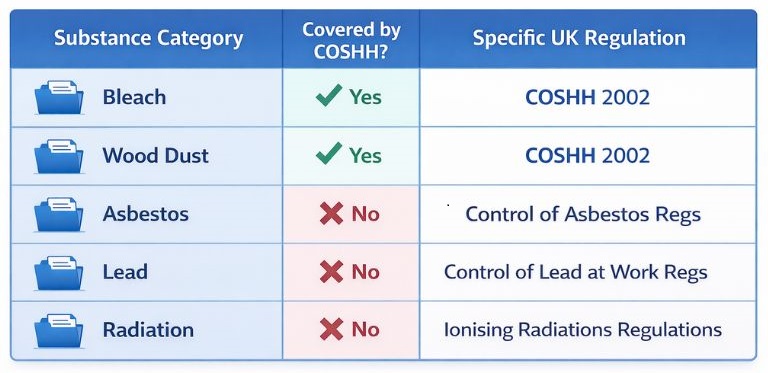
What Substances are NOT Covered by COSHH?
The “UK Gap” describes items not covered by standard COSHH. For example, lead and asbestos have their own specific UK regulations. These materials are so dangerous that they need much stricter rules.
Radioactive substances also fall under different legal safety guidelines in Britain. Therefore, you must look for specific laws for these three things. COSHH covers many items, but it does not cover everything.
How Do You Carry Out a Risk Assessment for Hazardous Substances?
You can follow a simple step-by-step guide to stay safe. First, you must identify all hazardous substances in your workplace. Secondly, you should review the safety data sheets for each item.
These sheets tell you exactly how to handle the chemical. Next, you must assess the exposure risks for your staff. You should ask how the chemical might enter the body. After that, you must decide on suitable controls to reduce danger. Finally, you should record findings and train your entire staff. Always monitor the situation and review the plan every year. This keeps the risk assessment and COSHH process fresh and useful.
What control measures should be considered?
Firstly, try to eliminate or substitute the dangerous chemical. Use a safer product if one is available in shops. Secondly, use ventilation to pull dirty air out of the room.
Furthermore, you should provide PPE like gloves or face masks. Safe storage in locked cupboards is also a very beneficial idea. Moreover, hygiene controls like hand-washing stations are very advantageous for staff. Lastly, regular staff training ensures everyone knows the safety rules.
What Is the Difference Between a General Risk Assessment and a COSHH Assessment?
A general risk assessment covers wider workplace hazards like trips. It also looks at ladders, electricity, and heavy-lifting tasks. However, a COSHH assessment focuses specifically on hazardous substances and chemicals.
Both are needed to keep a UK workplace fully safe. You cannot ignore it and only do the other one. Therefore, performing a risk evaluation along with a COSHH review is a double win. One keeps the floor safe, while the other protects your lungs.
Can one assessment cover both?
Occasionally, these two assessments can overlap in a single report. For example, a small cleaning company might combine their safety checks. However, separate detail is often necessary for very dangerous chemicals.
Using a separate COSHH form makes the details much clearer. It helps workers find the specific chemical safety info they need. Detailed notes prevent confusion during a busy day at work.
How Often Should Risk Assessments and COSHH Assessments Be Reviewed?
You should review your assessments at least once every year. This ensures that the information is still correct and helpful. However, you should verify them sooner if things change significantly.
Moreover, regularly scheduled reviews help you spot new potential dangers. It is a beneficial habit for any successful UK manager. Therefore, keep your risk assessment and COSHH papers in a folder. Check them often to make sure your team is safe.
What triggers an immediate review?
A workplace accident is a major sign that you need a review. If someone sustains injuries, your current plan may be ineffective. Secondly, you must review if you introduce new chemicals.
New tasks or equipment also require a fresh safety check. Furthermore, updated legislation or government guidance means you must change. Always stay informed about new safety laws in the UK.
How to Conduct an Effective Risk Assessment and COSHH Review?
Step 1: Walk the Floor
You should walk around the workplace to see everything. Identify all substances in use, including cleaning products and waste. Please remember to check the cupboards and storage sheds. Sometimes, old chemicals hide in corners and cause hidden dangers.
Step 2: Check Safety Data Sheets (SDS)
You must read the Safety Data Sheets for every product. These sheets come from the person who made the chemical. However, they are not a replacement for a risk assessment. You must still decide how your team will use them.
Step 3: Evaluate Exposure
You need to think about who is exposed to chemicals. Ask yourself how often they use the dangerous substance daily. Consider how long they stay near the hazardous material, too. This helps you understand the real level of danger present.
Step 4: Implementing Controls
You should follow the “Hierarchy of Control” for the best safety. Firstly, try elimination or substitution to remove the biggest risks. Next, use engineering controls like fans or protective glass shields. Finally, provide PPE like goggles if there is still danger.
Step 5: Documenting and Reviewing
You must update your assessment when a process changes significantly. Recording your safety steps proves that you care about staff. Keep these documents where workers can read them easily. This creates a culture of safety for every single employee.
What Are the Common Mistakes Businesses Make with COSHH?
Many businesses use outdated safety data sheets by total mistake. They forget that manufacturers change their chemical formulas quite often. Additionally, failing to train employees is a very big error.
If staff do not know the rules, they cannot follow them. Furthermore, not documenting findings properly can lead to legal trouble. Some bosses also ignore long-term exposure risks like breathing dust. They only worry about immediate accidents like spills or fires.
Lastly, relying too heavily on PPE is a common mistake. PPE ought to serve as the final safeguard, not the primary one. Therefore, doing a proper risk assessment and COSHH check is vital. It helps you see the whole picture of safety.
How can employers avoid these mistakes?
Bosses should conduct regular audits of their safety equipment. They must keep records updated whenever a new product arrives. Moreover, they should train staff consistently throughout the whole year.
Reviewing controls often ensures that the fans and masks work. Asking workers for their feedback is also a great idea. They often know the dangers better than anyone else does.
What Industries in the UK Need Risk Assessment and COSHH the Most?
The construction industry needs these tools because of heavy dust. Manufacturing plants use many chemicals that can be very dangerous. Furthermore, cleaning companies handle strong liquids every single morning.
Healthcare workers confront biological risks like germs and blood. Warehousing involves moving many different types of packaged goods safely. Hospitality and kitchens use heat and strong soaps every day. Even beauty and hair salons use dyes that can irritate skin.
Are office environments included?
Yes, even low-risk offices must obey these safety rules. They use cleaning agents to keep the desks very tidy. Printer chemicals and maintenance products are also hazardous if handled incorrectly. Every workplace has some risks that need a quick inspection. Occupational health matters in a big office just like in a factory.
What Documents Should Be Included in a COSHH Safety Process?
You should have COSHH assessment forms for every chemical used. Safety data sheets must be kept in a reachable file. Furthermore, training records indicate that you taught your staff well.
Incident reports help you learn from past mistakes or near-misses. You should also keep PPE records for masks and gloves. If needed, health surveillance records help monitor the staff’s breathing. Having all this paperwork ready makes inspections much easier.
How Can Businesses Improve Compliance with Risk Assessment and COSHH?
Appoint a competent person to lead the safety efforts. Use clear procedures that are very easy for everyone. Furthermore, train all staff in their own native language.
Keep documentation accessible so anyone can read it at work. Carry out periodic reviews to stay ahead of any problems. Some companies use digital systems to track their safety tasks. This makes the risk assessment and the COSHH process much faster.
Conclusion
Every UK workplace must carry out a risk assessment and COSHH verification. These steps keep workers safe from dangerous chemicals and accidents. Please remember to update your records and train your staff.
Proper safety planning prevents injuries and keeps your business running. If you want to learn more about hazard safety, check our ‘What is COSHH?’ blog. Staying informed is the best way to protect your team today.
Frequently Asked Questions (FAQs)
1. Does COSHH require risk assessments?
- Yes, employers must carry out risk assessments under the Control of Substances Hazardous to Health Regulations 2002 to identify and control hazardous substances.
2. What are the 5 steps of COSHH risk assessment?
- The five steps are identifying hazards, assessing risks, controlling exposure, recording findings, and reviewing the assessment.
3. What are the 5 P’s of risk assessment?
- The 5 P’s are people, premises, processes, products, and procedures.
4. What are the 4 types of risk assessment?
- The four types are qualitative risk assessment, quantitative risk assessment, generic risk assessment, and site-specific risk assessment.
5. How often should a COSHH risk assessment be done?
- A COSHH risk assessment should be reviewed regularly and whenever processes, substances, or workplace conditions change.
6. What are the 5 main steps of a risk assessment?
- The five main steps are identifying hazards, deciding who may be harmed, evaluating risks, recording results, and reviewing controls.
7. What are the 10 golden rules for COSHH?
- The rules include identifying hazards, using controls, wearing PPE, storing chemicals safely, training staff, monitoring exposure, and reviewing safety measures.
8. Are you legally required to have a risk assessment?
- Yes, UK employers are legally required to carry out workplace risk assessments under health and safety law.