
No products in the basket.
Have you ever wondered about the rules for dangerous materials? Specifically, you might have heard of a law called COSHH. Many people ask a very important question. Is lead covered by COSHH? Today, we will find the answer together. We will look at why lead is special. Furthermore, we will see how workers stay safe from it.
To start with, lead is a type of heavy metal. People used it for thousands of years. For instance, the ancient Romans used it for their water pipes. It is very soft and easy to shape. Consequently, you can find it in old water pipes today. Builders also used it in old house paint. However, lead is actually quite covert. It is a hazard because it can hurt our bodies.
Now, let’s dive into the legal details to find out if COSHH covers lead and how these safety rules protect you at work.
Is it COSHH or Something Else?
Now we must answer the big question. Is lead covered under COSHH? The answer is somewhat surprising. Usually, COSHH covers most harmful things at work. But lead is different. Lead is so dangerous that it has its own law. This law is called CLAW.
CLAW stands for the Control of Lead at Work Regulations. The UK government made these special rules. They wanted to make sure workers have extra protection. So, while lead is a hazardous substance, COSHH is not its main rule. Instead, CLAW takes the lead here.
Imagine you have a big box of toys. COSHH is the rule for the whole box. But lead is like a very soft glass toy. Therefore, it needs its own special padded box. That special box is the CLAW law. It makes sure the lead gets the most attention. This keeps everyone much safer at work.
Understanding COSHH vs. CLAW
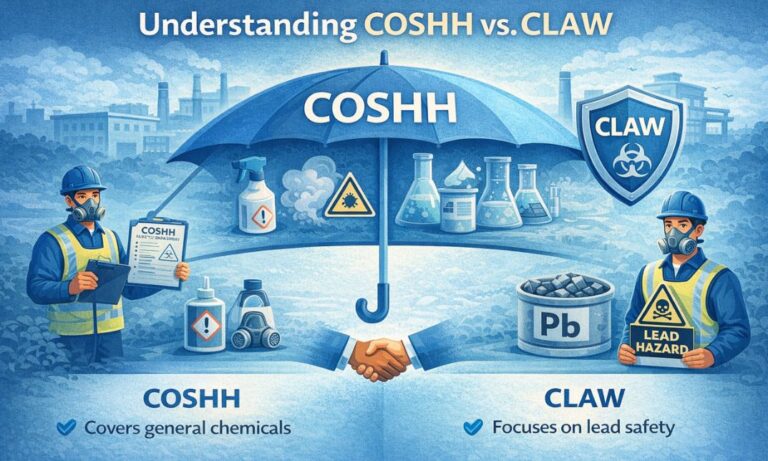
You can think of COSHH as a big umbrella. It covers things like bleach and dust. It also covers fumes and many chemicals. Most chemicals at work fall under COSHH. It helps companies keep their teams healthy. For example, it tells them how to store things. It also tells them how to clean up spills.
On the other hand, CLAW is like a dedicated bodyguard just for the lead. It focuses only on lead safety. Both laws have the same goal. Specifically, they want to stop people from getting sick. They work like two players on the same team. COSHH handles the general stuff. Meanwhile, CLAW handles the heavy metal risks.
If you work with lead, you follow CLAW. However, if you work with glue, you follow COSHH. Sometimes a job uses both things. Then you must follow both sets of rules. This might sound like a lot of work. But it is the best way to stay healthy.
Is Lead Covered by COSHH?
Many people assume that all dangerous workplace chemicals fall under one law. Consequently, they often ask the same question. Is lead covered by COSHH? Specifically, the simple answer is no. While lead is a hazardous substance, it is too dangerous for general rules. Therefore, the UK government created a unique law just for this metal.
This special law is the Control of Lead at Work Regulations. Most people call it CLAW for short. Furthermore, CLAW has stricter rules than the standard COSHH laws. For instance, it requires special medical tests and air monitoring. Alternatively, COSHH handles things like bleach or wood dust. By keeping lead separate, the law ensures that workers get the highest protection. In summary, lead is not covered by COSHH because it needs its own dedicated safety plan.
Where Do We Find Lead Today?
Lead is not as common as it used to be. But it is still around us. For example, you might find it in very old buildings. Old window frames often have lead paint on them. This paint is often hidden under new paint. When people fix old houses, they find it.
Some people work with lead every day. This includes people who make stained glass windows. Think of the pretty windows in old churches. Those windows use lead to hold the glass. Additionally, it includes workers who recycle car batteries. These batteries have lots of lead inside them.
Even some hobbies use lead. For example, some people use lead solder to join wires. You might do this in a school club. You must be very careful with these tasks. Always ask a teacher for help with soldering. They will show you how to be safe.
Case Study: The Old School Project
A builder named Tom worked on an old school. He had to sand the doors. However, he did not know the paint had lead. Tom did not wear a mask. He did not wash his hands well. Soon, Tom felt very tired and sick. He did not follow the CLAW rules. He did not check the paint first. This shows why checking for lead is vital. Tom learned a very hard lesson that day.
How to Stop the Dust?
How do we keep lead away from people? The best way is to use something else. This is called using an alternative. Many painters now use lead-free paint. It is much safer for everyone. Most shops do not even sell lead paint now.
If you must use lead, keep it clean. Workers use wet methods to stop dust. For example, they spray water on the lead. This keeps the dust from flying away. Wet dust stays on the floor. Therefore, it does not go into your lungs. This is a very smart trick.
Workers also wear PPE. This includes special masks and gloves. They also wear blue suits called coveralls. These suits stop lead from getting on their skin. They leave the suits at work. They never take them home to wash. As a result, this keeps their families safe from lead dust.
Hygiene: The Most Important Rule
Hygiene is the best way to stay safe. Workers follow the hand-to-mouth rule. They never eat near lead work. They never smoke or drink there either. Lead dust can land on your food. If you eat it, you get sick.
Before lunch, workers must wash up. They scrub their hands and faces. They use plenty of soap and warm water. Furthermore, they change their clothes before going home. This stops them from taking the lead for their families. Cleanliness is the best shield against lead.
Case Study: Sarah the Glass Artist
Sarah makes beautiful glass art. She uses lead strips every day. Sarah always wears gloves while she works. She washes her hands three times before eating. She has a special sink just for work. Because she is careful, Sarah stays very healthy. She follows the CLAW safety tips perfectly. Her blood tests always come back clear.
What Does the Law Say?
The law is very clear about lead. Employers must provide the right training. They must show workers how to be safe. Furthermore, they must give workers the best safety gear. They cannot charge workers for this kit. It is their legal duty to pay.
Workers have a job too. They must follow all the safety rules. They must wear their masks and suits. If they see a risk, they must tell someone. They should not hide mistakes. Instead, safety is a team effort for everyone.
The government sends inspectors to check on jobs. These inspectors make sure people follow CLAW. If a boss breaks the rules, they get in trouble. For example, they might have to pay a big fine. This keeps the workplace fair and safe.
Why Lead is Special Under the Law
One might still wonder why lead is kept separate from COSHH. This is mainly because lead is a heavy metal that behaves very differently from a standard cleaning spray. Unlike many chemicals, it stays trapped in your body for decades. Furthermore, it can cause serious, long-term harm to both your brain and your blood.
The UK government decided lead needed a bigger spotlight. By giving lead its own law, it gets more care. Doctors get involved more often with lead. There are specific limits for lead in the air. These limits are much stricter than for other things.
If lead were only in COSHH, people might forget it. They might treat it like normal dust. But lead is not normal dust. It is a toxic metal. CLAW makes sure no one forgets that. It keeps the focus on the real danger.
The Science of Lead: Why Is It So Heavy?
Lead is a very dense metal. This means the tiny atoms inside it are packed very tightly. If you pick up a small piece of lead, it feels heavy. For this reason, people used it for weights for a long time. It sinks quickly in water.
But this density is why it is hard to get rid of it. When lead enters your blood, your body gets confused. It thinks the lead is calcium. Your body loves calcium because it builds strong bones. So, your body sucks up the lead and hides it in your skeleton.
This is a big problem. The lead can stay there for thirty years! It sits in your bones like a hidden treasure that nobody wants. If you get sick, the lead can leak back out. This is why we have the CLAW rules. We stop lead from getting into your bone bank.
The Different Types of Lead Work
Not all lead work is the same. Some jobs are significant, and some are not.
- Significant Work: This is when you are sanding or melting lead. It creates lots of dust and fumes. Therefore, this work always needs a full CLAW plan.
- Non-Significant Work: This might be picking up a piece of lead with gloves. It does not create dust. You still need to be careful, but the rules are simpler.
Even if the work is small, you still must think about safety. You should never be casual with lead. Over time, it just takes a small amount to become problematic.
Lead in the Environment
Lead does not just stay in factories. If we are not careful, it gets into the soil. Long ago, many toys were painted with lead paint. If a baby chewed on a toy, they could get sick. Today, the law says toys must be lead-free. This is part of why we have strict rules for waste. If a builder takes down a lead roof, they recycle it. They take it to a special recycling place.
Recycling lead is actually a good thing. We can melt it down and use it again. For example, we use it for things like hospital X-ray rooms. This keeps the lead in a safe place. It cannot hurt the environment there.
Fun Facts & COSHH Trivia
- Exploding Flour: Did you know that flour is flammable? Indeed, if a lot of flour dust is in the air, a single spark can cause an explosion!
- Victorian Times: Long ago, people used lead in face paint. It made them look pale, but it also made them very sick over time.
- Wet Work: Even plain water can be a hazard. For instance, if a hairdresser has wet hands all day, their skin can break down.
- The 2002 Law: The COSHH rules we use now were made in 2002. Since then, they have saved thousands of people from getting sick at work.
- Leaded Petrol: Did you know lead was once used in petrol? It came out of the car exhausts and into the air. Governments banned it years ago to make our cities cleaner.
- The First Plumbers: The Latin term ‘plumbum’, which means ‘lead’, is where the word ‘plumber’ originates. This is because original plumbers worked almost exclusively with lead pipes.
How to Identify Lead in Your Daily Life?
You can spot lead if you know where to look. It is often hidden in plain sight within older buildings and objects. Here are the three most common ways to identify it:
- Check the Paint: Old paint often cracks in a square pattern. People call this alligatoring because it looks like the scales on a reptile. If you see this pattern on a wall or door, stay away from it. Most importantly, do not scratch it or lick it, as this creates dangerous dust.
- Look at the Roof: You might see lead on the roofs of churches or very old houses. It looks like a dull grey sheet of metal. It is very good at keeping the rain out. As long as the lead stays on the roof, it is safe. However, the danger starts when someone cuts or sands it, which releases fumes.
- Inspect the Pipes: If you live in a very old house, look at the plumbing. Lead pipes have a soft, dull grey colour. Consequently, you can often scratch them easily with a coin. If you think your pipes are lead, tell an adult immediately so they can get the water tested.
Final Thoughts on COSHH Safety
In conclusion, we have learned a lot today. So, is lead covered by COSHH? Not really. It has its own special law called CLAW. This law keeps workers safe from lead dust. Lead is dangerous, but we can manage it. Always remember to check the labels on your tools. Read the safety sheets before you start. Use wet cleaning and wear your mask. Wash your hands before you eat your snacks. Following the rules will keep you safe.
Lead is a part of our history. But we must be smart about its future. Safety is not just about laws. It is about looking after each other.
FAQs
Does COSHH apply to lead?
- No, lead is specifically regulated by the special CLAW rules instead.
What two substances are not covered by COSHH?
- Lead and radioactive materials have their own separate safety laws.
What are the 5 main substances covered by COSHH?
- Chemicals, fumes, dusts, vapours, and dangerous bacteria are all covered.
Is lead a hazardous material?
- Yes, lead is a very toxic metal that can hurt people.
What are the 7 main hazardous substances?
- These include toxins, irritants, corrosives, and substances that cause cancer.
What are the 9 main hazardous substances?
- The list includes explosives, gases, flammable liquids, and toxic solid metals.
What category does lead fall under?
- Lead is a toxic heavy metal that stays in the body.
Is lead a physical hazard?
- Yes, because breathing its dust or swallowing it causes real harm.
Can I still buy paint with lead in it?
- No, shops stopped selling lead paint for houses many years ago.