
No products in the basket.
Have you ever asked yourself about learning a trade for a secure future? If so, you likely want to know how long does it take to train as an electrician in the UK. Learning these skills takes time, but it leads to a great career with good pay.
There are different paths you can choose. An apprenticeship is the most popular choice and takes 3 to 4 years. College courses take about 2 to 3 years. If you are an adult changing careers, fast-track courses let you learn the basics quickly, but you still need hands-on work experience.
It takes an average of two to four years to become fully qualified. Along the way, you will learn safety rules, work on real job sites, and earn qualifications like the NVQ Level 3 and AM2 test.
Now, let’s look at the main training routes, key qualifications, and how much you can earn.
How Long Does It Take to Train as an Electrician?
When you ask how long does it take to train as an electrician, the answer depends entirely on your chosen training pathway. The UK electrical industry offers three main routes to help you gain your qualifications.
Here is a quick overview of the time each route takes, which includes:
| Training Pathway | Average Timeframe | Best For |
| Apprenticeship | 3 to 4 years | School leavers and young adults |
| Full-Time College + Workplace Portfolio | 2 to 3 years | College students seeking classroom learning |
| Fast-Track Adult Course + Work Experience | 8 to 18 weeks (course) + 1 to 2 years (NVQ) | Career changers and mature learners |
Each route leads to the same final goal: becoming a fully qualified electrician with an Electrotechnical Certification Scheme (ECS) Gold Card. However, the way you learn and how you earn money during your training will differ.
What Is the Standard Electrician Apprenticeship Timeline?
The traditional apprenticeship route is the most popular way to enter the profession. The electrician apprenticeship duration usually lasts 3 to 4 years.
As an apprentice, you work for a licensed electrical contractor while studying at a local college or training centre. You usually spend 4 days a week working on real job sites and 1 day a week in the classroom.
Let’s take a close look in detail:
Year 1: Basic Safety and Tool Skills
During your first year, you learn the basics. You spend time learning health and safety rules on construction sites. On top of that, you learn how to use hand tools safely, install simple metal containment, and wire basic lighting and socket circuits. Additionally, in class, you learn basic electrical theory, including Ohm’s Law and simple science.
The Second Year: Practical Installation and Regulations
In the second year, your employer gives you more responsibility. You install complex circuits, run cables through walls and floors, and fit distribution boards. Moreover, at college, you study advanced electrical science and start learning the main wiring regulations.
Year 3 and Year 4: Testing, Inspection, and the NVQ
During years three and four, you focus on advanced tasks like testing, inspecting, and finding faults in broken circuits. You also gather evidence for your workplace portfolio. This portfolio proves that you can perform real work on site to industry standards. However, once your portfolio is complete, you sit the final practical exam.
Entry Requirements
To join an apprenticeship programme, most employers look for:
- GCSE Maths at Grade 4 (Grade C) or above.
- GCSE English at Grade 4 (Grade C) or above.
- Good colour vision (to identify wire colours safely).
- Strong practical skills and a willingness to learn.
Can You Take Fast Track Electrician Courses in the UK?
If you are an adult looking to change careers, you might not want to spend 4 years on a low apprentice wage. In this case, you might look into fast-track electrician courses in the UK.
Fast-track courses offer intensive training modules. You can complete the classroom and workshop training in 8 to 18 weeks if you study full-time. You can also take evening or weekend classes over 6 to 12 months.
However, you must understand a key fact: a fast-track course alone does not make you a fully qualified electrician.
The Truth About Fast-Track Training
Phase 1 (The Course)
You spend 8 to 18 weeks learning theory, health and safety, and practical wiring inside a training centre workshop. You earn your fundamental diplomas here.
Phase 2 (Work Experience)
You must find work with an electrical company to gather real-world evidence for your NVQ Level 3 portfolio.
Phase 3 (The Assessment)
You complete your portfolio and pass your practical AM2 assessment.
Therefore, while the classroom training part is fast, you still need 1 to 2 years of real site experience to earn your full qualification. Fast-track courses are great for learning fundamental skills quickly, but you cannot skip the hands-on work phase.
Which Key Qualifications Do You Need to Fully Qualify?
To work independently as an electrician in commercial, industrial, or domestic settings, you must earn specific qualifications. These certificates show clients and employers that you can work safely and follow UK law.
Here are the main fully qualified electrician requirements:
1. Level 3 Electrical Installation Course
First of all, you need a fundamental theory qualification. Most trainees complete the City & Guilds 2365 Level 2 and Level 3 Diplomas, or the Level 3 Electrotechnical Qualification. This Level 3 electrical installation course teaches you electrical science, circuit design, and installation methods.
2. 18th Edition Wiring Regulations (BS 7671)
Every working electrician in the UK must hold the 18th Edition qualification. This short course teaches you the official national standard for electrical wiring safety. Whenever the regulations are updated, qualified electricians take a short refresher course to stay up to date.
3. NVQ Level 3 Electrical Qualification
The NVQ Level 3 electrical timeline usually takes 1 to 2 years to complete alongside your job. An assessor visits your work site to observe your practical work. You also collect photographic evidence, job sheets and witness statements to build a portfolio showing your competence.
4. The AM2 Assessment
The Achievement Measurement 2 (AM2) is a mandatory practical exam administered by National Electrotechnical Training (NET). You spend 16.5 hours over 2 to 3 days in a dedicated test centre. You must install, inspect, test and fault-find a complex electrical installation under strict exam conditions. Passing the AM2 is the final step to earning your ECS Gold Card.
How Much Can You Earn While Training and After Qualifying?
Financial planning is an important part of choosing a career path. Fortunately, electrical training allows you to earn money as you learn, especially on an apprenticeship.
Earnings During Training
- Apprentice Year 1: Apprentices receive the National Minimum Wage for apprentices. This rate increases each year.
- Years 2 to 4: As your skills improve, your wages rise. By Year 4, many apprentices earn close to a standard trainee wage.
- Adult Trainees: If you take a fast-track course, you might work as an electrician’s mate while building your portfolio. Electrician mates typically earn between £12 and £17 per hour.
Earnings After Qualifying
Once you pass your AM2 and claim your NVQ Level 3, your earning potential increases significantly.
The average electrician salary in the UK ranges between £35,000 and £45,000 per year for employed electricians.
- Apprentice (Year 1): £12,000 – £15,000
- Electrician’s Mate: £22,000 – £28,000
- Fully Qualified: £35,000 – £45,000
- Self-Employed / Specialist: £50,000 – £70,000+
However, if you work in London or Southeast England, salaries are often higher due to local demand. Furthermore, if you become a self-employed contractor, set up your own business, or specialise in high-voltage industrial systems, you can earn £50,000 to £70,000+ per year.
Final Thoughts
Becoming a fully qualified electrician in the UK takes time and dedication. To begin with, how long does it take to train as an electrician depends on the route you choose. Standard apprenticeships usually take 3 to 4 years, while college options take 2 to 3 years. Alternatively, fast-track adult courses let you finish your classroom learning in a few months, but you still need 1 to 2 years of real work experience to finish your NVQ portfolio and pass the AM2 assessment.
Secondly, completing key qualifications is essential to working safely on your own. You must complete a Level 3 course, learn the 18th Edition Wiring Regulations, and gain real site experience. During your training, you can earn a steady income that grows as your skills improve. Once you fully qualify, you can earn strong pay between £35,000 and £45,000 per year, or even more if you work for yourself. If you want to start learning key safety rules and electrical theory right away, taking a Professional Online Electrician Course is a smart way to boost your knowledge from home.
At last, while the journey takes 2 to 4 years, learning this trade is completely worth it. You gain a strong career, great pay, and skills that last a lifetime. Choosing the right path today will help you build a bright, successful future as a qualified UK electrician.
FAQs
Can I become an electrician quickly?
You can complete theory and workshop training in a few months on a fast-track course. However, you cannot legally become a fully qualified electrician without real work site experience, which takes at least 1 to 2 additional years.
Do electricians get paid well in the UK?
Yes. Fully qualified electricians earn an average salary between £35,000 and £45,000 per year. Specialist technicians and self-employed electricians can earn over £50,000 annually.
How fast can you become an electrician?
The absolute fastest path to full qualification takes around 2 years. This path requires rapid completion of classroom modules combined with immediate full-time employment to build your NVQ portfolio.
Is training to be an electrician hard?
Electrician training requires good practical skills and a solid understanding of basic science and math. While the theory requires real effort and focus, tutors and employers guide you through the process step by step.
Who earns more, a plumber or an electrician?
Plumbers and electricians earn similar average salaries in the UK. However, electricians often have more opportunities to branch into high-paying specialist fields, such as renewable energy systems, commercial automation and industrial machinery.
Is electrician worth it in 2026?
Yes, becoming an electrician remains a great career choice. The rise of electric vehicles, solar panel installations, heat pumps and smart home technology creates a rising demand for skilled electrical workers across the UK.
What is the toughest trade in the UK?
Many trade workers view electrical installation as one of the most mentally demanding trades because it requires strict adherence to safety codes, complex calculations, and careful problem-solving.
What is the hardest trade to get into?
Electrical installation ranks among the hardest trades to enter because it demands higher entry qualifications and rigorous testing standards compared to many other manual construction trades.
Is it quicker to become an electrician or plumber?
Both trades take a similar amount of time to reach full qualification, usually requiring 2 to 4 years of combined study and workplace training.
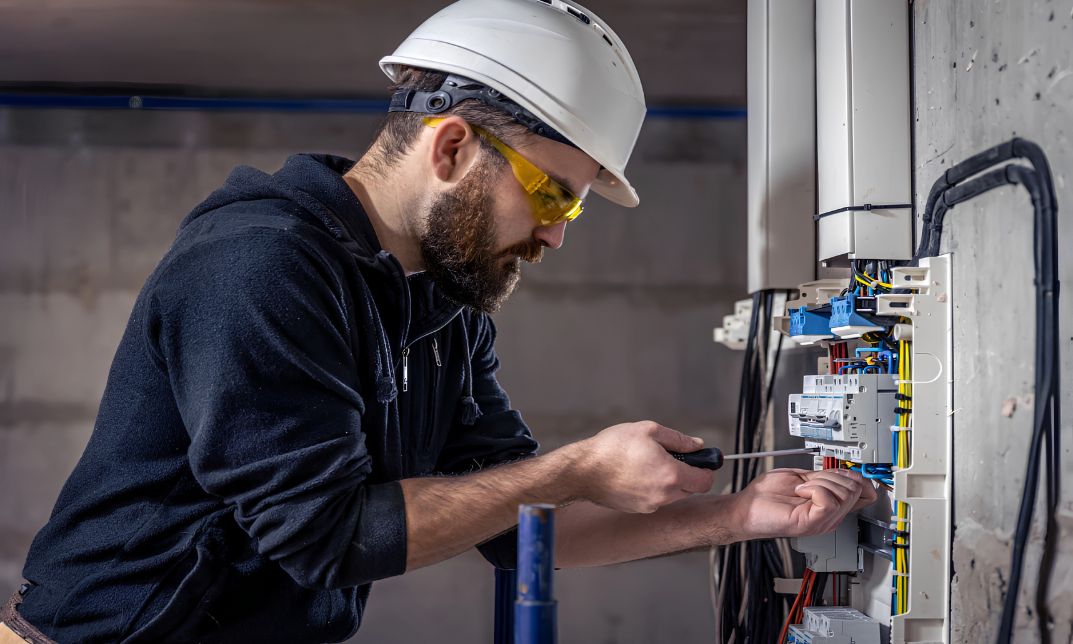
Professional Online Electrician Course
Course Description :
- Certificate: Yes(Free)
- Accreditation: CPD Accredited
- Access: Lifetime