
No products in the basket.
There is more than one route to becoming a PE teacher. A sports degree is not always necessary. So, how do you become a physical education teacher in the UK? In England, you usually need GCSE English and maths, a degree and training that leads to qualified teacher status (QTS). Primary teacher training also requires GCSE science.
Your degree can be in another subject but secondary PE providers will check your subject knowledge. You can qualify through undergraduate or postgraduate teacher training. During training, you gain classroom experience, complete school placements and learn practical teaching skills. However, not every sports or education course leads to QTS. So, check the qualifications you will gain before applying.
Now, let’s explore how your qualifications can lead to a PE teaching career, from choosing the right training route to stepping into your first classroom.
What Is a Physical Education (PE) Teacher?
A physical education (PE) teacher is a school teacher who helps pupils learn through sport and movement. Physical education is a school subject, not simply time away from the classroom. In primary schools, pupils build basic skills such as balance, control and coordination. At secondary level, they explore more advanced sports, tactics and physical performance. Some also study PE for GCSEs and A-levels.
But what makes PE different from simply playing games? Each activity builds knowledge that pupils can use in new situations. For example, learning how to move into space can later improve performance in team sports. Similarly, understanding body control helps pupils develop skills across different activities. A PE teacher connects these experiences, helping pupils become more confident and capable as they grow. This makes physical education a valuable part of school learning, rather than just exercise.
What Qualifications Do You Need to Become a PE Teacher?
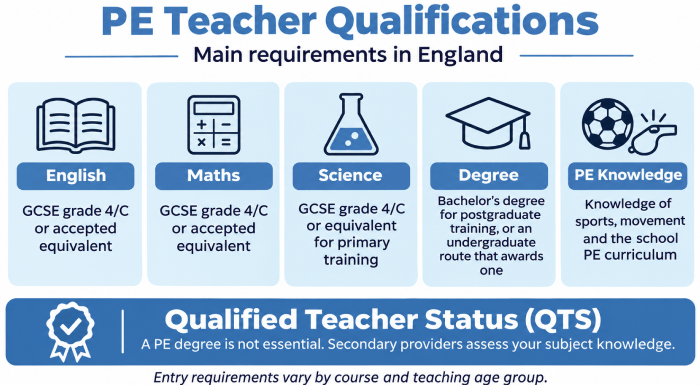
To become a qualified PE teacher in England, you generally need GCSEs, a degree and Qualified Teacher Status (QTS). You do not need a degree specifically in physical education. However, secondary PE training providers must be satisfied with your subject knowledge. The exact entry requirements depend on your chosen course and whether you want to teach primary or secondary pupils.
The main qualification requirements are:
- English: GCSE grade 4/C or an accepted equivalent.
- Maths: GCSE grade 4/C or an accepted equivalent.
- Science: GCSE grade 4/C or equivalent for primary teacher training.
- Degree: A bachelor’s degree for postgraduate training or an undergraduate route that awards one.
- PE knowledge: Suitable knowledge of sports, movement and the school PE curriculum.
What if you do not meet every requirement? Some providers accept GCSE equivalency tests and set their own degree grade rules. You must also pass safeguarding checks, which normally involve an enhanced DBS check. These checks help ensure you are suitable to work with children. So, check the provider’s entry rules before ruling yourself out.
But what is the difference between QTS and PGCE? QTS confirms that you meet England’s professional teaching standards. A PGCE provides academic learning about teaching methods and education. Some training courses award both, while others award QTS alone. Maintained schools generally require QTS, although academies and independent schools can employ teachers without it.
How Do You Become a Physical Education Teacher?
To become a physical education teacher in England, you need suitable qualifications and training that leads to QTS. The process starts with choosing your teaching age group and checking your eligibility. You then select a training route, apply and complete practical teaching. These seven steps explain what to do at each stage.
Step 1: Choose Your Teaching Age Group
Decide whether you want to teach primary or secondary pupils. Primary teachers often cover several subjects, including PE. Secondary PE teachers specialise in physical education and sometimes teach GCSE or A-level classes. Your choice affects the training course and subject knowledge you need. Not sure which suits you? Try observing lessons at both levels. Notice how teachers adapt activities and support different age groups.
Step 2: Check Your Entry Requirements
Compare your qualifications with the entry rules for your chosen PE teacher training course. Check your GCSE grades, degree requirements and any subject knowledge conditions. If you have an unrelated degree, ask what evidence the provider accepts. For example, relevant coaching experience or further study could help demonstrate your PE knowledge. Missing a GCSE grade? Ask whether an equivalency test is acceptable before paying for another course.
Step 3: Select the Right PE Teacher Training Route
Your education determines which training routes you can consider. Graduates can explore postgraduate PE training through universities or school-based providers. Applicants without a degree can seek undergraduate courses that award QTS. Some paid routes also exist, although availability and entry conditions vary.
| Training route | Who it suits | What you gain | What to check |
| Undergraduate teacher training | Applicants without a degree | Degree and QTS | Does the course award QTS? |
| Postgraduate PE training | Degree holders | QTS, sometimes PGCE | Does your PE knowledge meet the rules? |
| Salaried postgraduate training | Eligible graduates | QTS, sometimes PGCE | Is a paid PE place available? |
| Teacher degree apprenticeship | Eligible applicants without a degree | Degree and QTS | Does the provider offer PE? |
University-led and school-led courses both involve practical teaching. However, school-led training does not automatically mean you will earn a salary. Teacher degree apprenticeships offer paid training but PE places are not guaranteed. Always confirm the qualification outcome before choosing a course.
Step 4: Strengthen Your Physical Education Subject Knowledge
Compare your knowledge with the PE curriculum for your chosen age group. Select three activities, such as games, dance and gymnastics. Could you explain their basic skills and adapt them for different pupils? For example, a football coach might understand team tactics but lack confidence teaching dance. Use this simple check to identify areas that need improvement. You can then build your knowledge through study, lesson observations or practical experience.
Step 5: Find a Suitable PE Teacher Training Provider
Search for accredited PE training courses that lead to QTS. Compare the course structure, placement locations and learning support rather than choosing by reputation alone. Training arrangements can affect your travel costs and daily routine.
Check these five things before choosing a provider:
- Qualification: Confirm whether the course awards QTS alone or QTS with a PGCE.
- Entry requirements: Check whether your qualifications and PE knowledge meet the rules.
- School placements: Ask where you could complete your practical teaching.
- Course format: Compare full-time, part-time, fee-paying and salaried options.
- Mentor support: Find out how experienced teachers will guide your progress.
A nearby training centre does not always mean nearby school placements. Ask about the likely placement area before accepting an offer. You can compare courses using the official teacher training course finder.
Step 6: Prepare and Submit Your Teacher Training Application
Prepare your qualification records, work history and references before applying. Explain why you want to teach PE and how your experience supports that goal. For example, describe how you adapted an activity for pupils with different abilities. Providers might also assess your subject knowledge through interviews or practical tasks. School experience can help but it is not a national entry requirement.
For courses starting in 2027, applications opened on 6 October 2026. You can apply to four courses at once and submit up to 15 applications overall. Apply early because some providers close applications when places fill.
Step 7: Complete School Placements and Gain QTS
During training, you will plan lessons, teach pupils and receive feedback from experienced teachers. Under England’s 2026/27 rules, postgraduate courses provide at least 24 weeks of general school placements. Training must also cover at least two schools. This helps you gain experience with different pupils and teaching settings.
Another important part is intensive training and practice (ITAP). Postgraduate courses need four weeks of ITAP, while undergraduate courses usually need six weeks. However, some shorter undergraduate courses only need four weeks. During ITAP, trainees practise key teaching skills and get helpful feedback from experts. This training takes place alongside their wider school training.
But does completing your placements automatically give you QTS? Not quite. Your provider must confirm that you meet England’s Teachers’ Standards. Once you qualify, you can apply for PE teaching jobs and begin your teaching career.
Can You Become a PE Teacher Without a PE Degree?
Yes. In England, a degree in another subject can lead to PE training. You still need enough PE knowledge. A sports science graduate could show related study. A history graduate might need more proof of PE skills. The provider decides whether you qualify. Ask for an answer based on your actual degree, not just its name.
Without a degree, seek an undergraduate course with QTS. A paid teacher degree apprenticeship is another option where PE places exist. Coaching or PE assistant work gives you practice, not QTS. Some schools hire staff without QTS but that is different from qualifying as a teacher. Make sure you know which type of role you want.
How Long Does It Take to Become a PE Teacher?
A degree course with QTS often takes three or four years. If you have a degree, full-time postgraduate training often takes about nine months. Part-time routes can take 18 to 24 months. Paid routes and apprenticeships vary, so check each course. For a school leaver, the degree route takes longer. A graduate can often train in one school year. England’s two-year early career support comes after QTS.
How Much Does It Cost to Become a PE Teacher?
Course fees can vary, and travel to schools can add extra costs. In England, UK applicants can pay up to £9,790 for full-time postgraduate training in 2026/27. The part-time fee limit is £7,335 per year. However, some course providers charge less. If you plan to start in 2027/28, check the new fees. Also, ask how far you will need to travel for school placements. Even a cheaper course can cost more when you add rent and travel expenses.
Check these costs and funding options:
- Fees: Ask what the course charges and whether a PGCE costs extra.
- Rent and food: Work out how you will pay bills while you train.
- Travel: Allow for trips to both schools and the training centre.
- Loans: Check if you can get fee and living cost loans.
- Paid routes: Check wages, work hours and any costs you still pay.
Eligible fee-paying trainees can seek student loans, even after an earlier degree. Paid trainees usually cannot claim the same loans. PE gets no subject training bursary in England for 2026/27. Some parents, carers and disabled trainees can seek extra help. Check the latest terms on the official teacher training fees page.
What Does a PE Teacher Do Beyond Coaching Sports?
A PE teacher does more than lead games. You plan lessons, teach skills and track progress. You also help pupils who feel left out or unsure of sport. A good lesson gives every child a fair chance to learn. It is not just about the fastest runner or strongest player. Safety matters too.
The job involves five key tasks:
- Plan: Set a clear goal for each lesson and choose safe tasks.
- Adapt: Help pupils with different needs join in and make progress.
- Check: Watch what pupils learn and give feedback they can use.
- Protect: Check space, kit, weather and risks before an activity.
- Support: Help with school clubs, sports days and team events.
There is more to PE than sport on a field. In England, primary schools must offer swimming lessons in Key Stage 1 or 2. Pupils should develop the skills to swim 25 metres and rescue themselves safely in water. This is a goal for pupils, not a test all trainee PE teachers must pass. It shows why teachers need both subject skill and care for pupil safety.
Are PE Teacher Requirements Different Across the UK?
Yes. The steps above apply mainly to England. Wales, Scotland and Northern Ireland use different rules. Before you pay for training, check where you want to teach. A qualification from one nation might need a separate check elsewhere. It does not always give you an instant right to teach across the UK.
England: Maintained schools normally require QTS. Any degree subject can count for postgraduate training if you know enough PE. Academies and private schools can hire staff without QTS but many still want it. So, check the school type before you apply. This can affect which jobs are open to you.
Wales: For secondary training, at least 50% of your degree must relate to your subject. The course team judges this. Teachers also need the right QTS and registration with the Education Workforce Council. So, an unrelated degree might work in England but not in Wales.
Scotland: Secondary PE applicants normally need 80 SCQF credit points from degree study linked to PE. This can cover sport, dance, coaching or sports science. They also need practical skills. Teacher training leads towards registration with the General Teaching Council for Scotland. Check the full course rules.
Northern Ireland: Grant-aided schools need staff with accepted teaching awards and professional registration. They cannot hire unqualified teachers as a normal route. These rules differ from those for English academies. Before moving, check that your award counts there. Ask about registration as well as the course itself.
How Much Does a PE Teacher Earn After Qualifying?
A newly qualified PE teacher in England earns at least £34,069 per year outside London from September 2026. Starting salaries rise to £35,602 in the London fringe, £39,196 in outer London and £41,729 in inner London. PE teachers follow the same basic pay scales as other subjects in maintained schools. However, academies and independent schools can set different rates.
With experience, salaries can rise to £46,940 on the main pay scale outside London. Experienced teachers on the upper pay scale can earn up to £52,835 or £64,684 in inner London. Taking on roles such as Head of PE can bring extra responsibility payments of up to £17,819. However, pay progression is not automatic.
After gaining QTS, new teachers in England normally complete two years of early career induction. Eligible full-time teachers receive mentoring and 10% less timetabled teaching in year one, followed by 5% in year two.
Final Thoughts: How Do You Become a Physical Education Teacher?
The answer to how do you become a physical education teacher lies in choosing the right path. Your qualifications, PE knowledge and career goals will shape that choice. In England, focus on training that leads to QTS. However, look beyond the course title. Check the entry rules, school placements and costs before making your decision. Remember, the real goal is not simply to gain a teaching qualification. It is to turn your knowledge of sport into lessons where every pupil can learn, improve and feel included.
FAQs About How Do You Become a Physical Education Teacher
1. Do I Need Qualifications to Be a PE Teacher?
Yes. In England, you usually need GCSEs, a degree and qualified teacher status (QTS) to teach in maintained schools.
2. How Long Will It Take to Become a PE Teacher?
It usually takes three to four years through an undergraduate route. Graduates can often qualify through nine months of full-time training.
3. Are PE Teachers Well Paid?
Yes, PE teachers can earn a good salary. From September 2026, qualified teachers in England start at £34,069 outside London in maintained schools.
4. What Is the Fastest Way to Become a PE Teacher?
For graduates, a nine-month postgraduate training course is usually the fastest standard route to QTS. Experienced teachers might qualify sooner through assessment-only QTS.
5. Are PE Teachers in Demand?
PE teaching jobs are available across the UK. However, demand varies by location, school and available vacancies.
6. What Degree Do Most PE Teachers Have?
Physical education, sports science and sports coaching are common degree choices. However, England also accepts other degrees for PE teacher training if applicants meet subject knowledge requirements.